





 Portuguese
  English
  Spanish
  4 min of reading
  0 comments


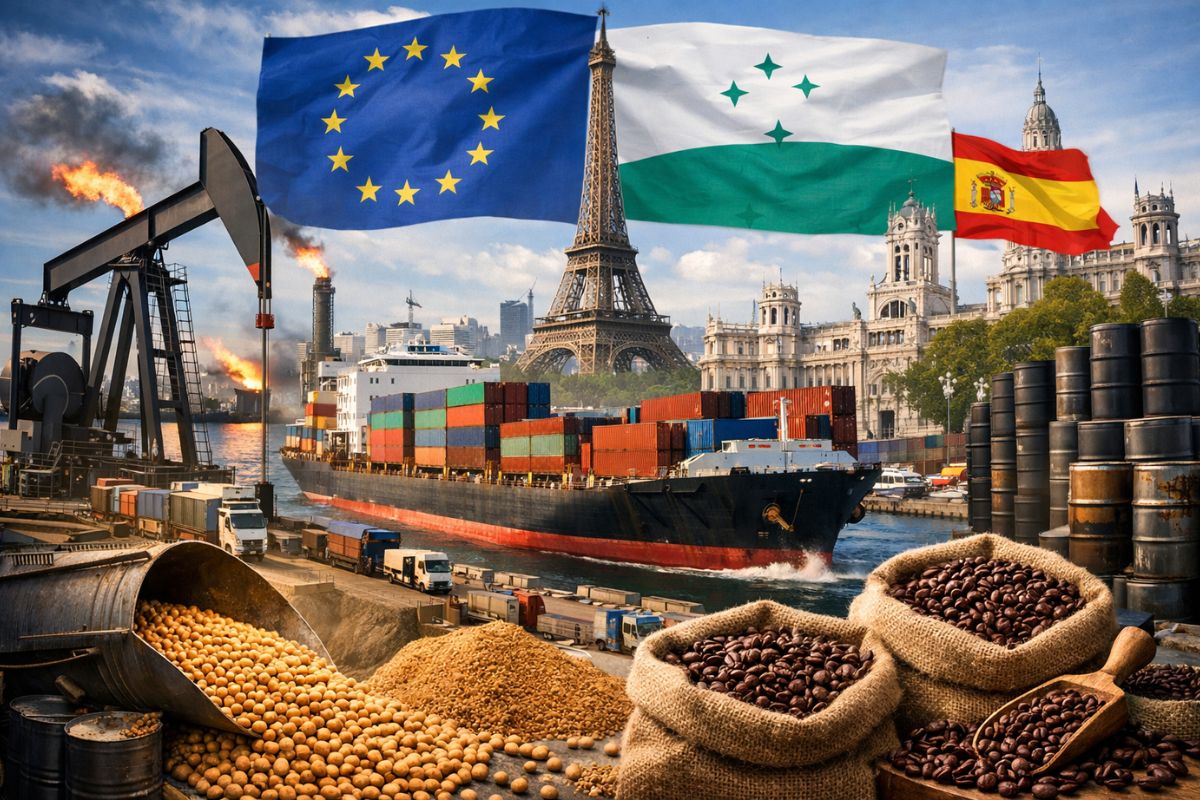
The Mercosur-EU Agreement Will Be Signed on the 17th, Creating the Largest Free Trade Area in the World and Promising to Reduce Tariffs. In 2025, 73% of Brazilian Sales to the European Union Will Be Concentrated in Five Countries, with the Netherlands on Top and Spain Right Behind. Germany, Italy, and Belgium Complete the List.
The Mercosur-EU reaches a decisive moment after a negotiation that spanned more than 25 years and includes, on the South American side, Brazil, Argentina, Paraguay, and Uruguay. The signing on the 17th puts the treaty into practical phase, with expectations for tariff and import tax reductions, which are likely to directly impact the buying and selling flow between the two blocs.
In the 2025 snapshot, Mercosur-EU already has a clear pattern: Brazil concentrates its exports to the European Union in a few destinations, with 73% going to only five of the 27 countries in the bloc. The Netherlands leads the Brazilian imports with US$ 11.746,4 million in 2025, followed by Spain (US$ 8.794,2 million), Germany (US$ 6.530,4 million), Italy (US$ 5.379,2 million), and Belgium (US$ 4.032,9 million).
Mercosur-EU on the Map: Where Most of Brazil’s Sales Go
The concentration of purchases in five countries sets the tone for Mercosur-EU in 2025.
-
Brazilian city bets on the business environment to generate jobs and attract investments in the energy sector — secretary reveals strategy at Macaé Energy 2026.

-
50 viaducts, 4 tunnels, 28 bridges, and 40 kilometers of bike paths: BR-262 in Espírito Santo will receive 8.6 billion reais for the largest engineering project in the state’s history, inspired by the Immigrant Highway in São Paulo.

-
Brazil produces too much clean energy and doesn’t know what to do with it: over 20% of solar and wind capacity was wasted in 2025 while investors flee and 509 renewable generation projects were abandoned in the last year.

-
Piauí will produce a new fuel that replaces diesel without needing to change anything in the truck’s engine and reduces pollutant gas emissions by half: truck drivers from all over the Northeast are already celebrating the news that will arrive later this decade.


The Netherlands appears as the dominant entry point, pulling in US$ 11.746,4 million in imports of Brazilian products. Right behind, Spain appears with US$ 8.794,2 million, keeping the country in second place among the largest destinations.
Next, the industrial and logistical axis of Mercosur-EU becomes evident with Germany (US$ 6.530,4 million), Italy (US$ 5.379,2 million), and Belgium (US$ 4.032,9 million).
Together, these five markets absorb 73% of everything Brazil exports to the European Union in 2025, leaving the remaining 22 countries in the bloc with the leftover share.
What Brazil Is Sending to Europe: Export Leaders in 2025

In Mercosur-EU, the champion products leaving Brazil for the European Union in 2025 show a mix of energy, agriculture, and raw materials, with some industrial items gaining space.
The top spot is led by crude oil, followed by unroasted coffee and soybean derivatives used as animal feed, along with minerals and pulp.
The list of the main products exported from Brazil to the European Union in 2025 is as follows:
Crude petroleum or bituminous mineral oils, crude: US$ 9,816,473,465
Unroasted coffee: US$ 7,187,545,404
Soybean meal and other animal feeds (excluding unground grains), meat meals, and other animal products: US$ 4,058,264,480
Copper ores and concentrates: US$ 3,065,942,177
Soybeans: US$ 2,460,052,288
Pulp: US$ 2,150,883,286
Fruit or vegetable juices: US$ 1,552,090,854
Aircraft and other equipment, including parts: US$ 1,149,686,861
Iron ore and concentrates: US$ 1,141,993,025
Fuel oils from petroleum or bituminous minerals, except for crude oils: US$ 1,125,299,022
Tobacco, stripped or unstemmed: US$ 1,070,587,851
Fresh, chilled, or frozen beef: US$ 906,958,263
Fresh or dried non-oilseeds fruits and nuts: US$ 815,531,479
Why the Mercosur-EU Signature Matters for Prices, Flow, and Strategy
The Mercosur-EU is described as the largest trade agreement for the South American bloc, and with the signing scheduled for Saturday, 17th, the expected impact comes from the most direct mechanism: reduction of tariffs and import taxes.
In practice, this opens up space for exports and imports to grow, as the cost of entry for products tends to decrease.
This point is central because the 2025 portrait already indicates a preferential trade corridor for Mercosur-EU: few countries concentrate most of the purchases and, within what comes from Brazil, the items with the highest financial weight include crude oil, unroasted coffee, and chains associated with soybeans, in addition to minerals, pulp, juices, tobacco, beef, and fruits.
The “Five Countries” Effect: What the Concentration Reveals About Mercosur-EU
When 73% of Brazilian exports to the European Union stay in five countries, Mercosur-EU takes on a shape with “centers of gravity”.
The Netherlands and Spain drive the volume, while Germany, Italy, and Belgium complete the group that dominates the destination of Brazilian cargo in 2025.
In other words, even with 27 members in the European Union, Mercosur-EU shows that, in practice, Brazil operates with a well-defined entry funnel, which helps to understand why some markets appear so above the others in the import ranking.
Do you think that Mercosur-EU will lower prices for products in the short term or will it first just change the route of Brazilian exports within the European Union?






Seja o primeiro a reagir!