





 Portuguese
  English
  Spanish
  3 min of reading
  0 comments


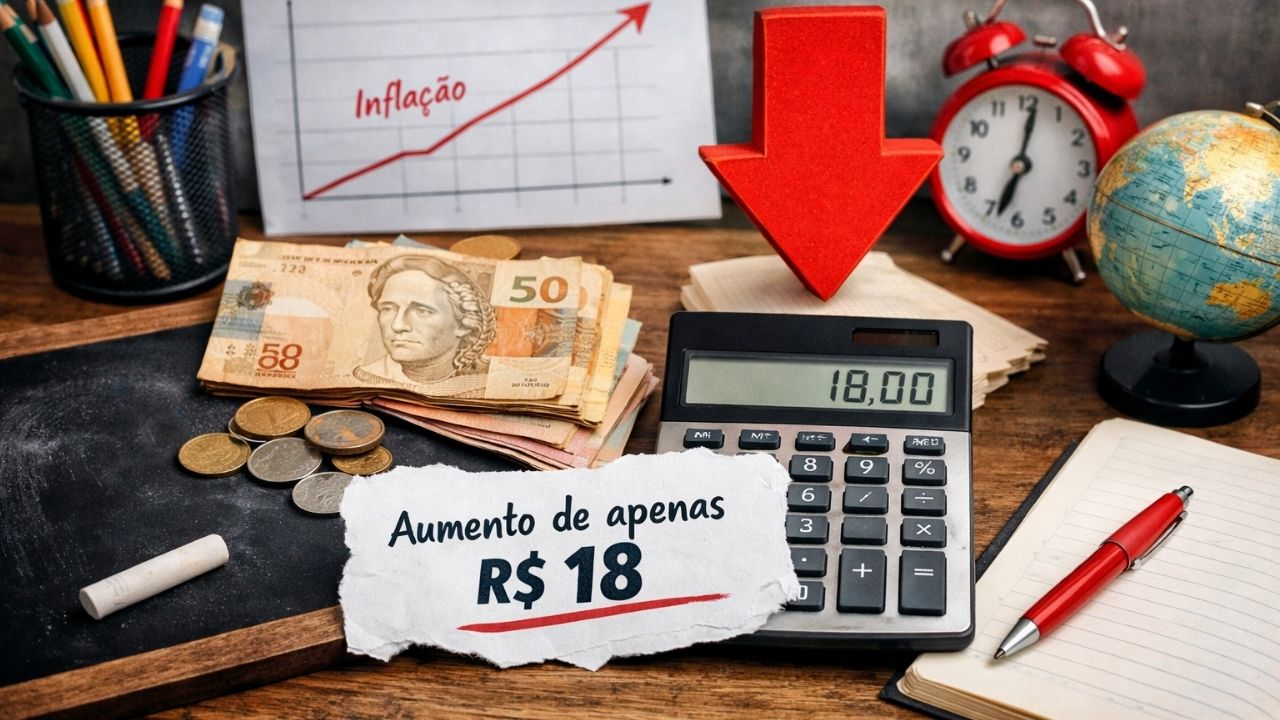
Federal Government Prepares Provisional Measure to Change the Calculation of the Teachers’ Salary Floor and Avoid Symbolic Increase in 2026.
The salary floor of teachers in basic education has returned to the center of the national debate after the Federal Government acknowledged that the current adjustment rule may result in increases far below inflation.
The situation led the Executive to announce the drafting of a Provisional Measure, expected to be published by mid-January, aimed at ensuring a fairer adjustment and preserving the purchasing power of the category in 2026.
Minimum Adjustment Raised Concerns Among Teachers
The discussion gained momentum after official projections indicated that, following the current model, the salary floor would see an increase of only 0.37%.
-
The government requests the Federal Revenue Service for a new system to automate the income tax declaration, reducing errors, time, and bureaucracy for millions of Brazilians.

-
Pix in installments, international Pix, and contactless payment without internet: the Central Bank revealed the new features coming to the tool that is already used by almost every adult in Brazil.

-
Mercado Livre has just started selling medications with delivery in up to three hours to your door, and this move could completely change the way Brazilians buy medicines on a daily basis.

-
In Dubai, rising tensions from the war in the Middle East are causing super-rich individuals to leave the Gulf and direct their fortunes to a new financial refuge in Asia.


In practice, the value would rise from R$ 4,867.77 to R$ 4,885.78, an increase of about R$ 18.
This percentage fell far below the estimated inflation of approximately 4%, which would represent a real loss for education professionals. The possibility sparked strong reactions from unions and representative entities.
Why Did the Current Model Fail This Year?
Currently, the adjustment of the salary floor is calculated based on the growth of the Annual Value per Student (VAAF), an indicator linked to Fundeb.
This method worked well in years of higher revenue and economic expansion. However, during periods of slowdown, such as the current one, the same system produces almost symbolic increases.
According to the government itself, the formula does not guarantee predictability or protect teachers’ salaries against inflation.
Government Prepares New Rule for the Teachers’ Salary Floor
In light of the criticisms, the federal government confirmed that it is working on a Provisional Measure to change the calculation of the salary floor.
The proposal is to combine the inflation of the previous year with part of the real growth in Fundeb revenues.
This way, the adjustment would no longer depend solely on a single indicator and would better reflect the cost of living.
Education entities believe that the new model could result in an increase of over 6% in 2026.
The mobilization of teachers played a central role in the government’s change of stance.
For unions like the National Confederation of Education Workers (CNTE), an adjustment of only R$ 18 would be incompatible with the social importance of the profession.
The entity advocates that the salary floor needs to guarantee, at a minimum, inflation compensation and real gains, preventing the teaching career from losing attractiveness over the years.

States and Municipalities Call for Caution
While teachers demand recognition, representatives from states and municipalities expressed concern about the financial impact of higher adjustments.
Entities such as Undime and Consed warned that abrupt changes could compromise local budgets.
Therefore, they advocate for a balanced model that ensures professional recognition without generating fiscal insecurity for education networks that already operate with limited resources.
How the Teachers’ Salary Floor Evolved in Recent Years
Between 2016 and 2025, the salary floor for teachers more than doubled, rising from R$ 2,135.64 to R$ 4,867.77.
In some years, adjustments were significant.
In 2022, the increase reached 33.24%, followed by 14.95% in 2023.
These high percentages contrast with the projected minimum adjustment for 2026, highlighting the instability of the current model.
Expected Impacts of the Change in Calculation
Experts point out that a salary floor adjusted above inflation could bring long-lasting positive effects.
Among them are the valorization of the career, the reduction of teacher dropout, and greater interest from new professionals in basic education.
Additionally, more stable salaries tend to strengthen the quality of education, contributing to the retention of experienced teachers in public networks.
The expectation is that the Provisional Measure will be published by January 15. After that, the text will go for analysis by the National Congress, which can approve or adjust the proposal.
Until the final decision, teachers, states, and municipalities are monitoring the negotiations, while expectations grow that the salary floor for 2026 will mark a new phase of greater predictability and valorization of education.









-

-

-

7 pessoas reagiram a isso.