





 Portuguese
  English
  Spanish
  5 min of reading
  1 comment


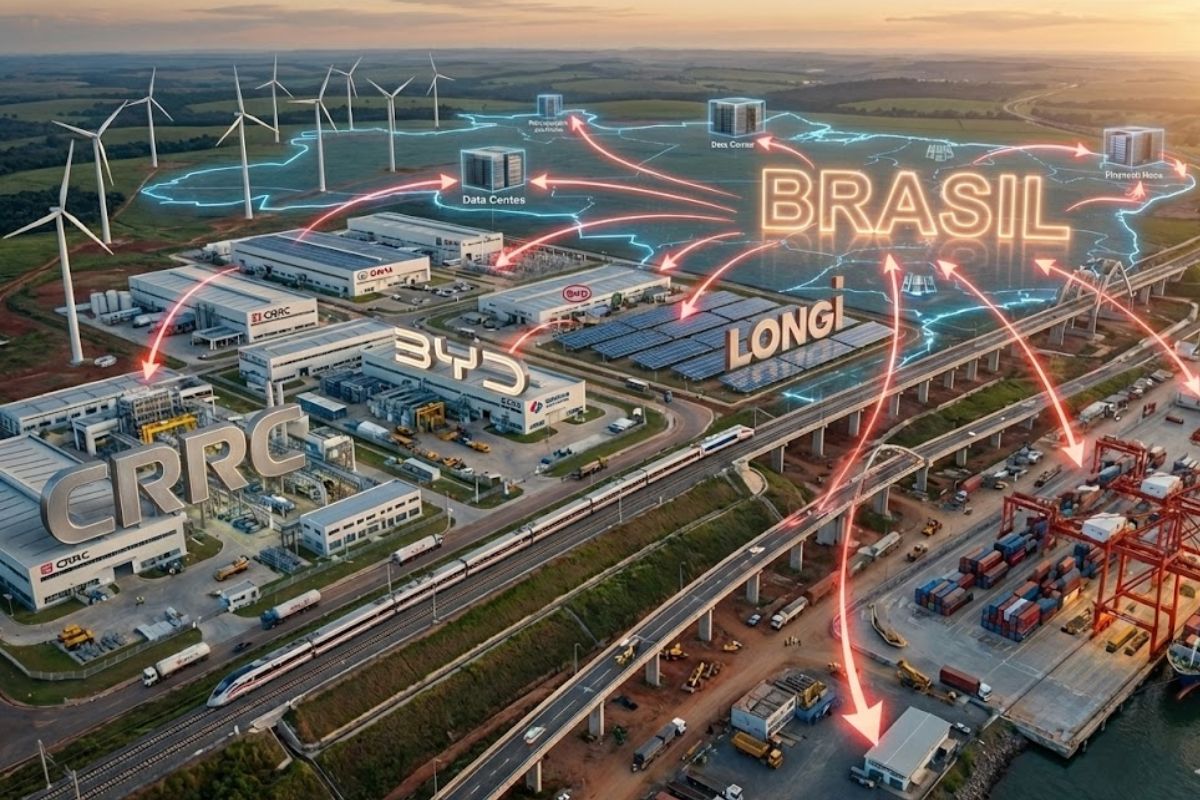


Between 2007 and 2023, Chinese companies invested US$ 73 billion in 265 projects in Brazil and, after large acquisitions in energy and oil, now prioritize greenfield investments, factories, engineering services, and complete value chains, with financial support from state-owned Chinese banks in infrastructure, electric mobility, and energy transition.
According to information posted by the Estadão portal in December 2025, in less than two decades, Brazil has witnessed a profound change in the landscape of investments from Chinese companies. Between 2007 and 2023, the country received US$ 73 billion in 265 confirmed projects, and after the 2020 hiccup caused by the pandemic, investments began to grow again in 2021, with US$ 5.9 billion invested, 85% of which was directed toward oil and gas extraction.
If initially this presence was marked by megacquisitions such as CPFL Energia in 2017, Duke Energy’s assets in Brazil in 2016, and 90% of the Port of Paranaguá Container Terminal at the same time, today the movement is different. Smaller transactions, greenfield projects, and complete value chains have transformed the visible occupation of state giants into a silent and dispersed advance of Chinese companies across various sectors of the economy.
From The Shock of Megacquisitions to Silent Occupation
In the first cycle, Brazil got used to seeing Chinese companies arrive through large mergers and acquisitions, especially in electricity. In 2017, State Grid spent R$ 14.2 billion on CPFL Energia; in 2016, China Three Gorges bought Duke Energy’s assets in the country for R$ 3.1 billion; and China Merchants Ports Holding took 90% of the Paranaguá container terminal for R$ 2.9 billion.
-
Unemployment rises again to 5.8% at the beginning of 2026, raising alarms about the end of temporary positions and its impact on the Brazilian job market.

-
Document organization can cut invisible costs in small businesses, a simple step that prevents waste, rework, and losses in daily operations.

-
Chinese giant worth nearly R$ 4 billion that manufactures cables for electric cars, solar energy, and robotics wants to open a factory in SC.
-
Many employers do not know, but the law guarantees domestic workers a 25% increase in salary during trips, 50% for overtime, 20% for night shifts, and 17 additional benefits that can lead to labor lawsuits if not paid.


These operations marked the phase in which state giants took positions in strategic assets of energy and logistics, including the Formosa wind farm from CPFL Renováveis, which concentrates the largest investment from State Grid outside China.
This was the period when Brazil stopped being just a destination for American debt securities and began to integrate into the productive internationalization strategy of Chinese capital.
Greenfield Explodes and Shrinks The Average Ticket of Projects
Starting in 2021, the profile shifted significantly. According to a study by Araújo Fontes, mergers and acquisitions lost relative weight while investments in new greenfield projects surged. In 2021, about half of the funds were already directed to projects initiated from scratch; by 2023, this share reached approximately 90%.
The average size of the checks confirms the turnaround. Between 2010 and 2014, each investment project by Chinese companies in Brazil was around US$ 507 million. From 2015 to 2019, the average value fell to US$ 313 million.
From 2020 to 2024, the average ticket dipped again, to about US$ 112 million per project. Fewer isolated mega-operations and much more series entries, creating a dense mesh of Chinese capital in different regions and activities.
Energy, Oil, and New Sectors in The Sights of Chinese Companies
Between 2007 and 2023, 45% of the US$ 73 billion invested by Chinese companies in Brazil was directed towards electricity, 30% to oil extraction, and the remainder was divided among industrial manufacturing, mining, infrastructure, agriculture, and other segments.
The country has established itself as the main destination for Chinese investments in Latin America between 2008 and 2017, serving as a regional hub.
Globally, China’s external investments rose from US$ 24.8 billion in 2007 to a peak of US$ 170.1 billion in 2016, remaining since then above US$ 110 billion per year, with over 60% of the resources spread across several countries.
Within this movement, Brazil stands out as a showcase where Chinese companies test business models, adjust technology, and from here, target other Latin American markets.
Factories, Engineering Services, and Credit Form The Value Chain
The new phase is not limited to controlling ready-made assets. Chinese companies have started to bring with them a supply chain of engineering, equipment, and services, tied to credit lines from Chinese banks.
An example is the purchase of Concremat by China Communications Construction Company, which transformed the Brazilian company into the engineering platform of the Asian giant in Brazil and Latin America.
With this base, CCCC has entered into large infrastructure projects, such as the Salvador-Itaparica bridge and railway projects, and also acquired a stake in the Portuguese Mota Engil, winner of the Santos-Guarujá tunnel auction.
Each major contract pulls a set of construction companies, designers, parts manufacturers, and service providers with Chinese capital, expanding control over crucial stages of Brazilian infrastructure.
Trains, Mobility, and The Automotive Industry Under Chinese Capital
In mobility, the advancement is also clear. CRRC, in partnership with the Brazilian group Comporte, won the auction for the Intercity Train between São Paulo and Campinas and will take over the operation of the metropolitan train line 7.
As part of the production chain logic, CRRC is constructing a train factory in Araraquara, in the interior of São Paulo.
In the automotive sector, Brazil already hosts around 15 manufacturing plants of Chinese companies, mostly focused on electric and hybrid cars.
Great Wall Motors occupies the former Mercedes Benz plant in Iracemápolis, and BYD took over the factory that belonged to Ford in Camaçari, Bahia.
By reusing industrial assets from American and European groups, Chinese companies quickly occupy existing production capacity and position themselves as protagonists in the transition to low-emission vehicles.
Soft Power, Reinvestment of Profits, and Dispute With The United States
This economic advance is accompanied by a soft power strategy. The image of Chinese companies as promoters of the energy transition is reinforced by the production of electrical equipment, which supplies both power plant and transmission concessions as well as the emerging electric car market.
By integrating export infrastructure, clean energy, and mobility, China connects business interests with long-term diplomacy.
There is also the geopolitical dispute with the United States. The tariffs imposed by Donald Trump affected American companies operating in Brazil and opened up additional space for Chinese movements, such as BYD’s purchase of the Ford plant in Camaçari or China Three Gorges’ acquisition of Duke Energy’s operations.
At the same time, many Chinese companies have opted to reinvest the dividends generated in Brazil instead of remitting them to the parent company, gaining scale and influence to participate in public policy negotiations.
Curtailment Crisis and The Next Targets: Batteries and Green Hydrogen
The situation in the electricity sector creates new opportunities. The curtailment crisis, where compulsory generation cuts affect project profitability, leads companies from other countries to reassess investment plans in Brazil under shareholder pressure.
It is precisely in this uncertainty that Chinese companies tend to advance, buying assets, assuming risks, and reinforcing their presence in energy infrastructure.
The next steps are already outlined: participation of Chinese companies is expected in the battery auction that Aneel will hold later this month, in addition to a strong presence in green hydrogen projects associated with the energy transition.
For Beijing, this is a state agenda, conducted with a 50-year horizon. For Brazil, the result is a silent and profound redesign of production chains, qualified jobs, and control of strategic assets.
Do you think that the advance of Chinese companies in Brazil strengthens the country’s development or increases dependence on foreign capital and technology?








Como cidadão acho um perigo, no Brasil tudo bem, mas é necessário um controle do governo para o acompanhamento desses investimentos. Áreas vulnerável ao país não devem ser bem controladas. Só falta elas entrar no projeto de terras raras.