





 Portuguese
  English
  Spanish
  2 min of reading
  0 comments



Brazilian Currency Achieves Historical Strength Against Argentina and Exposes Economic Fragility
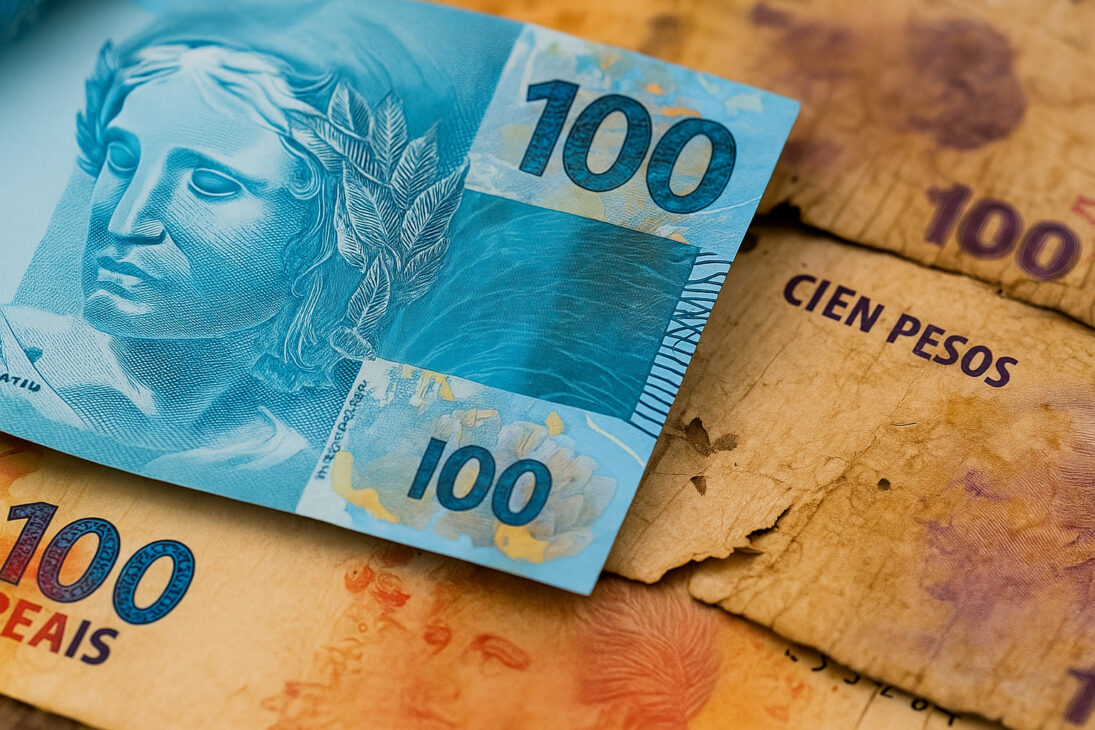
The real reached a record exchange rate against the Argentine peso this Monday (8). This occurred shortly after the defeat of Javier Milei’s party in the provincial elections in Buenos Aires.
Just in 2025, the Argentine currency has already accumulated a decline of 37% against the Brazilian one, according to official data released by the Central Bank of Argentina.
Argentine Peso Loses Value Quickly
Throughout the year, the Argentine peso has been experiencing successive devaluations. At the beginning of January 2025, one real bought 163 Argentine pesos.
-
The government requests the Federal Revenue Service for a new system to automate the income tax declaration, reducing errors, time, and bureaucracy for millions of Brazilians.

-
Pix in installments, international Pix, and contactless payment without internet: the Central Bank revealed the new features coming to the tool that is already used by almost every adult in Brazil.

-
Mercado Livre has just started selling medications with delivery in up to three hours to your door, and this move could completely change the way Brazilians buy medicines on a daily basis.

-
In Dubai, rising tensions from the war in the Middle East are causing super-rich individuals to leave the Gulf and direct their fortunes to a new financial refuge in Asia.


Now, after the election on Sunday (7), the same amount in reals became worth 262 pesos, according to figures from the foreign exchange market in Buenos Aires.
This exchange rate was recorded around 4:22 PM on Monday. Therefore, the Argentine currency continues on a path of significant loss, increasing internal pressures.
Electoral Defeat Pressures Milei Government
With almost 100% of the votes counted, the Peronist-Kirchnerist coalition National Force obtained 41.75% of the votes in the province of Buenos Aires.
Milei’s party, La Libertad Avanza (LLA), received only 34.15% of the electorate. Thus, the election on Sunday (7) was interpreted as a thermometer for the federal legislature.
The election is scheduled for October 26, 2025. As the province accounts for 40% of the Argentine electorate, the defeat represented a severe political blow to Milei.
The president is trying to maintain support for his reform agenda. However, the results increased uncertainty regarding his governability and the future of his economic project.
Declining Electoral Participation
The voter turnout rate was 63%, seven points below the rate recorded in 2021, according to Argentina’s Electoral Justice.
This data reinforced the perception of popular discontent and signaled weaknesses in Milei’s support base.
Moreover, experts emphasize that the election in Buenos Aires is strategic. It sets scenarios that can directly influence the national outcome in October.
Economic Crisis and Political Instability
The electoral defeat of Milei adds to structural problems in the Argentine economy, such as high inflation and scarcity of international reserves.
Additionally, corruption allegations involving his sister, Karina Milei, have increased the perception of instability and fueled currency devaluation.
Therefore, the Argentine peso has once again lost value against the real and also against the Chilean peso. These currencies are seen as safer in the region.
As a result, pressure on the Argentine economy is growing. The country has already been suffering from market distrust and political instability.
In light of this, analysts foresee greater difficulties in implementing economic reforms in the coming months.









-

-

7 pessoas reagiram a isso.