





 Portuguese
  English
  Spanish
  6 min of reading
  5 comments


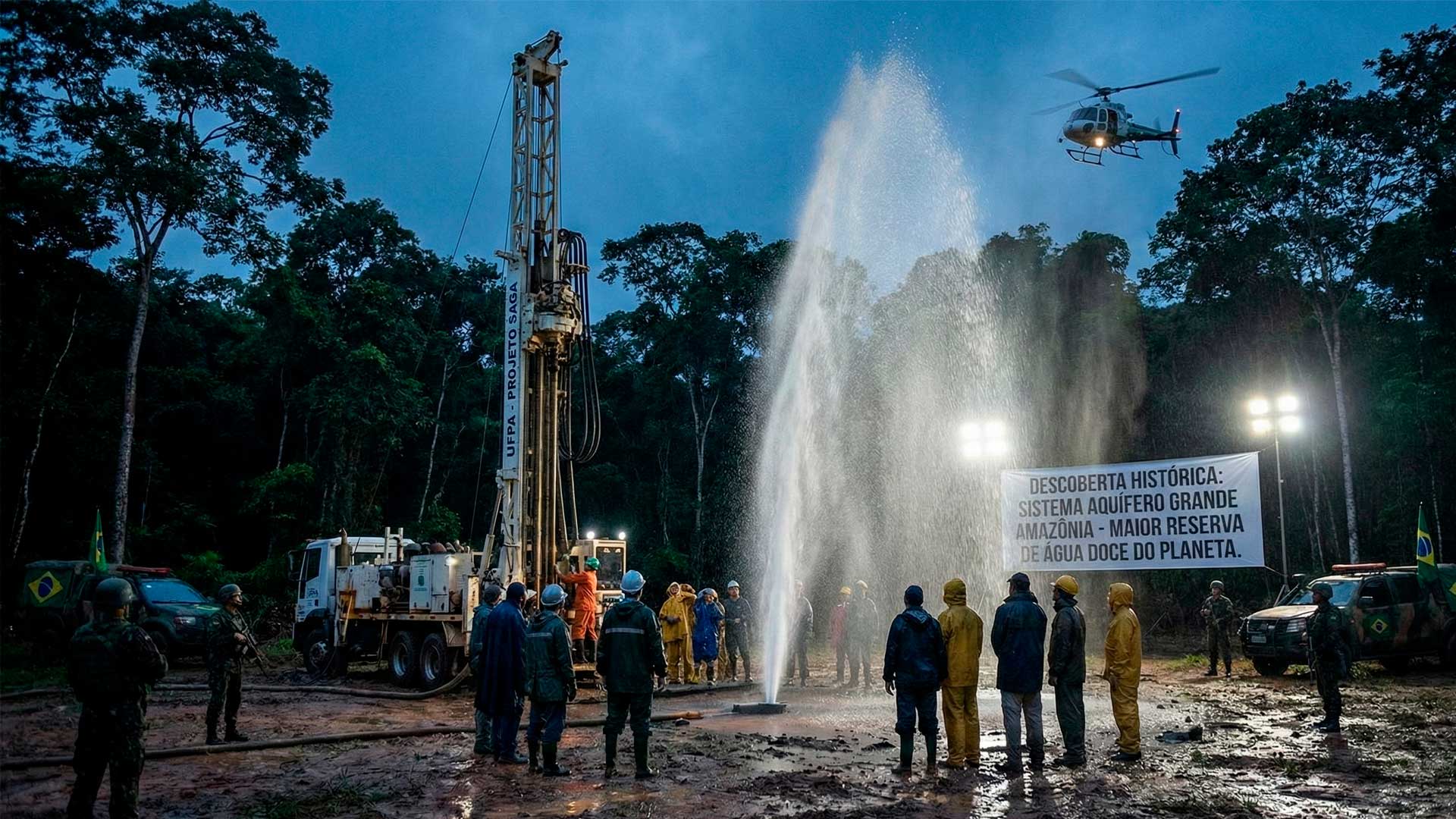


Great Amazon Aquifer System, Largest Subterranean Freshwater Reservoir Ever Mapped, Surpasses Guarani Aquifer and Rekindles Debate on Climate, Agribusiness, and Sustainable Exploitation
The confirmation of the size of the Great Amazon Aquifer System (SAGA) puts Brazil back at the center of the global water map. Beneath the Amazon rainforest, researchers have identified a true subterranean ocean of freshwater, with a volume much greater than that of the well-known Guarani Aquifer.
Located in deep sediment layers stretching from Ecuador to Pará, this aquifer system has been studied for at least a decade, but only recently were its numbers consolidated and widely publicized.
Reports published in 2025 indicate that the SAGA can store more than 150 trillion liters of water, a volume sufficient to supply the entire global population for about 250 years, in a theoretical scenario of controlled use.
-
The Argentine government celebrates the lowest poverty rate in 7 years, but experts warn that the methodology has changed, real wages have fallen, unemployment has risen, and the number of people on the streets of Buenos Aires has increased by 57% since Milei took office.

-
7.8 magnitude earthquake in Indonesia frightens the population, triggers tsunami alert, and hits an island with over 200,000 inhabitants this Thursday.
-
Google will finally let you change that embarrassing Gmail address you created in your teenage years without losing any accounts, logins, or old emails: the feature is already available in the United States.

-
Heading to Brazil in a Bonanza F33 single-engine aircraft: a couple departs from Florida on a visual flight, makes technical stops in the Caribbean to refuel and organize paperwork, and begins the staged crossing until they reach the country.

The discovery, led by researchers from the Institute of Geosciences at the Federal University of Pará (UFPA), is not just a source of scientific pride. It raises questions about water management, preservation of the Amazon, and potential economic and geopolitical pressures on one of the planet’s greatest natural resources.
What Is the Great Amazon Aquifer System and Why Does It Surpass the Guarani Aquifer?
The SAGA is a massive system of subterranean waters that occupies sedimentary basins like Acre, Solimões, Amazonas, and Marajó, at depths that can reach hundreds of meters. In simple terms, it is a gigantic geological sponge capable of storing and conducting freshwater under the forest.
According to studies presented at conferences and projects coordinated by UFPA since 2013, the system has been redefined based on geological revisions that showed that the former Alter do Chão Aquifer was, in fact, part of a much larger structure. From there, the designation Great Amazon Aquifer System was established.
While the Guarani Aquifer, which extends across Brazil, Argentina, Paraguay, and Uruguay, was considered one of the largest subterranean reservoirs in the world, new measurements indicate that the SAGA is at least four times more voluminous. Therefore, it has been described in reports and studies as the largest aquifer on the planet among those already known.
Water Volume, SAGA Extension, and Comparison With Other Aquifers in the World
According to a summary released by outlets such as Agência Brasil, academic portals, and specialized reports, the SAGA has an estimated volume of about 162,000 cubic kilometers of subterranean freshwater. In other words, a water stock considered sufficient to sustain global supply for approximately two and a half centuries, assuming it could be accessed in a fully efficient manner.
Its estimated area is around 1.3 million square kilometers, with most of it located in Brazilian territory, although the system extends into other Amazonian countries. Compared to the Guarani, which has around 45,000 cubic kilometers, the SAGA puts Brazil in an even more strategic position in debates about water security, climate change, and future conflicts over freshwater.
Relationship Between the Amazon Aquifer, Flying Rivers, and the Water Crisis in Brazil
The existence of a subterranean ocean beneath the Amazon is linked to a much broader water cycle, which includes rivers, soil, atmosphere, and vegetation. Climatology studies show that the Amazon rainforest acts like a water pump, capable of sending about 20 trillion liters of water per day into the atmosphere through evapotranspiration.
This vapor forms what are known as flying rivers, large flows of humidity that travel thousands of kilometers and help bring rain to the central-west, southeast, and south regions of Brazil. Reports from entities such as WWF, research institutions, and science popularization outlets explain that the flow of these aerial rivers can be comparable to that of the Amazon River itself.
In practice, this means that the water circulating in the Amazon aquifers, in the roots and canopies of trees, directly influences food production in states like Mato Grosso, São Paulo, and Rio Grande do Sul. Without the forest standing, the cycle of aquifer recharge and the formation of these vapor rivers are compromised, increasing the risk of water crises like those already experienced in major metropolitan areas.
Experts consulted in scientific TV programs, such as Fiocruz’s Science Bulletin, and in studies from INPE, warn that the destruction of Amazon vegetation can literally “break” this natural pump. Fewer trees mean less water being pumped from the ground into the air, less rain over the interior of the continent, and greater vulnerability for cities, industries, and the Brazilian agribusiness itself.
Therefore, the discovery that the largest aquifer in the world lies beneath the Amazon reinforces the notion that preserving the forest is not just an environmental issue. It is also a water infrastructure policy and a guarantee for the future of an economy that depends on rain, energy, and urban supply.
Sustainable Use, Risks of Exploitation, and Future Disputes Over Water
Despite the enormous potential of the SAGA, researchers remind us that it is a reserve still poorly studied in terms of water quality, recharge dynamics, and potential impacts of intensive exploitation. Technical texts and scientific reports emphasize that draining this stock without planning could lead to level depletion, contamination, and conflicts over different uses.
The example of the Guarani Aquifer is often cited as a warning. In various regions, disorganized use, lack of sanitation, and uncontrolled well drilling have generated contamination risks and debates over privatization or granting water usage rights. Experts in environmental law and water resources argue that the SAGA needs to be protected by clear regulations, public monitoring, and transparency, preventing immediate economic interests from unilaterally deciding the fate of this wealth.
At the same time, the confirmation of the SAGA’s size rekindles discussions about sovereignty and water geopolitics. In a scenario of climate change, more frequent droughts, and population growth, major water reserves are increasingly seen as strategic assets, capable of attracting both investments and external pressures. Researchers suggest that the topic should be incorporated into Brazilian diplomacy and negotiations on climate and biodiversity.
In this context, the challenge is to reconcile three agendas that do not always align: the preservation of the forest, long-term water security, and the economic development of the Amazon region. Any proposal for the use of the SAGA that ignores one of these dimensions tends to create imbalances that are difficult to reverse, especially in geological systems that took millions of years to form.
For Brazil, it is not enough to have the largest freshwater reservoir in the world beneath its feet if the surface is being deforested, burned, and occupied without planning. The future of the SAGA and the water that reaches taps in cities depends largely on the decisions made today regarding the Amazon.
Knowing that Brazil hosts an aquifer capable of supplying the planet for centuries, do you think the country should prioritize the absolute preservation of the Amazon, or do you consider it legitimate to use part of that water to expand agribusiness and industry? Leave your opinion in the comments, say whether you trust Brazilian water resource management, and if you fear that private or foreign interests may end up overriding public interest in this new frontier of freshwater.








Pior e estamos poluindo as águas de superfície, mas cidades da Amazônia todos igarapés já estão mortos.
Não tem base científica comprovada.
É só uma tese com base em leituras de temperatura e nas perfurações de poços petrolíferos.
Descoberta muito importante, não no sentido de crescimento e sim de conscientização de que não apenas devemos, mas sim temos a obrigação de preservar de mãos dadas com nossa mãe natureza!