





 Portuguese
  English
  Spanish
  3 min of reading
  0 comments


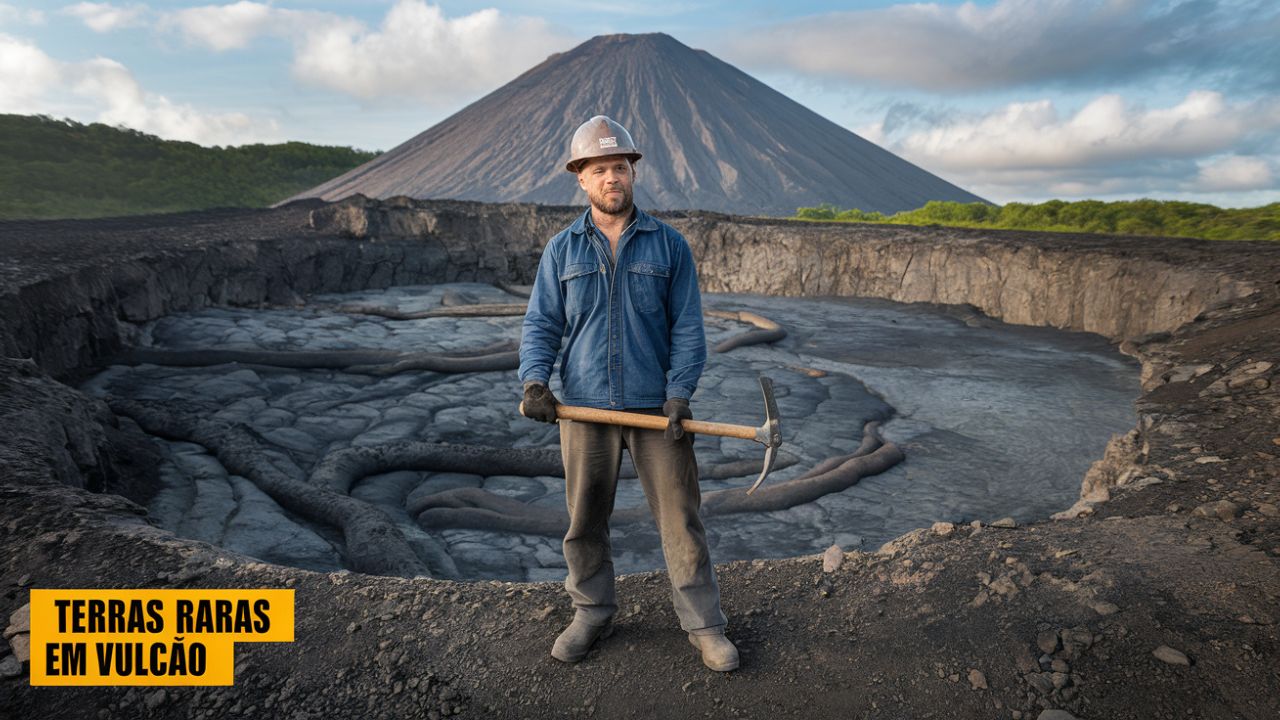
Researchers Reveal That The Magma Of Extinct Volcanoes May Concentrate Essential Rare Earth Elements For Wind Turbines, Batteries, And Cell Phones, With Promising Reserves In Brazil, Chile, And Australia.
Can you imagine finding a hidden gold mine in an extinct volcano? Indeed, researchers have discovered that the magma from some of these volcanoes may contain valuable elements known as rare earths. These substances are crucial for technologies such as electric car batteries, wind turbines, and even smartphones. The research reveals a massive potential for harnessing these natural riches in a more efficient and sustainable way.
But what exactly are these rare earths? Why have they caused such a stir in the industry? Let’s explore this discovery and the impact it may have on the future.
What Are Rare Earth Elements And Why Do They Matter?
Rare earths are a group of 17 essential metals for the manufacturing of modern technologies. Elements like neodymium and terbium are present in products we use daily, such as TVs, cell phones, and electric vehicles. Despite their name, they are not actually “rare.” The difficulty lies in extracting them efficiently and sustainably.
-
A new Brazilian shopping center worth R$ 400 million will be built in an area equivalent to more than 4 football fields, featuring 90 stores, 5 cinemas, a supermarket, a college, and parking for 1,700 cars, potentially generating 3,000 jobs.

-
Larger than entire cities in Brazil: BYD is building a 4.6 km² complex in Bahia with a capacity for 600,000 vehicles per year, but the discovery of 163 workers in conditions analogous to slavery has shaken the entire project.

-
With an investment of R$ 612 million, a capacity to process 1.2 million liters of milk per day, Piracanjuba inaugurates a mega cheese factory that increases national production, reduces dependence on imports, and repositions Brazil on the global dairy map.

-
Brazilian city gains industrial hub for 85 companies that is equivalent to 55 football fields.


Today, China dominates the rare earth market, controlling the majority of global production. This concerns other countries seeking to reduce dependency on this supply chain. The discovery of new deposits in volcanic magmas could be a game changer.
The Innovative Discovery Of Iron-Rich Magma
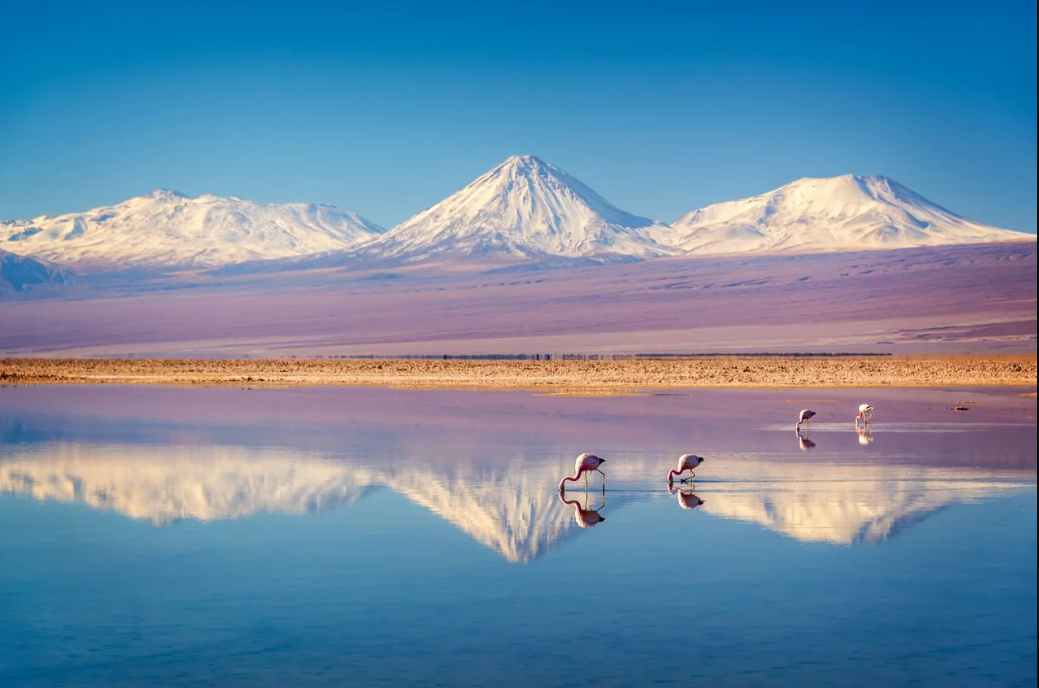
Researchers from the Australian National University made a surprising discovery: the magma of extinct volcanoes, especially those rich in iron, can concentrate rare earth elements up to 200 times more than common magmas. Using laboratory eruption simulations, scientists identified bubbles of magmatic fluid indicating high levels of elements such as lanthanum and cerium.
This opens doors to explore ancient volcanoes as real underground vaults. A notable example is the El Laco volcano in Chile, which is already being studied to assess its potential.
Promising Volcano Examples
In addition to Chile, countries like Brazil and Australia also have promising deposits. Brazil, for instance, holds the second largest rare earth reserve in the world, surpassed only by China. In Australia, extinct volcanoes have also shown signs of similar riches.
These locations could become strategic for sustainable mining, helping to diversify the supply chain and reduce pressure on current producing countries.
Challenges And Opportunities In Extraction
Despite the good news, extracting rare earth elements is not an easy task. Current technology is expensive and involves complex processes to separate elements from solidified magma. There are environmental and geological concerns that need to be assessed before mining becomes viable.
One alternative would be to invest in technologies that recycle already discarded materials, such as old electronics, reducing the need to open new mines.
The Future Of Sustainable Rare Earth Mining
If these discoveries are properly applied, they could transform the global industry. Countries like the United States and Sweden are already investing in research to ensure their economic independence in the production of rare earths.
The demand for these elements is expected to grow up to five times in the coming years, driven by green technologies. Harnessing the potential of extinct volcanoes could be the key to meeting this demand sustainably.
Discovering that extinct volcanoes could be true rare earth mines is like finding lost treasure. This research not only expands our possibilities for sustainable mining but also challenges the dominance of major players in the market.








-

Uma pessoa reagiu a isso.