





 Português
  Inglês
  Espanhol
  4 min de leitura
  0 comentários



Archeologists Make An Amazing Discovery By Recovering Over 900 Artifacts From The Ming Dynasty Of Wrecked Merchant Ships In The South China Sea, Revealing Historical Secrets Submerged For Centuries.
In an underwater operation that dates back to the history of the Ming Dynasty, Chinese archeologists made one of the most impressive discoveries in recent years: more than 900 artifacts were recovered from two wrecked merchant ships in the South China Sea.
These ships, dated to different periods of the dynasty, were located at a depth of about a mile, and 93 miles (approx. 150 km) southeast of Hainan Island.
The found artifacts, among ceramics, porcelain, copper coins, and other objects, are part of a huge collection of over 10,000 items identified at the site.
-
The world’s first octopus farm wants to open in the Canary Islands and is already provoking an international reaction: the plan aims to produce 3,000 tons per year.

-
Drought may be creating stronger superbugs in the soil and helping antibiotic resistance reach hospitals, warns a study highlighting a problem that could grow alongside extreme weather.

-
The biggest scam in history: Napoleon’s France deceived the United States by selling them a territory that was Spanish.

-
Why is the Danakil Desert so dangerous? It has unstable terrain and how extreme temperatures and toxic gases turn the region into one of the most hostile environments on Earth.


The expedition is seen as an important milestone for underwater archeology and a window into the trade and cultural exchanges that occurred along the ancient Maritime Silk Road.
An Operation To Rescue The Merchant Ships
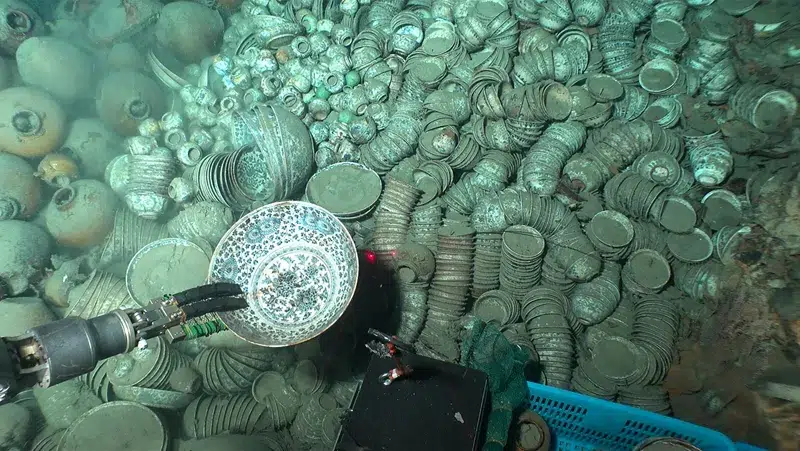
The discovery is the result of a joint effort that involved several phases of underwater excavations over the past year.
During this period, researchers removed 890 objects from one of the merchant ships, which likely carried porcelain from Jingdezhen, one of the most important cities in China in terms of ceramic production.
Additionally, another 38 items were retrieved from the second ship, which was farther away from the first. Among the items from this second wreck, archeologists found shells, deer antlers, and ebony logs, material indicating a possible origin in the Indian Ocean.
A mixed team, composed of researchers from the National Center for Archeology, the Chinese Academy of Sciences, and a museum in Hainan, conducted the operations.
To access the artifacts, archeologists employed a combination of manned and unmanned submersibles. Advanced technologies, such as high-definition underwater cameras and 3D laser scanners, were also used, which helped in the precise documentation of the shipwreck sites.
Traces Of A Flourishing Trade
National Cultural Heritage Administration
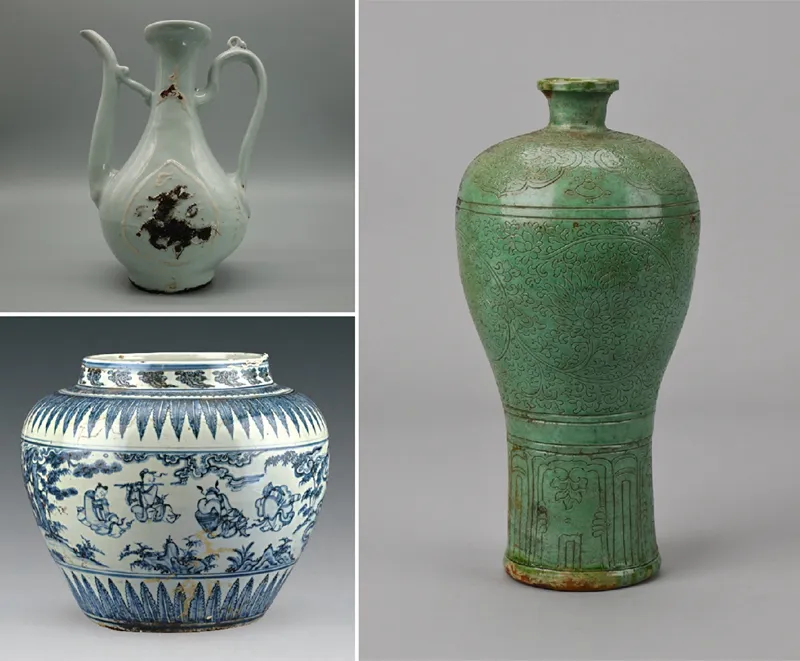
According to the National Cultural Heritage Administration of China (NCHA), the discovery of these shipwrecks and their artifacts serves as testimony to the commercial activity and cultural exchanges during the Ming Dynasty.
Many of the recovered objects date to the Zhengde period (1505-1521), while others may be even older, dating back to the Hongzhi Emperor era (1487-1505).
The deputy head of the NCHA, Guan Qiang, highlighted the historical importance of this discovery: “The discovery provides evidence that Chinese ancestors developed, utilized, and traveled to and from the South China Sea, with the two shipwrecks serving as important witnesses to trade and cultural exchanges along the ancient Maritime Silk Road.”
During the Ming Dynasty, China not only expanded its territorial domains but also formed cultural and commercial ties with the West. Ming porcelain, recognized for its classic blue and white color scheme, became one of the most popular exports of the time.
Additionally, China also exported silk and received foods such as peanuts and sweet potatoes, in a continuous exchange of goods and cultures.
The Cultural Wealth Of The Ming Dynasty
The Ming Dynasty (1368 -1644) is widely recognized as one of the most prosperous and influential periods in Chinese history.
During this time, the population of China doubled, and the country emerged as a global center for trade and culture.
The arts flourished, particularly ceramics and painting, as noted by the Smithsonian’s National Museum of Asian Art, which mentions the skill of the painters of the time in depicting religious themes, moral narratives, and grand landscapes.
Maritime trade played a central role in this prosperity. Trade routes extended across vast regions, connecting China with countries as distant as Africa and Europe. The discovery of the two merchant ships in the South China Sea reinforces the importance of this trade network, which, in addition to goods, facilitated the exchange of ideas and culture between East and West.
Ongoing Discoveries In The South China Sea
Recent archaeological excavations in the South China Sea are not limited to artifacts from the Ming Dynasty.
Recently, authorities also announced the discovery of an American Navy submarine from World War II near the Philippine island of Luzon.
These discoveries highlight the historical wealth submerged in the depths of this sea, which continues to reveal new secrets with each expedition.
As the excavations progress, archeologists hope to uncover more artifacts, offering an even more detailed insight into the trade routes and life in China during the Ming Dynasty.
With the use of modern technologies and international collaboration, the South China Sea promises to continue being a fertile ground for new and significant archaeological discoveries.







Seja o primeiro a reagir!