





 Portuguese
  English
  Spanish
  9 min of reading
  2 comments


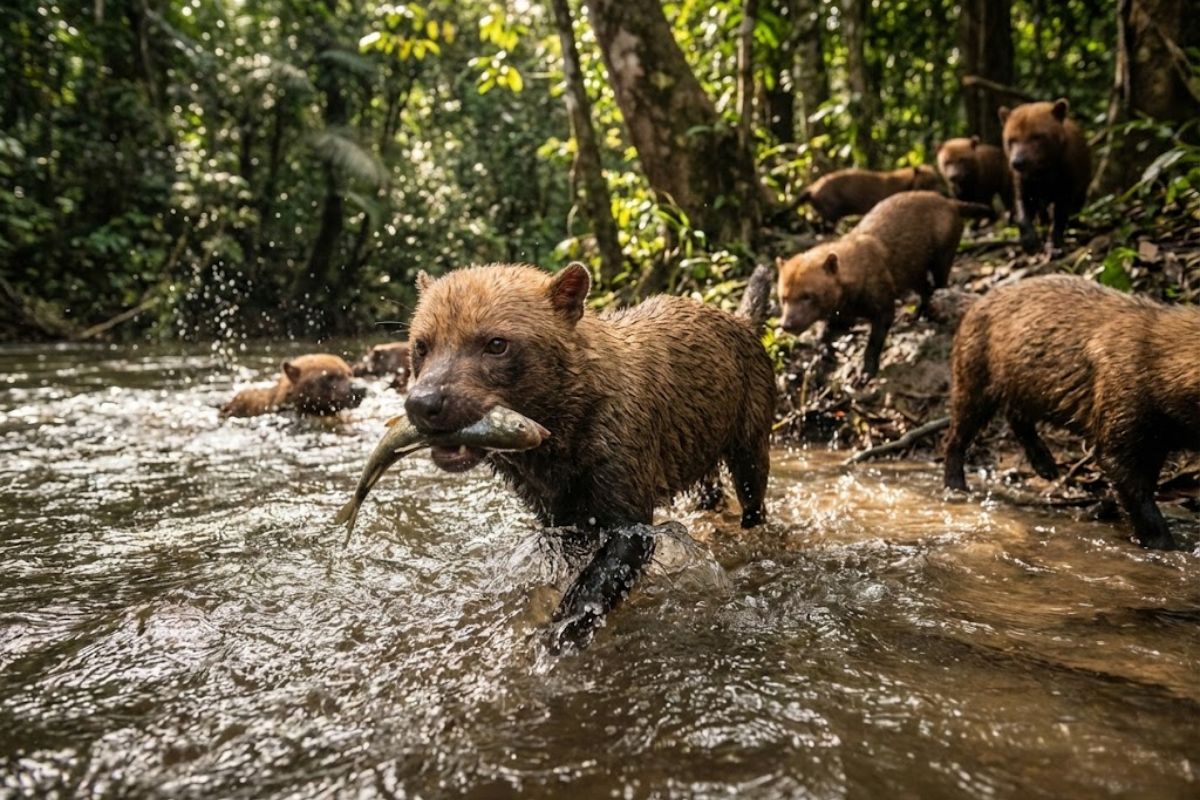


The Vinagre Dog Was First Discovered Through Fossils in Caves and Was Considered Extinct, But Reappeared Alive with Unique Semi-Aquatic Habits Among Canines. Small and Reclusive, It Lives in Packs, Uses Burrows and Logs as Shelter, Hunts Rodents and Even Peccaries, and Depends on Forests Near Water.
The Vinagre dog is one of the strangest and most enigmatic canines ever recorded by science, as it combines two rarities at once: a history of being a “living fossil” and a semi-aquatic lifestyle that is practically unique among canines. It was first described as a fossil, was considered extinct for years, and only later reappeared alive, revealing that it swims efficiently and can hunt underwater, as if it had a piece of otter hidden in the body of a wild dog.
Even though it occurs in a vast area of Latin America, the Vinagre dog remains difficult to see and poorly studied, precisely because it is small, reclusive, and lives in discreet groups that hide well in dense environments. It uses hollow logs, ground holes, armadillo burrows, and even caves as shelter, often forming organized packs and possesses a set of physical and behavioral adaptations that turn it into a specialized predator in landscapes where forest and water mix.
The Discovery That Began in the Subsoil and Confused Science for Decades

The origin of the Vinagre dog mystery is linked to Brazilian caves and a central figure in paleontology. In 1842, the paleontologist Peter Wilhelm Lund described the remains of a canid found in caves in Brazil.
-
In a flooded well, archaeologists found a 1,700-year-old Roman egg that still contains clear and yolk intact inside the very thin shell.

-
Something is happening around the Earth: Inside the huge explosion of fireballs in 2026

-
A hot air bubble coming from Argentina expands over Brazil, causing thermometers to exceed 38 degrees with a thermal sensation of 40 degrees in late March, affecting 6 states at once.

-
The radish leaf that almost everyone throws away has more polyphenols, flavonoids, and fiber than the consumed root, and a 2025 study showed that the leaf contains compounds that protect the intestine, combat inflammation, and may inhibit the growth of cancer cells.


The most intriguing point is that these first records were not of a living animal, but of fossils, which led to years of interpretation that it was an extinct species.
This detail completely alters the narrative because, in the scientific imagination, the Vinagre dog was born as an animal of the past, a “disappeared” canine, known only from bones.
The species was labeled as extinct even before it was understood as a flesh-and-blood animal, and this helps explain why it still carries an aura of enigma today.
The Moment When the “Extinct” Reappeared Alive

Over time, sightings emerged along with a capture by hunters that matched the description of the animal described by Lund.
It was this coincidence between the fossil and the living individual that confirmed that the Vinagre dog was not extinct.
From that point on, the animal ceased to be just a paleontological record and began to be treated as a living species, albeit extremely difficult to observe.
The turnaround is rare: a canid first known from fossils and then confirmed as alive, as if the forest had kept, for decades, a secret that the subsoil had revealed too soon.
Who Was Peter Wilhelm Lund and Why Does He Matter in This Story
Lund’s name is associated with the description of various megafauna animals from Brazil, including the Smilodon populator, the so-called Brazilian saber-toothed tiger.
This detail is important because it places the discovery of the Vinagre dog in the same scientific universe as significant fossil finds, reinforcing why the species was easily slotted, at first, into the idea of an “extinct animal.”
When described in this context of caves and megafauna, the Vinagre dog ended up carrying a label that would only fall later, when nature “revealed” that it was still there, alive, hidden in challenging habitats.
A Small, Elongated Canine Made for Slipping Around

The Vinagre dog is considered a relatively small canid. It can reach about 30 centimeters in height, approximately 75 centimeters in length, and weigh up to 8 kilograms.
The quoted life expectancy is 10 years.
The body is elongated, with short legs and tail, a combination that facilitates movement in dense environments, among roots, logs, and thick vegetation.
Its coloration varies between dark brown and reddish tones, while puppies usually have darker colors. It is a body design that seems made to vanish in the bushes and only reappear when it wants to.
Why Almost No One Sees: The Reclusive Behavior and Hidden Shelters

Even with wide geographical distribution, the Vinagre dog is seldom observed. The reason is a mix of discreet behavior and choice of shelter.
It can hide in hollow logs, ground holes, armadillo burrows, and even caves.
These shelters serve as resting bases and protection, reducing encounters with humans and even researchers.
The species lives as if it has an invisibility manual, which explains why we know relatively little about it in its natural environment and why many behaviors have been recorded in zoos.
Life in a Pack: Social Organization and Controlled Reproduction


The Vinagre dog is frequently found in small packs, although there are also records of solitary hunting.
The groups are usually formed by a breeding pair and close relatives.
The social structure has clear rules: everyone takes care of the pups, but only the breeding pair can have offspring.
The groups can have up to 12 individuals living together. The litters vary from three to six puppies. The babies are born blind and defenseless, but they develop quickly, reaching maturity around one year of age.
This model of “extended family” increases survival chances, as caregiving is shared and the group functions as a unit.
Where It Lives: From Costa Rica to Southern Brazil and Beyond
The Vinagre dog ranges from Costa Rica to the southern tip of Brazil.
It is mainly associated with dense, humid forests near bodies of water, which fits its semi-aquatic style. Nonetheless, some packs can also live in drier environments, such as the Brazilian cerrado.
This point is impressive because it shows that despite its wide territorial range and habitat flexibility, the animal remains poorly studied and seldom seen.
It’s as if it exists in many places but is always one step ahead of the human gaze.
Three Subspecies and Different Territories in South America
The material describes at least three subspecies of the Vinagre dog living in South America, with distinct distributions.
The South American Vinagre dog has the widest distribution, appearing from southern Colombia to northern Paraguay and much of Brazil, with darker coloration.
The Panama Vinagre dog occurs from Panama to northern Venezuela and western Ecuador, being described as the smallest of the three subspecies.
The Southern Vinagre dog ranges from southern Brazil and Paraguay to the extreme northeast of Argentina.
This regional division reinforces that the species occupies a vast corridor on the continent, with internal variations.
The Name That No One Forgets: The Strong-Smelling Urine
The origin of the name Vinagre dog is not a metaphor or folklore. It comes from the very strong odor of its urine, which is often used for territorial marking and is compared to vinegar.
This detail is more than mere curiosity: territorial marking is a vital part of animal communication.
The smell becomes a chemical signature of the group, helping to delineate areas and maintain the spatial cohesion of the pack.
The Canine That Swims Like an Otter and Turns Water Into Hunting Ground
The most unusual aspect of the Vinagre dog is its semi-aquatic habit, which is described as unique among canids. It swims and can hunt underwater.
The association with rivers, lakes, and flooded areas is not a coincidence: it is part of its way of life.
It is a voracious carnivore and primarily hunts large rodents such as pacas and agoutis, as well as capybaras. Some packs have even been seen hunting a peccary, even though the peccary is larger than they are.
The hunting takes place in daylight, which contrasts with other canids that are more nocturnal or crepuscular.
This positions the Vinagre dog as a diurnal predator that operates in groups and uses water as a weapon.
The Hunting Strategy in Packs with Ambush in the Water
The hunting method is one of the most fascinating aspects of the Vinagre dog. Part of the group approaches and begins a chase on land, while other members take positions in the water, waiting for the prey to come close.
This is especially effective because pacas, cited as primary prey, often run into the water to escape predators.
However, this escape route does not work against the Vinagre dog.
When the prey enters the water, it encounters pack members already prepared to continue the pursuit and make the kill. The water, which would normally save the prey, becomes a trap set in advance.
Interdigital Membranes: The Adaptation That Reveals the Lifestyle
Examining the paws of the Vinagre dog reveals an anatomical clue to its behavior: it has interdigital membranes, layers of skin between the toes that help propel it in the water.
Combined with its elongated and compact body, these membranes make swimming more efficient.
It is a functional adaptation, not a coincidence, and helps explain why it is treated as the only truly semi-aquatic canid described.
Why Zoos Became Sources of Behavioral Data
As the Vinagre dog is difficult to study in its natural environment due to the rarity of sightings, many records of its semi-aquatic behavior have been made in zoos.
This does not mean that it “learned” in captivity, but that the controlled environment allows constant observation, repetition, and documentation.
The difficulty of seeing the animal in the forest creates a scientific bottleneck, and captivity becomes a window to understand what rarely appears in the wild.
Comparisons With Other Canids Linked to Water
Although the Vinagre dog is described as the only truly semi-aquatic canid, there are other canids associated with aquatic environments.
An example cited is the short-eared dog, also from South America and extremely rare to spot.
Another is the raccoon dog, an Asian canid that approaches bodies of water to hunt small aquatic animals.
The difference is that none of these have adaptations for swimming like the Vinagre dog. It does not just frequent water: it operates within it with strategy and compatible anatomy.
Conservation Status: Nearly Threatened and with Declining Populations
The Vinagre dog is categorized as “near threatened” according to the International Union for Conservation of Nature.
Despite occurring over a vast area, its populations have declined by approximately 20 percent in the last 12 years.
This decline is noteworthy because it shows that broad distribution does not guarantee stability. A species can be widespread but still shrink silently, especially when facing constant pressures.
The Threats That Tighten the Noose: Habitat, Prey, and Diseases
The threats cited to the Vinagre dog include habitat loss due to deforestation, extensive cattle ranching, loss of prey to human hunting, and diseases contracted from domestic dogs.
The hunting of the Vinagre dog is illegal in most countries where it occurs, including Brazil, but the material points out that few countries have public policies or the capacity to monitor populations.
This creates a scenario where protection exists on paper, but real monitoring is weak. Conserving a rare and difficult-to-observe species becomes a double challenge, as even measuring the problem is complicated.
Recent Sightings and the Suspicion That It Hides in More Places
There have been recent records of Vinagre dog sightings in regions of Costa Rica where there had previously been no records. This suggests that its geographic distribution may be even more extensive than previously thought.
This type of discovery reinforces the enigmatic character of the animal.
It may be occupying areas where it simply went unnoticed, and each new record becomes a clue that there are still significant gaps in the real map of the species.
A Canine That Seems from Another World, but Is Right Here Next Door
When you combine the fossil history, the living reappearance, the reclusive life in improbable shelters, the rigid social organization, the diurnal hunting in packs, the ambushes in the water, and the membranes on its paws, the Vinagre dog becomes a complete package of scientific strangeness.
It is small, yet hunts large prey. It is discreet, yet occupies a continent.
It is a canid, yet swims like an otter. It was described as extinct but has always been alive, hidden. And that makes it one of the most intriguing animals in Latin America.
Do you think the Vinagre dog is that rare, or do we just not see it because it is an expert at disappearing in the forest and water?







,MEU pai,andando a cavalo no Pantanal,quando tinha 20 anos, avistou uma matilha de ****-vinagre, que, a partir do momento que chegaram perto e o viram, sumiram no capim, que ele ficou impressionado com a rapidez!!!!
Vivia contando pra nós, quando crianças.
Ele pensou que estavam extintos!!!
Agora,com 75 anos de idade, conseguiu avistar outra matilha de ****-vinagre!!!!
Ficou tão feliz, com o “achado” ,que passou uma semana falando disso!!!!
Sinceramente, a quantidade de animais que estão reaparecendo depois de serem considerados extintos, faz-me pensar que está existindo uma intervenção de algo superior, este algo superior está repondo as espécies extintas principalmente pelo homem.