





 English
  Francês
  Alemão
  Italiano
  Japonês
  Norueguês
  Portuguese
  Spanish
  3 min of reading



With the Heating Up of the Oil and Gas Market in Brazil, Many Foreign Service Providers Are Looking to Establish Themselves in Brazil with an Eye on New Opportunities
Although the main attraction of the South American country continues to be exploration and production (E & P) in the post-salt and pre-salt areas, other significant opportunities will be offered. One niche will be the decommissioning of various offshore structures, from decommissioned subsea infrastructures to rusted equipment legs for entire platforms and floating production storage and offloading units (FPSOs).
As Many of Brazil’s Offshore Production Units Are Aging, Especially in the Campos Basin, decommissioning in Brazil will be an important market that will last for decades. Of the more than 160 offshore production platforms in Brazil, 67 have been in operation for over 25 years and will soon need to be decommissioned. Another 24 rigs are between 15 and 25 years old and around 70 rigs are less than 15 years old.
Some of the decommissioning areas that will be in demand include fixed oil platform disposal; creation of artificial reefs, well abandonment, removal of pipelines, FPSOs and floating storage and offloading units (FSOs), removal of risers/flowlines, waste and effluent management for exploration and production activities, environmental licensing for decommissioning projects, drafting decommissioning plans, underwater decommissioning, and dismantling of engineering offshore structures and ballast water and bio-invasion. The new market existing in Brazil’s offshore industry will certainly attract foreign companies with experience in dismantling production units and subsea systems.
-
Government unlocks R$ 554 million for a highway that has been requested for decades and accelerates the duplication of BR.
-
Without bricks, without cement, and without endless construction: the cardboard house that is assembled in modules and can be moved.

-
Billions of barrels on the equatorial margin could lead Amapá to double its oil production in Brazil — the state aims to enter the route of companies in the Campos Basin, attract investments, and boost jobs and businesses in the oil and gas sector.
-
Without bricks, without cement, and without endless construction: the cardboard house that is assembled in modules and can be moved.

The National Petroleum Agency (ANP) is in the process of reviewing guidelines regarding decommissioning issues, including the review of ANP Resolution No. 27/2006, and the decommissioning process should begin in earnest as soon as these revised guidelines are implemented. established. The Revision of ANP Resolution Will Present New Obligations for Operators That May Flow into Services Related to the Search for Innovative Technical Solutions, engineering studies, risk analysis, environmental and social assessments, inspection and monitoring services, and waste management solutions.
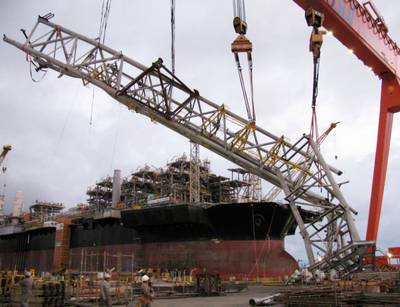
Shipyard EAS – Brazil
The Availability of Vessels, Port Facilities and Support, Waste Management Chain (Including NORM / TENORM) May Be Constraints to Decommissioning, Depending on the Demand for Projects That Will Be Presented in the Coming Years. Possibly, New Demands for Services Will Arise Due to Government Incentives to Reuse Facilities for Other Purposes, Besides Those Related to the Oil and Gas Industry, Such as Artificial Reefs (Old Vessels and Ships Can Be Used Along with Platform Structures Once Decontaminated), Wind Energy Generation, Wave and Tidal Energy, Tourism, Research, Among Other Possibilities.
Considering the Incipient Phase of the Decommissioning Industry in Brazil, Collaborative Efforts Among Operators, Service Industry Representatives, Universities, and Government Are Imperative and Can Be Beneficial for All Parties Involved.
Petrobras Has Submitted a Small Number of Decommissioning Projects for ANP Evaluation. The State Company Has Also Issued a Request for Information (RFI) for Companies Specialized in Decommissioning Projects. More Than 100 Companies from Various Countries Around the World Responded to Petrobras’s RFI. The Auction Date Has Not Yet Been Seen.
Industry Sources Estimate That Petrobras Will Need to Decommission at Least 67 Units in the Short to Medium Term. As This New Challenge Arises in Brazil’s Offshore Sector, Global Companies with Experience in Offshore/Subsea Decommissioning Looking for New Business May Be Encouraged to Explore Business Opportunities in the Country, With the Possibility of a New Horizon with Less Government Interference, Less Environmental Licensing Taxation, and with Government and Regulatory Support.
Some of the Facility Decommissioning Programs Under Analysis at SSM * / ANP:
- P-07 (Bicudo – Semisubmersible)
- P-12 (Linguado – Semisubmersible)
- P-15 (Piraúna – Semisubmersible)
- P-33 (Marlim – FPSO)
- FPSO Cidade do Rio de Janeiro (Espadarte)
- Spirit FPSO Piranema (Piranema)
Some of the Facilities Disable Programs Approved by ANP:
- FPSO Brasil (Campo de Roncador)
- FPSO Marlim Sul (Campo Marlim Sul)
- Campo de Cação (Three Rigs)







Seja o primeiro a reagir!