





 English
  Francês
  Alemão
  Italiano
  Japonês
  Norueguês
  Portuguese
  Spanish
  3 min of reading
  0 comments


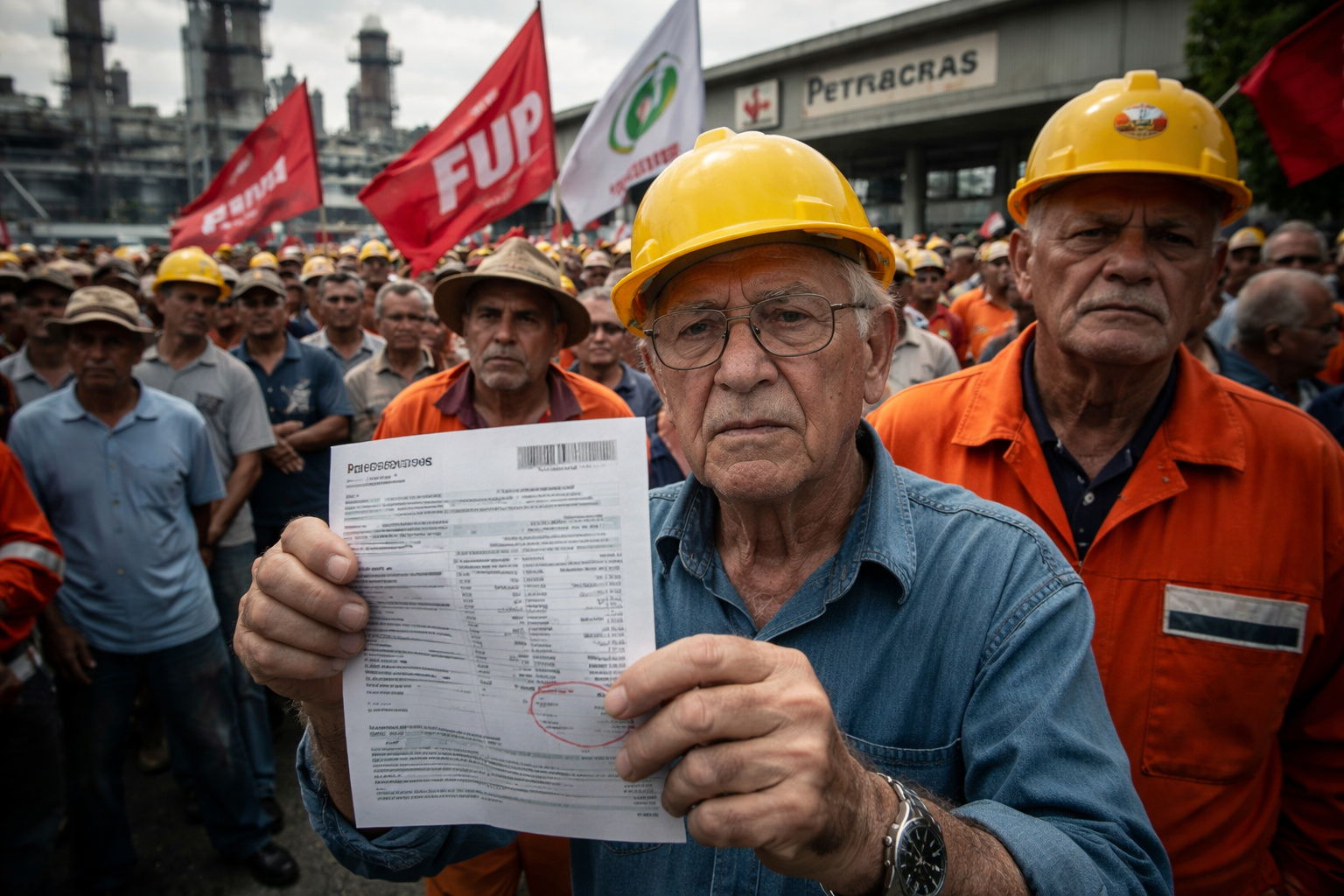
More Than 50 Thousand Retirees and Pensioners Face High Deductions as Strike Advances, Pressures Collective Bargaining, and Involves Billions in Discussion
A complex social security dispute has come to occupy the center of negotiations between workers and Petrobras, amplifying the deadlock of the oil workers’ strike, which completed a week this Monday, the 22nd. The debate involves deductions of up to 20% on the payroll of retirees and pensioners and, therefore, increases the risk of prolongation of the stoppage.
From the beginning, unions have emphasized that the issue is not recent. On the contrary, it affects about 50 thousand beneficiaries, who have suffered reductions in the amounts received since 2018, with the implementation of the Deficit Equational Plans (PEDs). Thus, the issue has been treated as an absolute priority in the strike movement.
Billions Expand Complexity of Negotiations
At the same time, sources connected to the company acknowledge that the amounts involved could reach billions, although there has been no official disclosure. Nevertheless, executives admit that this is neither a simple nor low-cost solution, which, consequently, delays immediate advances in negotiations.
-
Government unlocks R$ 554 million for a highway that has been requested for decades and accelerates the duplication of BR.

-
Without bricks, without cement, and without endless construction: the cardboard house that is assembled in modules and can be moved.

-
Billions of barrels on the equatorial margin could lead Amapá to double its oil production in Brazil — the state aims to enter the route of companies in the Campos Basin, attract investments, and boost jobs and businesses in the oil and gas sector.

-
Without bricks, without cement, and without endless construction: the cardboard house that is assembled in modules and can be moved.

In this scenario, Petrobras management states that it is seeking alternatives together with unions and the pension fund Petros. However, discussions drag on, mainly due to the large number of affected participants and the legal restrictions involved in the process.
2026 Electoral Fear Pressures Early Solution
According to Paulo César Martin, director of social security at the Unified Federation of Oil Workers (FUP), workers’ concerns are directly linked to the 2026 electoral calendar. As he stated to Reuters, the approach of the electoral period may complicate dialogue with the company’s board and the government, making the current moment strategic for ensuring advances.
For union leaders, resolving the issue now reduces the risk of setbacks and prevents negotiations conducted in the last two and a half years from being interrupted by political changes.
Strike Hits Platforms, Refineries, and Strategic Units

Meanwhile, the stoppage affected all operational platforms owned by Petrobras in the Santos and Campos basins. Additionally, the movement reached refineries, thermoelectric plants, biodiesel plants, ground production fields, and gas treatment and compression units.
Despite this, Petrobras claims that contingency teams have been activated to avoid significant impacts on supply and maintain the safety of essential operations.
Collective Agreement Escalates Tension Beyond Social Security Agenda
Simultaneously, unions are also pushing for changes in the collective labor agreement. The proposal presented by Petrobras foresees 0.5% real gain, while oil workers demand 3%, along with other category claims. Thus, the social security deadlock is directly connected to wage negotiations.
This combination of factors makes the scenario even more sensitive, complicating a quick solution to the stoppage.
Equations Since 2018 Affect Majority of Beneficiaries
Currently, participants in two of the largest plans administered by Petros contribute between 15% and 20% for the equations, always respecting contributory parity with Petrobras. These plans comprise 52.3 thousand participants, including 49.7 thousand retirees and pensioners and 2.5 thousand active employees, which amplifies the social impact of the problem.
According to Sérgio Borges, from Sindipetro-NF and director of FUP, the deductions generate direct losses for workers who dedicated decades to the state-owned company.
Commitment Letter and Legal Limits of the Solution
At the center of the stoppage, unions demand a commitment letter that guarantees beneficiaries the receipt of at least 95% of the net benefit prior to deductions. However, as Martin explains, the Constitution prohibits Petrobras from directly covering the deficit of the plans.
Thus, the alternative under discussion involves the creation of a new plan, the migration of participants, and the formalization of a judicial agreement, which will still need approval from regulatory bodies.
Given the billions at stake, legal hurdles, and political uncertainties, the strike enters a decisive moment — Will Petrobras be able to present a concrete signal before the deadlock drags on further?









Seja o primeiro a reagir!