





 Português
  Inglês
  Espanhol
  3 min de leitura
  0 comentários


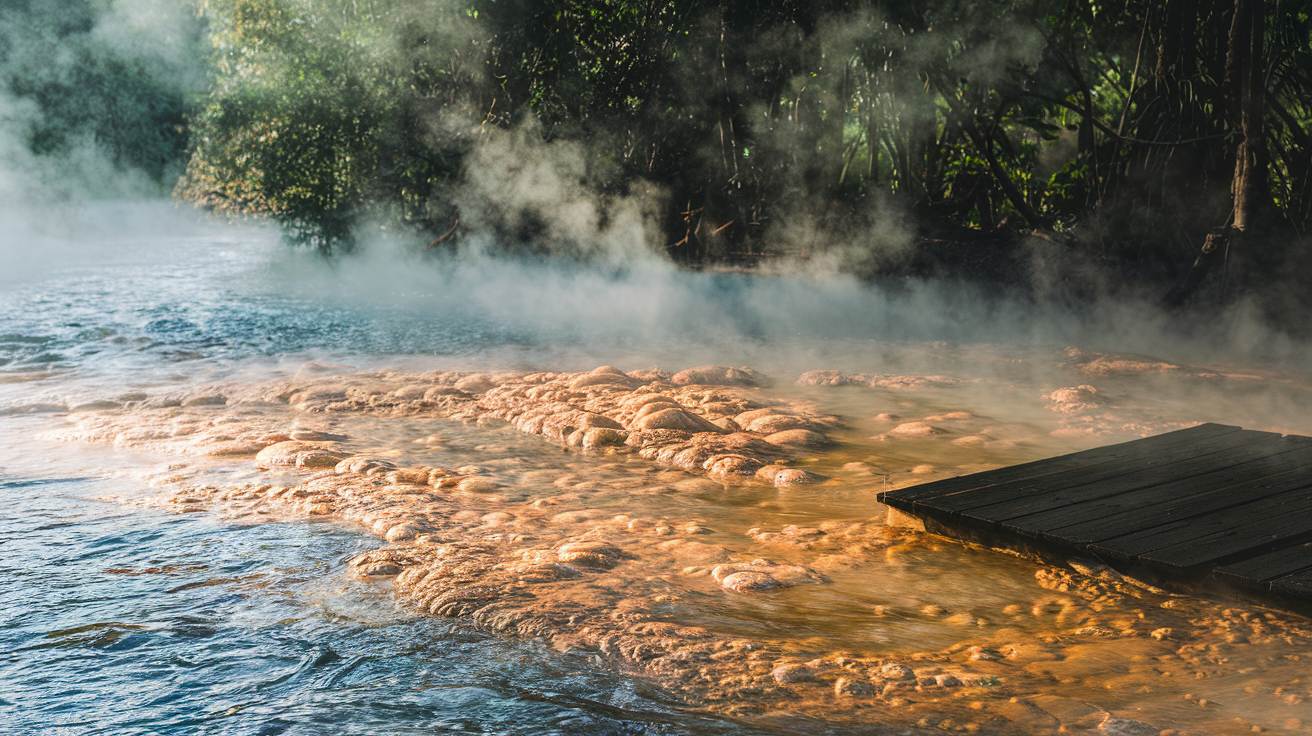
Mystery Of The Boiling River Of Peruvian Amazon: With Centuries Of Existence, Get To Know The Story Of The Peruvian Amazon River That Boils And Can Reach Almost 100 °C.
The Amazon, often referred to as the “heart of the planet,” is recognized for its unparalleled biodiversity and vastness. This biome encompasses the Amazon Rainforest and the Amazon Basin, extending across several countries beyond Brazil, including Bolivia, Colombia, Guyana, Ecuador, French Guiana, Peru, Venezuela, and Suriname. One of the most intriguing peculiarities of the Amazon is the boiling river Shanay-Timpishka, known as the “river that boils with the heat of the sun.” Located in the Peruvian Amazon, this river has temperatures that can reach up to 99°C, making it a unique natural phenomenon. Discovered by geoscientist Andrés Ruzo, the Shanay-Timpishka remained a legend for a long time until its scientific confirmation. The study of this river offers valuable insights into geothermal processes and highlights the untapped natural wealth of the region.
Peruvian Amazon River That Boils Has More Than 6.4 Kilometers In Length
The boiling river of the Amazon, called Shanay-Timpishka, can reach temperatures of up to 99°C and literally burns those who enter it. In fact, no animal survives in the waters of the boiling Amazon river. According to a legend, the Inca people who inhabited the region spoke of the existence of a boiling river.
Shortly after, when Spanish expeditions arrived in the area, they reportedly found it too, and some even died in its waters.
-
Drought may be creating stronger superbugs in the soil and helping antibiotic resistance reach hospitals, warns a study highlighting a problem that could grow alongside extreme weather.

-
The biggest scam in history: Napoleon’s France deceived the United States by selling them a territory that was Spanish.

-
Why is the Danakil Desert so dangerous? It has unstable terrain and how extreme temperatures and toxic gases turn the region into one of the most hostile environments on Earth.
-
With a height of 221 meters and a capacity for trillions of liters, Hoover Dam still holds a trick that makes water defy logic.



When science began to investigate the boiling river of the Peruvian Amazon, something seemed off, given that hot waters are typically associated with geothermal hot springs usually fed by volcanic activity.
This is not the case, as the Amazon has no nearby volcanoes. Thus, at first, it seemed to be a legend. The Shanay-Timpishka river, which in the indigenous language means “boil with the heat of the sun,” is over 6.4 kilometers long.
Understand Why The Boiling River Reaches Such Temperatures
In 2011, Peruvian geologist and geothermal energy specialist Andrés Ruzo, who holds a PhD from Southern Methodist University, decided to investigate the case of the boiling Amazon river more deeply and confirmed its existence.
The boiling river of the Peruvian Amazon, which is currently the hottest river in the world, was found by Ruzo on an expedition when he reached the warm waters with steam rising above them and took an initial measurement.
The thermometer read 86°C at that moment, and after further measurements, the number rose to 99.1°C. To give an idea of how hot that is, food can be cooked starting from 47°C.
After several analyses, the geologist demonstrated that the boiling river of the Peruvian Amazon does not require volcanic action to have high temperatures. According to him, the waters may be coming from rainfall or even melting glaciers in the Andes. The melted ice seeps deeply below the ground, into porous sedimentary rocks, where it is heated by geothermal energy from the Earth’s interior.
Then, upon encountering a geological fault, this hot water would be forced to rise to the surface, reemerging in the Amazon region and giving rise to this boiling river with extreme temperatures.
Boiling River In The Peruvian Amazon Is Cold In The Morning And Night
Its name “boil with the heat of the sun” is not by chance, as during the mornings, the waters of the river are cold, then they begin to warm up, but at night they become cold again.
According to Ruzo, in an interview with Galileu magazine, the river is sacred to the indigenous peoples of the region and must be preserved. However, in the right way, it can be used to study indications of other geothermal systems in Peru that may be better exploited.








-

-

-

-

12 pessoas reagiram a isso.