





 Portuguese
  English
  Spanish
  5 min of reading
  0 comments


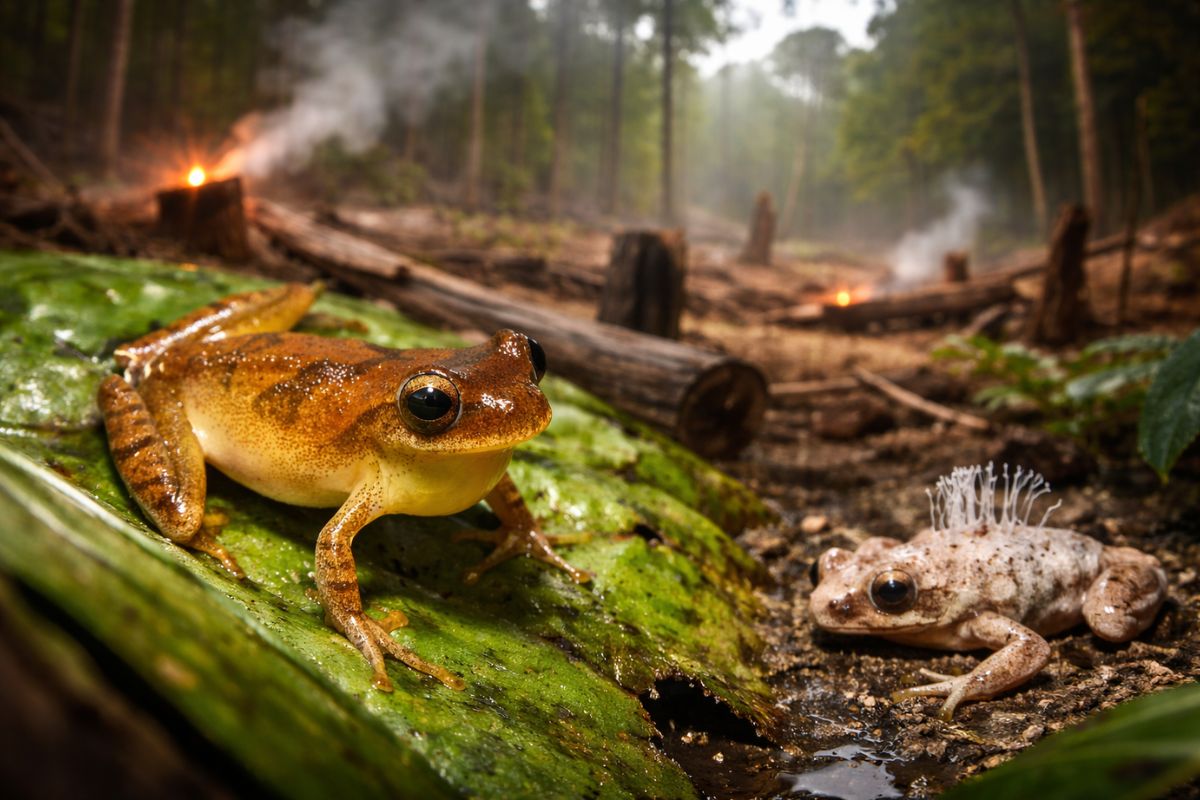
Deforestation Alters Skin Microbiome, Reduces Diversity of Protective Bacteria and May Facilitate Infection by the Chytridiomycosis Fungus, One of the Most Serious Epidemics Ever Recorded Among Wild Vertebrates on Different Continents.
The deforestation may be directly interfering with the natural defense capability of frogs and toads against one of the deadliest fungi ever recorded in wildlife. Brazilian researchers are investigating how the loss of forest modifies the skin microbiome of amphibians and may leave them more vulnerable to chytridiomycosis.
The hypothesis is that deforestation reduces the diversity of protective bacteria that live on the skin of these animals, weakening an essential biological barrier against the fungus Batrachochytrium dendrobatidis, the agent of the disease that has already caused population collapses in various regions of the planet.
What Changes in the Skin of Amphibians When the Forest Disappears

The skin of amphibians is not just an external covering. It functions as a living ecosystem, full of microorganisms that compete with pathogens and help to prevent infections.
-
Brazilian city neighboring Paraguay becomes a ‘magnet’ for people seeking quality of life and high standards with exceptional growth and commutes of up to 15 minutes.
-
A rare storm transformed part of the Gulf into an unlikely scene of hail, extreme rain, and tornado risk in the middle of the desert, with volumes that exceeded the annual average in a single day.

-
Brazil catches the world’s attention with ships powered by ethanol and biodiesel that have lower emissions, an unprecedented certification with advantages in chartering, and a revolution in cabotage.

-
A couple who only has Sundays free has built a hand-dug pool, a hamburger joint, a dance hall, and a playground in their own home without hiring a mason, and even with breaks due to accidents and the pandemic, the work has never truly stopped.


This microscopic community is called the skin microbiome.
In areas of preserved forest, the composition of this microbiome tends to be more diverse and balanced among individuals of the same species.
In contrast, in areas affected by deforestation, researchers observed a reduction in bacterial diversity and greater variation among animals, a sign of ecological imbalance on the skin itself.
This impoverishment may compromise the so-called natural skin protection, which hinders the establishment and multiplication of invading microorganisms, including the fungus responsible for chytridiomycosis.
The Species Chosen to Understand the Problem

To investigate this relationship between deforestation, microbiome, and disease, scientists needed a species that lived in both continuous forest areas and degraded regions.
The chosen one was the marsh frog Dendropsophus minutus.
This species exhibits moderate tolerance to the fungus, allowing for a comparison of individuals that are more or less resistant to infection and correlating this difference with the diversity of bacteria present on the skin.
Populations were studied in the São Paulo Atlantic Forest and the Araucaria Forest region in the south of the country, in both preserved areas and altered environments.
How the Researchers Analyzed the Microbiome
About 600 individuals were sampled in the field, and 187 underwent detailed molecular analyses. The collection of skin material was done using sterile techniques, employing swabs to remove microorganisms from the skin surface.
The material underwent genetic sequencing, generating a database with hundreds of types of bacteria per animal.
From this data, indices of diversity, abundance, and evolutionary relationship among the identified bacteria were calculated.
This set of information allowed for a comparison of how the microbiome varies between amphibians from preserved areas and regions affected by deforestation.
Preserved Forest Means More Diverse Microbiome
The results indicated that individuals from intact forest areas exhibited more diverse and more similar microbiomes among themselves.
In contrast, in open or degraded areas, the microbiome was less diverse and more irregular from one animal to another.
This pattern suggests that deforestation may disrupt the bacterial community of the skin, reducing its effectiveness as a barrier against pathogens.
Although it is not yet possible to definitively claim that this loss of diversity directly increases the risk of infection, the data point to a potential weakening of the natural resistance of amphibians.
What Happens When the Fungus Establishes
When the chytridiomycosis fungus infects an amphibian, it attaches to the skin and begins to multiply.
At the onset of the infection, the number of bacteria may even increase, possibly because the animal’s immune system is compromised, creating opportunity for opportunistic microorganisms.
As the disease progresses, the skin thickens, gas exchange is impaired, and the balance of the microbiome collapses. When bacterial diversity plummets, the situation is usually severe, and many animals do not survive.
The skin is vital for adult amphibians as it participates in respiration. The fungus attacks keratin, alters permeability, and interferes with gas exchanges, leading to physiological disturbances that can result in death.
An Epidemic That Has Devastated Continents
Chytridiomycosis is considered one of the worst epidemics ever recorded among vertebrates. The fungus spreads through spores in the water of ponds and rivers, infecting different species.
The disease has been associated with local disappearances and severe population declines in the Americas, Australia, Europe, New Zealand, and parts of Africa.
In some regions, areas that were once rich in amphibians have become practically silent in just a few years.
In the Brazilian Atlantic Forest, the fungus is endemic. Although the impacts are not as extreme as in some areas of Central America, there are records of significant historical declines, especially at the end of the last century.
Why Deforestation May Aggravate the Scenario
Deforestation does not only affect the quantity of trees. It alters temperature, humidity, availability of shelter, and water quality.
These environmental changes can directly influence the microbiome of amphibians and the dynamics of the fungus in the environment.
By reducing the bacterial diversity of the skin, deforestation may remove a layer of natural defense, facilitating the establishment of the pathogen.
At the same time, altered environments may create favorable conditions for the persistence and spread of the fungus in water.
This set of factors can turn degraded areas into higher-risk locations for outbreaks of the disease.
Next Steps in Research
The researchers are now seeking to identify which bacteria on the skin of amphibians have the potential to inhibit the growth of the fungus. The idea is to discover if specific microorganisms act as natural protectors.
If these bacteria are identified, it may be possible in the future to develop probiotics to strengthen the microbiome of threatened populations, helping to reduce vulnerability to chytridiomycosis in regions where deforestation has already compromised ecological balance.
Have you ever imagined that the loss of forest could weaken even the invisible defense of the skin of frogs and toads?






-

Uma pessoa reagiu a isso.