





 Portuguese
  English
  Spanish
  7 min of reading
  1 comment


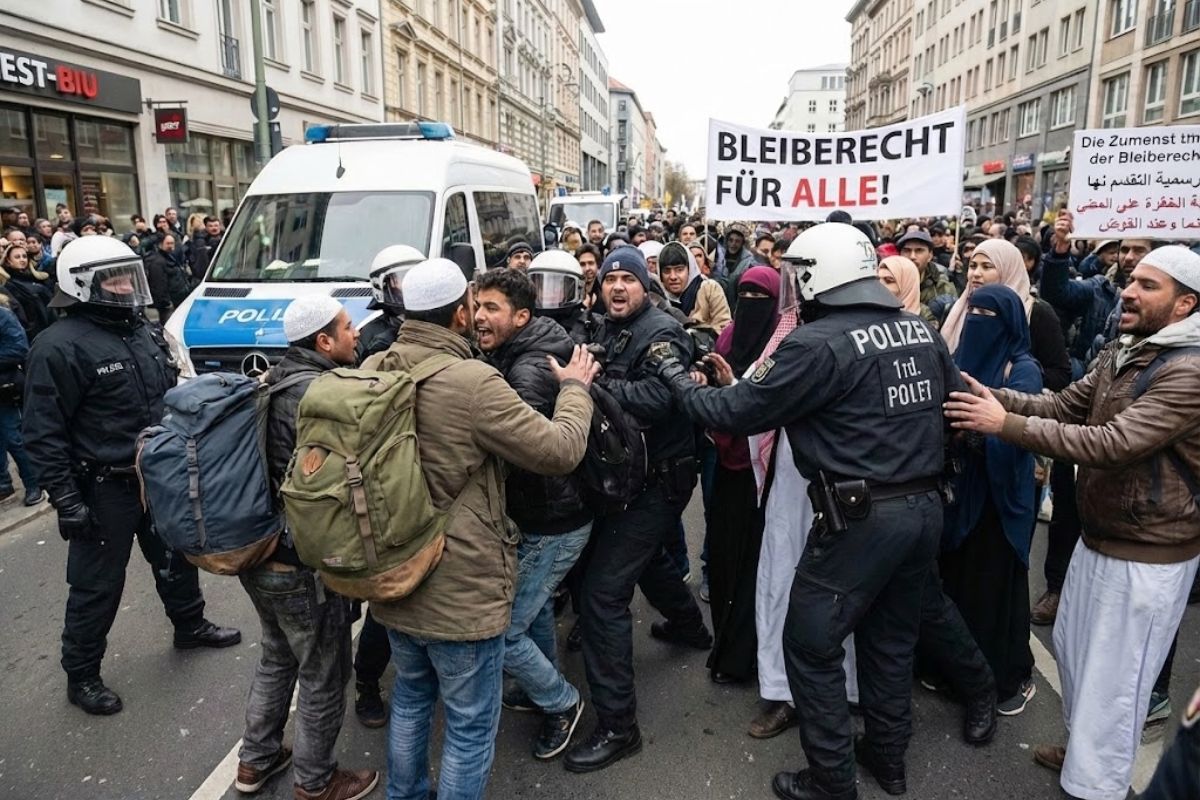


Ten Years After The Arrival Of More Than One Million Refugees In 2015, Germany Lives Overloaded Cities, Political Disputes, Labor Market In Demographic Crisis, Stories Of Silent Integration, Growing Racism, Fear, Violence And A Society Divided Between Welcoming And Closing Its Doors In The Open Future Today
In 2015, at the height of the migration crisis and shortly after receiving almost 480,000 asylum requests in a single year, Germany decided to open its borders to more than one million refugees, largely coming from Syria, Afghanistan, and Iraq. The decision by then-Chancellor Angela Merkel was presented as a humanitarian triumph and a political bet in a country that saw itself as optimistic, economically strong, and willing to lead a European response to wars and the collapse of neighboring countries.
Ten years later, in 2025, the scenario is much tenser. About 3.5 million refugees now live in German territory, migration policies are being tightened, reinforcing border control and imposing stricter rules, and nearly 70 percent of the population states in surveys that the country should receive fewer people seeking asylum. The result is a Germany divided between the recognition that it needs immigration to survive demographically and the feeling of being overwhelmed by integration challenges that have not been fully resolved.
Ten Years Later: Numbers, Public Opinion And Toughening Of The Rules

Today, Germany coexists with a very different migration structure than that of 2015.
-
Spain surprises the world by erecting 62 artificial dunes, mixing sand with natural remains of posidonia, and causing the structure to lose only 1.4% of its volume in 1 year.

-
With 16 Bulava missiles, improvements in acoustic stealth, and a design focused on silent patrols, Russia’s nuclear submarine was born to ensure Moscow’s invisible retaliation and has become one of the pillars of its maritime strength.

-
‘Populous’ city in Rio among the worst in Brazil in national ranking and exposes silent development crisis.
-
Couple buys house in the South Zone of São Paulo, opens a hidden door in the garage, and finds a secret wine cellar with dozens of old wines forgotten since the 1970s.

Over the decade, the number of foreigners has nearly doubled, while the number of civil servants tasked with processing, granting visas, and managing asylum requests has hardly grown.
In practice, this means long lines, waits of three to six months to release work permits, and cases in which refugees are prevented from formally entering the market for years.
At the same time, the tightening of rules responds to political pressure.
The rise of the far-right AfD party, which is now the second strongest force in the national Parliament and has already reached about 20 percent of the votes in federal elections, owes much to the migration agenda.
In places like Boostedt, in the north of the country, a quarter of the electorate voted for the AfD, driven by the perception that the massive arrival of refugees was not accompanied by the necessary infrastructure to absorb so many people.
Overloaded Villages, Full Cities And Tense Coexistence Routine

The small village of Boostedt, with fewer than six thousand inhabitants, illustrates this overload.
At one point, nearby shelters housed up to two thousand refugees, completely changing the local routine.
Residents expressed being divided between the desire to help those fleeing war and the fear of groups of newcomers circulating in mass through the streets, in dozens or hundreds of people.
In various regions of the country, similar reports repeated. Villages and medium-sized cities saw the proportion of non-German residents multiply in just a few years, putting pressure on schools, social services, housing, and reception structures.
In Cottbus, in eastern Germany, near the border with Poland, the proportion of foreign residents has almost tripled since 2014.
Some of the refugees remained there due to cheaper rent, creating pockets of migrant population in historically homogeneous areas.
Successful Integration Stories: From Shelters To German Citizenship


Alongside the overload, there are emblematic cases of integration.
The family of Nebal Altabl arrived in Germany in 2015 after fleeing a region near Damascus, Syria, constantly bombarded.
After a difficult crossing of the Mediterranean, the family went through the reception circuit reserved for refugees and, over the years, earned residency, work, and finally, German citizenship.
Today, Nebal lives in Ulm, in the south of the country, speaks German fluently, works as a laboratory assistant, and pays rent in a quiet neighborhood.
His daughters attend university, and his husband, Haitham, transitioned from his previous work as a self-employed shoemaker in Syria to the orthopedic footwear sector in Germany.
The family describes their current situation as a balance between two worlds, trying to contribute both to their homeland and to the host country. For some refugees, this is the ideal scenario that was envisioned in 2015.
When The Promise Fails: Frustrations, Dependence On Benefits And Language Barrier
Not everyone has reached the same point. In Cottbus, the journey of Kamiran Dawood shows a less celebrated side of the process.
He also left Syria in 2015, fleeing the war with his family, but carries a paralysis in his hand caused by a car accident and an educational background that stopped in the eighth grade.
With difficulty writing, Kamiran could not go beyond the basic levels in German classes, and ten years later, he still depends on a social worker to deal with bureaucracy and everyday tasks.
Without mastery of the language and with low education, he is part of the group of refugees who continue to receive social benefits and face enormous difficulty accessing the formal market.
Experts remind us that many arrived traumatized, with a history of violence and forced displacement, and that this impacts mental health, concentration, and adaptation.
The result is a significant contingent of people in a state of prolonged dependence, which fuels internal criticism and reinforces the discourse that the system encourages passivity.
Labor Market, Labor Shortage And Role Of Refugees In The Economy
Despite these difficulties, the German labor market increasingly depends on immigrants.
Studies cited by migration researchers estimate that the country needs at least 288,000 qualified workers per year to compensate for the aging population.
There are already about two million foreign professionals working in sectors with labor shortages, and Syrians are now the largest group among foreign doctors, with approximately six thousand professionals.
The data shows that refugees and asylum seekers take a long time to insert themselves into the market, but seven years after the arrival of 2015, more than 60 percent had already found some form of work.
Still, many are employed in low-skilled positions, far from their education or previous experience.
The recognition of diplomas obtained in their countries of origin remains a structural obstacle, and the bureaucracy to regularize documents contributes to Germany, while needing workers, having difficulty fully utilizing them.
Crimes, Fear, Far Right And Violence Against Refugees
Crime has become one of the most sensitive chapters of this decade.
Official statistics indicate that foreigners appear as suspects of crimes more frequently than Germans.
In a recent period, about 35 percent of suspects did not have German citizenship, although people with foreign nationality represent about 15 percent of the total population.
Researchers emphasize, however, factors that distort this reading, such as greater willingness to register complaints against those seen as foreigners and the over-representation of young men among refugees, a group that, in any context, tends to be more associated with violent crimes.
High-profile cases have reinforced the climate of fear.
The new year transition from 2015 to 2016 in Cologne recorded over 600 reports of sexual assault, initially associated with groups of men from North Africa, although only 32 cases resulted in convictions, mostly for property crimes.
There was also the terrorist attack at a Christmas market in Berlin in 2016, the knife attack at a festival in Solingen in 2024, and the attack against children in Aschaffenburg in 2025, attributed to an Afghan man with psychological problems about to be deported. In each episode, the image of refugees was once again placed under suspicion.
At the same time, immigrants have become an increasing target of violence.
In 2020, Hanau recorded a racist attack that killed nine people, mostly of migrant origin.
Intelligence services indicate that the number of far-right extremists considered potentially dangerous has increased sixfold since 2015, and racist crimes have multiplied since 2017.
Syrians like social worker Nadeem, who arrived as a refugee and is now a German citizen, report physical assaults, threats, and symbolic episodes such as the sending of pig ears by mail.
Volunteering, Social Fatigue And Germany Between Fatigue And Need For Immigration
In 2015, surveys indicated that about half of the German population had helped refugees in some way, including through volunteer work.
Residents like Bernd, in villages in Swabia, organized support networks for newly arrived families, offering classes, guidance, and daily support.
In Boostedt, volunteer groups created cleanup brigades with the participation of asylum seekers to reduce litter in the streets and improve the perception of safety.
However, over the decade, enthusiasm has worn thin.
Two years after the peak of 2015, the desire to help had already significantly declined, while skeptical and hostile voices grew stronger.
The AfD began to exploit the issue of crime and migration in electoral campaigns, using insecurity as a mobilization platform.
Still, local leaders who work with refugees insist on mediation initiatives, presence of social workers in the streets, and building bridges between old and new residents, even in a tougher climate.
After A Million Refugees, What Went Right And What Remains Open
Ten years later, Germany presents an ambiguous balance.
On one hand, hundreds of thousands of refugees have built stable lives, learned the language, secured jobs, become naturalized, and now help keep entire sectors of the economy running.
On the other hand, heavy bureaucracy, slow recognition of qualifications, the concentration of vulnerable young men, and the lack of infrastructure in some cities have fueled conflicts, frustrations, and a sense of overload.
Experts highlight that the country depends on immigration to survive in a context of an aging population but needs to find politically intelligent ways to deal with the problems created or amplified in the last decade.
The discussion has shifted from whether Germany will be able to integrate refugees in significant volumes to how it will do so in an environment of polarization, rising extremism, and ongoing demand for foreign workers amid wars and climate crises that push more people into forced displacement.
In your opinion, after these ten years, has Germany managed to balance the welcoming of refugees and internal security, or is the country still far from an acceptable equilibrium?








Brasileiro agora é refugiado? Alguns foram para lá sem terem cidadania e querendo ganhar muito. Toma ****. Enquanto isso várias obras no Brasil, sem a fiscalização dos órgãos responsáveis.