





 Portuguese
  English
  Spanish
  4 min of reading
  0 comments


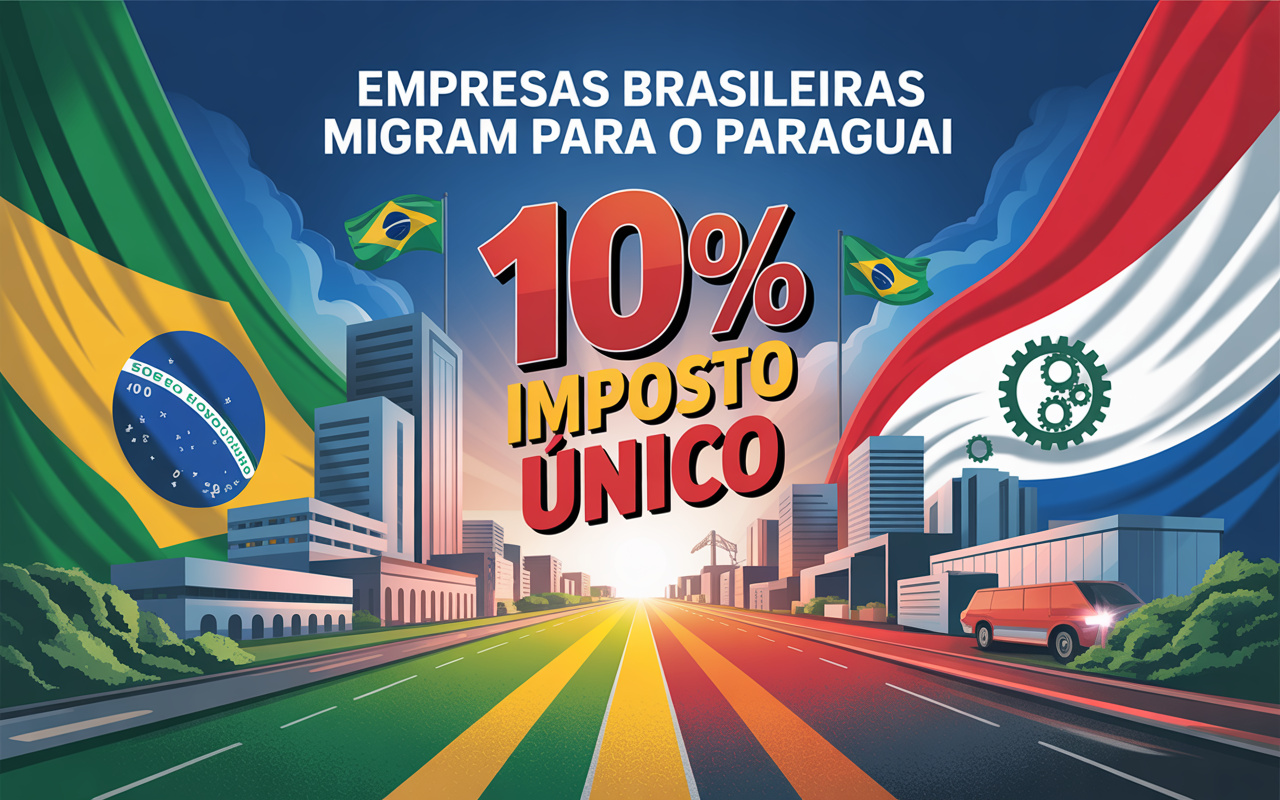
Understand Why Dozens Of Brazilian Companies Are Transferring Their Operations To Paraguay Attracted By Simplified Tax Burden And Cheaper Labor
For years, the idea of Brazilian entrepreneurs crossing the border to set up their factories in Paraguay sounded improbable, almost like a joke. But recent reports from Jornal Empresas & Negócios (2023) show that the phenomenon has ceased to be an exception and has become a consolidated trend.
According to these sources, hundreds of Brazilian companies have already migrated to Paraguay in search of a much lighter tax burden, abundant and cheap energy, less complex labor laws, and a special tax incentive regime for exporters known as Maquila Law. The result is a true corporate exodus that impacts both the Brazilian economy, which loses jobs and revenue, and the Paraguayan economy, which gains unprecedented industrial dynamism in its history.
Low Tax Burden In Paraguay Attracts Brazilian Companies
One of the main factors behind this change is the slim tax burden. While in Brazil the average corporate taxation exceeds 34% on profits, according to data from OECD, companies in Paraguay operate under a simple and predictable system:
-
With 74% of companies facing difficulties in hiring, technicians and engineers in renewable energy are becoming scarce in Brazil and are essential to support the expansion of solar, wind, and green hydrogen projects.

-
Historic bankruptcy of Centauro shocks the market, and the century-old company puts more than 500,000 products, machines, and complete infrastructure up for online auction.

-
New shoe factory in Ceará is expected to create 400 jobs and strengthen the local economy.
-
No one imagined it, but a mixture of sawdust with a mineral that fights fires surprises scientists with a result that changes the course of fire-resistant construction.




- Corporate Income Tax (IRACIS): 10%
- VAT (Value Added Tax): 10%
- Dividend Tax: 5% to 10%
A report from Jornal Empresas & Negócios (2023) highlights that this model is already considered a “Paraguayan Dream” by Brazilian entrepreneurs, tired of the complexity of the national tax system, which includes more than 90 different taxes.
As a result, companies setting up in Paraguay can save up to 40% on production costs, especially in sectors like clothing, furniture, footwear, and metallurgy — which are heavily labor and energy-intensive.
Cheap And Abundant Electricity: The Power Of Itaipu
Another powerful attraction is the cost of electricity. Paraguay is home to one of the largest hydroelectric plants in the world, Itaipu Binational, built in partnership with Brazil, alongside others like Yacyretá.
Thanks to this generation capacity, Paraguay offers one of the cheapest electricity rates in South America. According to data from ANDE (Administración Nacional de Electricidad), the average cost for industries is 60% lower than in Brazil.
For Brazilian companies, accustomed to dealing with tariff flags, constant adjustments, and the risks of rationing, this difference is a decisive factor for competitiveness. Sectors that consume a lot of energy, such as processed foods, refrigeration, and metallurgy, see in Paraguay a chance to drastically reduce electricity bills.
Maquila Law: The Regime That Changed The Paraguayan Industry
In addition to the simplified tax burden, Paraguay implemented the Maquila Law, which grants special benefits to companies that export their production. Under this regime, taxation drops to 1% on the added value in Paraguayan territory, making it one of the most aggressive incentives in the world.

According to a survey by Rediex (Network of Investments and Exports of Paraguay), this regime has attracted more than 250 foreign companies since its implementation, a significant portion of which are Brazilian.
This explains why entire sectors of clothing and manufacturing have already set up factories in cities like Ciudad del Este and Hernandarias.
Cheaper Labor And Simple Labor Legislation
Another differentiator is the labor force. The minimum wage in Paraguay is lower than in Brazil, and social charges are also smaller.
According to data from the World Bank (2023), the total cost of hiring a worker in Paraguay can be up to 30% lower than in Brazil.

Additionally, Paraguayan labor legislation is considered simpler and less bureaucratic. For entrepreneurs complaining about the rigidity of the CLT in Brazil, this aspect becomes a relief factor, allowing greater flexibility in team management.
Growing Flow Of Brazilian Companies To Paraguay
Reports from the Federation of Chambers of Commerce of Mercosur indicate that more than 800 Brazilian companies are already operating in Paraguay under different modalities, especially within the maquila regime.
- Textile Sector: companies transfer entire production lines to take advantage of lower costs.
- Automotive Sector: parts suppliers set up branches in Paraguayan territory to serve Mercosur manufacturers.
- Agribusiness: producers of oils, soybeans, and corn find cheaper logistics and energy.
This movement is already visible in border regions, but is also advancing in Asunción and other cities in the Paraguayan interior, consolidating the country as a new regional production hub.
Brazil Loses While Paraguay Grows
For Brazil, this phenomenon means loss of industrial jobs, tax revenue, and productive capacity.
According to economists from Fundação Getulio Vargas (FGV), Brazilian deindustrialization accelerates when companies choose to transfer their plants abroad.
For Paraguay, the gain is evident. The country, historically dependent on agricultural and energy exports, is diversifying its economy, generating thousands of formal jobs, and establishing itself as an attractive destination for foreign investment.
Criticisms And Challenges Of The Paraguayan Model
However, not everything is perfect. Experts warn that Paraguay still faces limited logistical infrastructure, weaker institutions, and a small internal consumer market.
However, as highlighted by a report from Empresas & Negócios (2023), these challenges are offset by direct access to Mercosur, allowing companies to produce in Paraguay and sell to neighboring countries with reduced tariffs.
What once seemed like a joke has turned into reality: more and more Brazilian companies are crossing the border to produce in Paraguay.
The neighboring country offers a rare combination of low taxes, cheap energy, fiscal incentives, and accessible labor, transforming it into a fiscal and productive refuge in the heart of South America.
For Brazil, the warning remains: while tax reform is still debated without concrete progress, Paraguay already presents itself as a competitive alternative and, in practice, is winning entire industries that once ensured jobs and tax revenue in national territory.







-

-

-

7 pessoas reagiram a isso.