





 Portuguese
  English
  Spanish
  5 min of reading
  0 comments


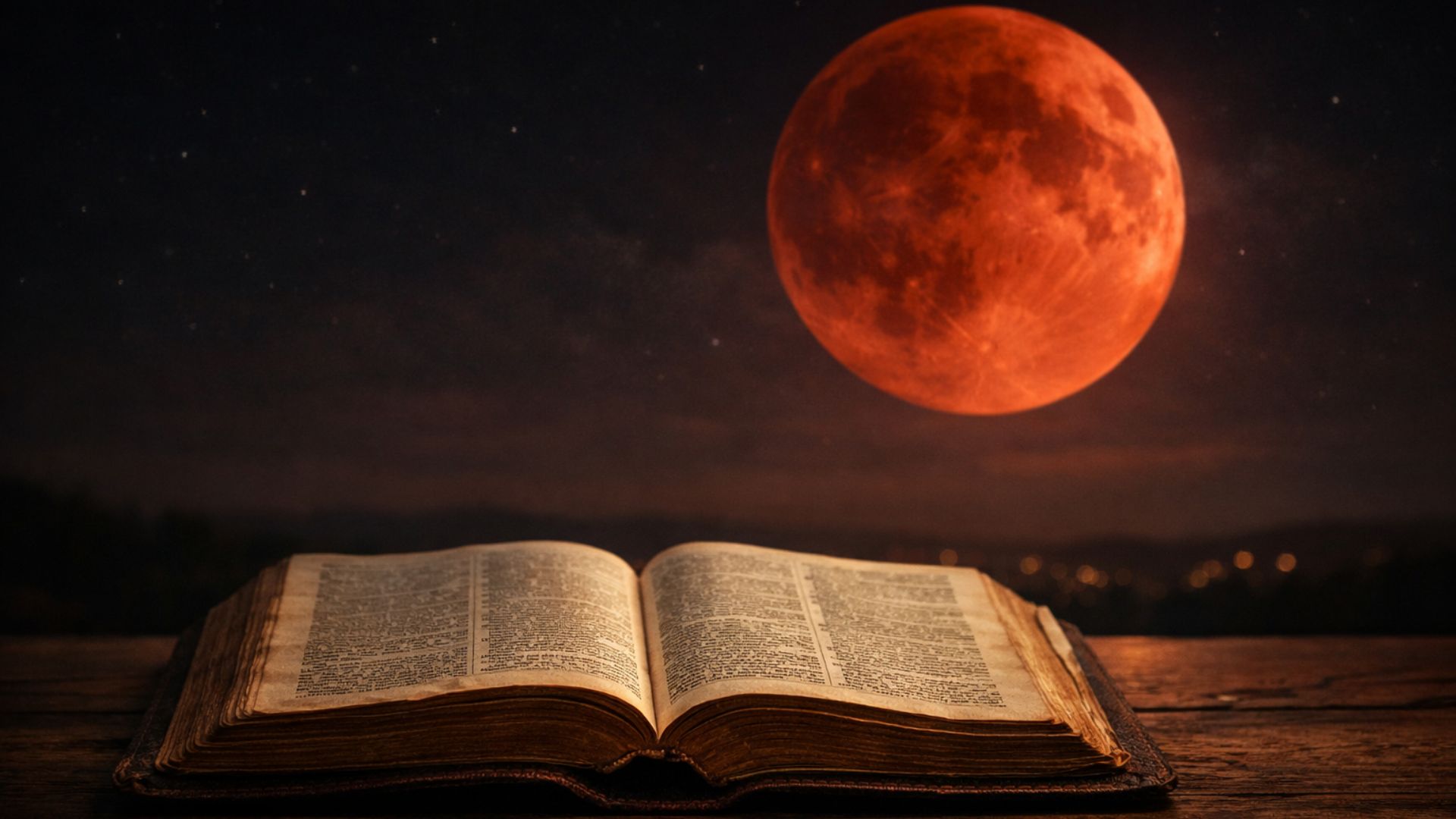
Rare Astronomical Phenomenon Reignites Debates on Biblical Prophecies and Signs of the End Times, Uniting Scientific Explanations and Religious Interpretations Surrounding the So-Called Blood Moon, Visible in Total Eclipses and Associated with Passages from Joel and Revelation.
A total lunar eclipse that turns the Moon a reddish hue often returns to the spotlight for uniting a precalculated astronomical event with religious readings that associate it with passages about the “day of the Lord” and final judgment.
On such occasions, the red coloring, popularly known as the “Blood Moon,” can be seen with the naked eye in large areas of the planet where it is nighttime, while churches and social networks revisit biblical texts cited as signs of end times.
Why Does the Moon Turn Red During a Total Lunar Eclipse
The red tone does not arise because the Moon changes its nature, but because sunlight passes through the Earth’s atmosphere before reaching the satellite, undergoing filtration that reduces the presence of bluish tones and favors reddish ones.
-
He started running at 66 years old, broke records at 82, and is now a subject of study for having a metabolic age comparable to that of a 20-year-old, in a case that is intriguing scientists and inspiring the world.

-
Oldest tree on the planet reappears after 130 years of searches: Wattieza, 385 million years old, was 10 meters tall and had no leaves or seeds; Gilboa fossils in New York solved the mystery in 2007.

-
A 48-square-meter house assembled in hours with 4,000 bricks made of recycled plastic that does not absorb moisture, has natural thermal insulation, and costs less than 90,000 reais in a complete kit.

-
Luciano Hang revealed that Havan’s air fleet has already accumulated more than 20,000 landings, 10,000 flight hours, and 6 million kilometers traveled, and he says that without the planes, the company would never have grown so quickly.

The deeper the Moon enters the Earth’s central shadow, the greater the sensation of darkening and color change, but the intensity of red varies according to dust, humidity, and particles in the atmosphere, which explains visible differences between eclipses.
Although some descriptions talk about a “100% red” Moon, the real appearance usually oscillates from copper to dark red, with varying gradations and edges that are more or less luminous, as the atmospheric lighting is not uniform across the entire lunar disk.

The duration of the period in which the Moon remains entirely within the Earth’s shadow is also not fixed, as it depends on alignment and the path traveled, which can exceed an hour in some events and be shorter in others.
What Do Joel 2:31 and Revelation 6:12 Say About the Blood Moon
The most quoted excerpt is in the prophet Joel, in a passage that associates changes in the sky with the arrival of a time of judgment, stating: “The Sun will be turned to darkness, and the Moon to blood, before the coming of the great and dreadful day of the Lord.”
In Revelation, the image reappears as the text describes the opening of the sixth seal, within a sequence of cosmic signs and convulsions in creation, including the reference to the Moon becoming “like blood” in the midst of the narrated scenario.
However, these mentions occur alongside other elements in the biblical context itself, which leads some Christian scholars to treat the expression as a set of signs and symbolic language, not as an isolated event of astronomical calendar.
In this sense, the more cautious religious reading usually separates the physical explanation of the eclipse, accepted as a natural phenomenon, from the spiritual interpretation, which varies according to denominations, traditions, and theological currents, without a single consensus among Christians.
Science and Faith in the Debate About the Blood Moon
Astronomy explains the “Blood Moon” as the effect of sunlight refracted and filtered by the Earth’s atmosphere, a process akin to what turns the sunset reddish, and therefore the event can be predicted accurately.

On the religious side, the phenomenon is often cited as a “sign” in a broad sense, both for evoking fear and expectation as well as serving as a reminder of passages about vigilance and spiritual preparation, regardless of orbital calculations.
A recurring point in this debate is that Joel mentions, in addition to the Blood Moon, “blood, fire, and pillars of smoke,” which, for interpretations following this line, reinforces the idea of a broader picture than an eclipse by itself.
On the other hand, the biblical tradition itself shows varied uses of these images, with prophetic and apocalyptic language employing signs in the sky as literary and theological resources, which broadens the possibilities of interpretation without reducing everything to the literal.
Pentecost and the Historical Application of Joel’s Prophecy
The book of Acts of the Apostles records that Peter quotes Joel when explaining the outpouring of the Holy Spirit at Pentecost, which, for many readers, indicates that the prophecy had an initial application in that narrated episode.
Still, Christian interpretation is not homogeneous, as some understand that the use in Acts concludes the main sense of the text, while others see a dual horizon, with a historical dimension and another future one still awaited.
This difference helps to understand why eclipses, even when common in history, gain weight in religious conversations, as some believers receive them as reminders of vigilance while others see them merely as coincidences with ancient biblical images.
In public debate, confusion grows when the term “Blood Moon” is used as if it were a technical biblical term, since the Bible does not describe the mechanism of the eclipse nor establish a rule connecting a specific astronomical event to the end times.

Global Visibility and Impact on Social Media
Unlike total solar eclipses, which depend on a narrow observation band, a total lunar eclipse can be seen from any location where the Moon is above the horizon during the night, which broadens the reach of the spectacle.
In such situations, the impact is often global because millions of people can watch the event simultaneously, while live broadcasts and photographic records multiply the images, feeding religious readings that reappear with each significant eclipse.
Despite the notion that “billions” may see the reddish Moon, this number varies depending on whether the eclipse occurs at favorable times for populous regions, and it also depends on clear skies, as clouds can obstruct observation even where the phenomenon is happening.
Therefore, when the discussion migrates to predictions about the “day of judgment,” Bible experts and sky observers often insist on separating two different questions: how the eclipse occurs and what meaning, if any, each religious tradition attributes to it.
Predictable Phenomenon and Diverse Interpretations Throughout History
The astronomical explanation does not eliminate the cultural and religious impact of seeing the Moon change color, because the visual experience tends to provoke symbolic readings, and various ancient cultures also related eclipses to omens and periods of transformation.
In Christianity, the association with Joel and Revelation remains because the theme connects with a repertoire of signs in the sky present in prophetic texts, but the practical application of this symbolism lacks standardization, ranging from spiritual alertness to mere curiosity.








-

-

-

-

9 pessoas reagiram a isso.