





 Portuguese
  English
  Spanish
  5 min of reading
  0 comments


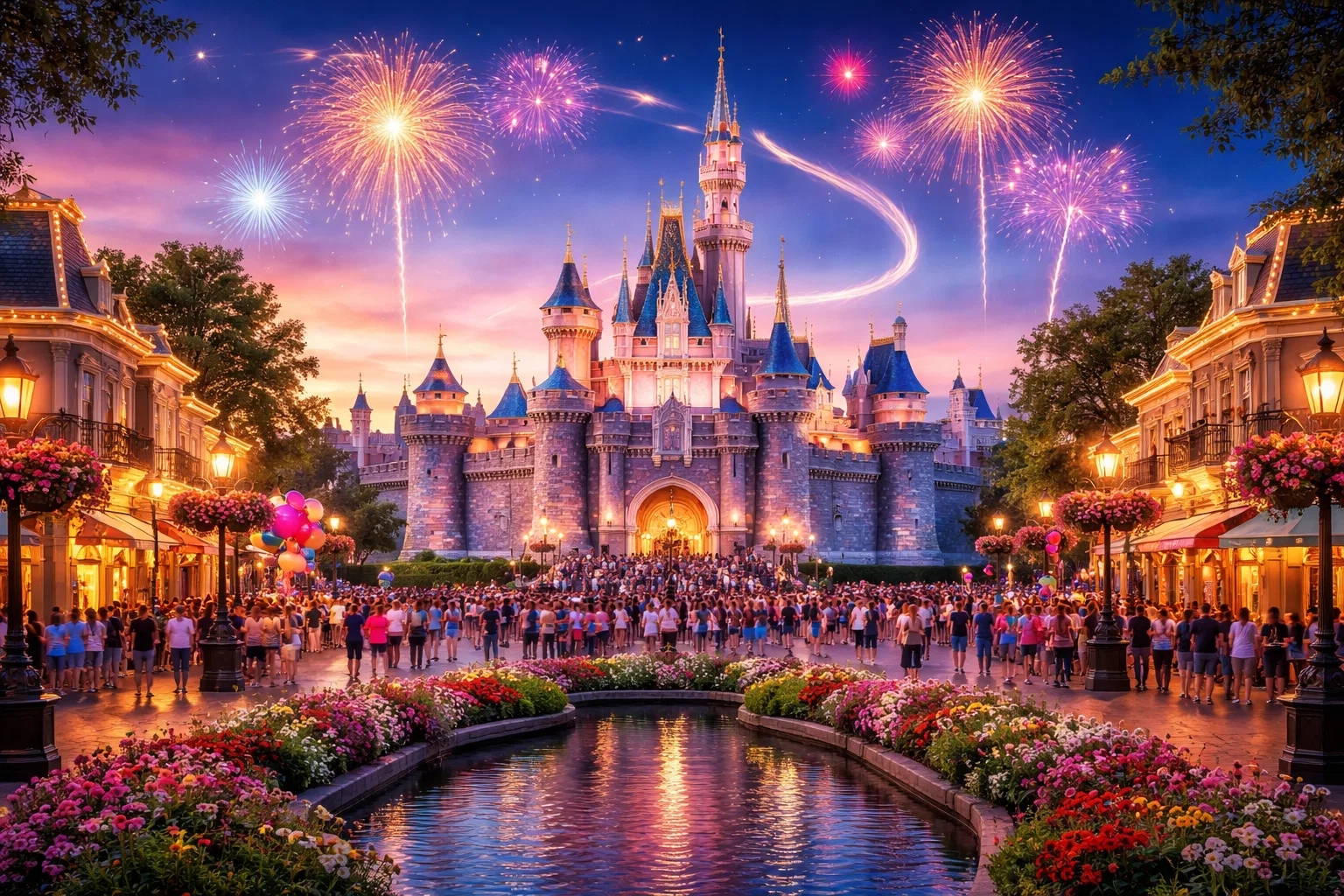
In 1955, Walt Disney bet his own fortune to build a paid park when the norm was free entry, created a layout that guides crowds like a Hollywood movie script, and used forced perspective to make everything look bigger than it is.
In the summer of 1955, just weeks before Disneyland opened, Walt Disney had a problem of the “this wasn’t in the storyboard” kind. Plumbers on strike, construction racing against time, money tight for the size of the dream, and a ridiculous choice of such practicality: finish restrooms or install drinking fountains.
It seems small, but this kind of decision shows what Disneyland really was at its core: a gigantic project pushed to the limit, with surgical improvisation and an obsession with experience.
The reality is that, post-war, Disney was far from being the impregnable empire we imagine today. The studio went through World War II producing material related to the war effort, and the cash flow wasn’t easy. Even so, he decided to do something risky: build a paid theme park, with narrative, scenery, and flow of people designed as if it were cinema, not a fair.
-
This small town in Germany created its own currency 24 years ago, today it circulates millions per year, is accepted in over 300 stores, and the German government allowed all of this to happen under one condition.

-
Curitiba is shrinking and is expected to lose 97,000 residents by 2050, while inland cities in Paraná such as Sarandi, Araucária, and Toledo are experiencing accelerated growth that is changing the entire state’s map.

-
Tourists were poisoned on Everest in a million-dollar fraud scheme involving helicopters that diverted over $19 million and shocked international authorities.

-
Hidden beneath the dense forest of the Sierra Nevada, Betoma emerges in a neighbor of Brazil as the greatest archaeological discovery of the century, revealing a colossal ancestral city covering over 18 km², with 8,334 stone structures and the potential to rewrite the history of South American civilizations.


And that’s where the story gets good. Because Disneyland wasn’t just “a park.” It became a manual on how to design a world.
A Park With a Script, Not a Pile of Rides Thrown Together
Amusement parks and fairs already existed. What was missing, in Disney’s mind, was charm with logic. The standard was to have attractions scattered, some decor here and there, and the visitor figured it out. His proposal was different: to create a place that told a story, with a sense of its own world, with innocence, purity, and a type of escapism that only cinema could deliver.
To take the dream and turn it into a blueprint, he called art director Herb Ryman, and during a frenetic weekend in September 1953, the two sketched out the initial concept of the park. From there came a decision that seems obvious today but was rare at the time: a coherent layout to control navigation and crowds.
While many parks had multiple entrances and open access, Disneyland would have a main entrance. The idea was simple and powerful: if everyone enters through the same place, the experience begins the same for everyone, from the very first step to the castle. It’s the kind of control that seems small but changes the feeling of being inside a story.
Right at the entrance, visitors find a miniature railway circling the park and, more importantly, a berm that acts as a physical and psychological barrier. It blocks the view and sound of the outside world. Then, a tunnel. Disney referred to this tunnel as the stage curtains, as it was literally the moment of stepping out of the real world and into the imagined world.
The first view inside is Main Street USA, an idealized American street, inspired by his childhood in Marceline, Missouri. From there forward comes a cinematic directing insight applied to urbanism: eye-catching visual focal points that draw people into the park, guiding their gaze and movement. The strongest of these is the castle, which functions as a lighthouse and as the center. You see it, you go.
The Invisible Engineering That Transformed Hollywood Tricks Into a Functional City
With the concept defined, came the problem that kills any dream: money. Roy Disney went to New York to seek financing, and Walt needed to assemble a team capable of building something that no one had built that way before.
The solution was to seek people who understood how to create physical illusions quickly: set designers. Part came from the studio itself, but people accustomed to building entire fake cities for films, including from big Hollywood competitors, also showed up. From there, the creation process was fluid, with constant adjustments, moving from proposal to storyboard, from storyboard to model, and from model to real structures.
The Sleeping Beauty Castle is a perfect example. It draws inspiration from Neuschwanstein Castle in Germany and was shaped based on visual references. And in one of those moments of controlled chaos, a model cleanup had engineers reassemble part in the wrong place. Disney saw it, liked it, and decided that’s how it would be. A mistake became the official design.
This spirit also appeared in attractions like Jungle Cruise. Nowadays, an attraction like this would be planned by huge teams. Back then, the art director Harper Goff basically drew on the ground with a stick, with an excavator operator watching, and that’s how the layout was born. It seems like crazy improvisation, but it was the way to beat the clock.
In the midst of this pressure, the size of the risk was brutal. When construction started, Disney already had loans around 17 million dollars, a huge amount for the time, and he put personal money at stake, selling assets and pulling resources from wherever he could. The park needed to open soon and start generating revenue quickly, preferably before the peak summer season.
According to the video from The B1M, construction began on July 16, 1954, exactly one year and one day before the inauguration, turning it into a daily race to get the essentials ready, even if it wasn’t perfect.
The War Discipline Behind the Fantasy World
To manage logistics, Disney brought in two key figures: Cornelius Vanderbilt Wood and Joe Fowler. Wood had an organizer’s profile, one of those who brings order to chaos. Fowler was a retired admiral, a veteran of two wars, used to supervising the construction of warships. He initially came in to take care of a steamboat for the park, but soon became a central piece of the entire project.
Fowler’s initial evaluation was tough: of the 20 attractions planned for opening day, only a few had a real chance of being ready. Then came the realistic strategy: prioritize what supported the narrative and cut where it could be cut. The goal was to open “good enough” and keep fixing things afterward.







Seja o primeiro a reagir!