





 Portuguese
  English
  Spanish
  4 min of reading
  0 comments


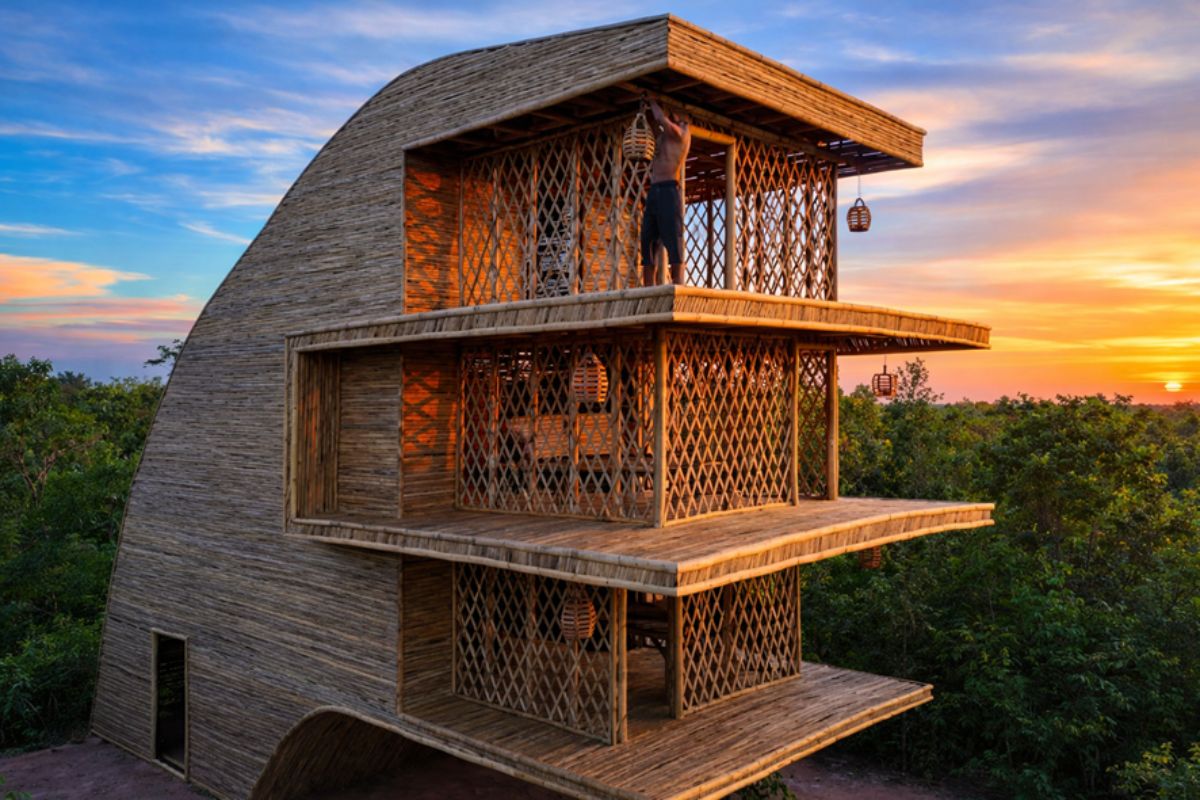
In a Vegetated Area, Two Men Built a 3-Story Bamboo House with Three Elevated Levels to Create Functional Housing, Causing Immediate Visual Impact and Catching the Attention of Those Who Follow Natural Architecture
What seemed impossible happened amidst the dense vegetation. Two men began constructing a 3-Story Bamboo House starting from just a cleared land, a central trunk anchored in the ground, and dozens of rods aligned around it.
At first, there was only compacted earth and rough structure. In the end, a vertical construction with three floors, an inclined internal staircase, side balconies, and a curved roof emerged, completely changing the visual of the complex.
It is impressive because everything was done manually. No visible concrete or metal structure. Just bamboo, repeated joints, and clear structural organization.
-
Friends have been building a small “town” for 30 years to grow old together, with compact houses, a common area, nature surrounding it, and a collective life project designed for friendship, coexistence, and simplicity.

-
This small town in Germany created its own currency 24 years ago, today it circulates millions per year, is accepted in over 300 stores, and the German government allowed all of this to happen under one condition.

-
Curitiba is shrinking and is expected to lose 97,000 residents by 2050, while inland cities in Paraná such as Sarandi, Araucária, and Toledo are experiencing accelerated growth that is changing the entire state’s map.

-
Tourists were poisoned on Everest in a million-dollar fraud scheme involving helicopters that diverted over $19 million and shocked international authorities.

The Base of the 3-Story Bamboo House Begins with Vertical Pillars and a Central Trunk as Structural Axis
The construction began with cylindrical pillars driven directly into the ground. In the center, a thick trunk served as the main axis of the structure. This detail was decisive.
Horizontal beams were fixed connecting each column. Cross braces reduced the bending of the thinner rods. The mesh formed created visible rigidity right from the first level.
The impact was immediate. The elevated base freed up lower space and defined the rectangular shape of the 3-Story Bamboo House. What was once just land became a suspended structure.
The detail that caught the most attention was the constant alignment between pillars, showing precise manual adjustment.

Assembling the Three Floors Reveals Technical Repetition and Manual Joints That Support the Structure
With the base ready, the two men began assembling the floors. Parallel bamboo rods were positioned side by side on support beams.
Each end was adjusted to reduce gaps. Smaller cross braces prevented lateral displacement. The repetition of the joint was repeated dozens of times until forming a continuous surface.
The change became clear when the second and third levels appeared. The 3-Story Bamboo House now had three well-defined platforms, all supported by the lower mesh.
Inclined panels were installed under one of the platforms, reinforcing the connection between floor and ground and increasing overall stability.

Internal Inclined Staircase Connects the Three Levels and Changes the Dynamics of the Construction
Vertical circulation was not outside. An inclined bamboo staircase was installed internally, connecting the three levels.
Flat steps were fixed between two side beams. The joint was repeated step after step, maintaining uniform spacing. The incline is pronounced, requiring constant support.
This step changed everything. The 3-Story Bamboo House now had organized internal flow. Access became an integral part of the structural construction rather than an improvised solution.
The steps were formed by small aligned rods, expanding the support area and reinforcing stability when climbing.
Lateral Closing with Vertical Rods Transforms Open Structure into Complete Volume
After the three floors were defined, external closing began. The bamboo rods were positioned vertically, side by side.
Each piece was fixed to internal horizontal beams. Rectangular frames defined doors and accesses to the balconies. In some places, perforated panels allowed light and ventilation to enter.
The transformation was evident. The open structure became a closed volume. The vertical lines reinforced the height of the 3-Story Bamboo House.
The balconies received guardrails made of bamboo lattice, expanding the usable space and creating suspended areas facing the natural surroundings.

Curved Roof Supported by Structural Arches Finishes the 3 Floors with Total Visual Integration
The final step elevated the visual impact even further. Structural arches supported dense rows of bamboo that followed the curvature from the top to the sides.
The two men worked at height supporting ladders on the façade itself. Rod by rod was fixed until forming a continuous layer over the third floor.
The result was surprising. The roof integrated the ceiling and upper walls into a single curved surface. The horizontal lines spanned the entire length to the top.
As the Colombian architect Simón Vélez, a global reference in the use of the material, asserts, “bamboo is not poor wood, it is vegetable engineering.” And this is confirmed in this engineering.
The most decisive factor was the combination of vertical pillars, horizontal beams, and upper arches. The structural repetition distributed weight across the three levels and ensured visible stability.
This construction draws attention because it shows, in practice, that a 3-Story Bamboo House can be elevated, enclosed, and functional when there is a clear structural logic and careful execution.
If you followed each step of this construction and were also impressed with the result, leave your comment and share it with those who appreciate natural architecture and smart solutions.










-

-

-

-

27 pessoas reagiram a isso.