





 Portuguese
  English
  Spanish
  3 min of reading
  4 comments


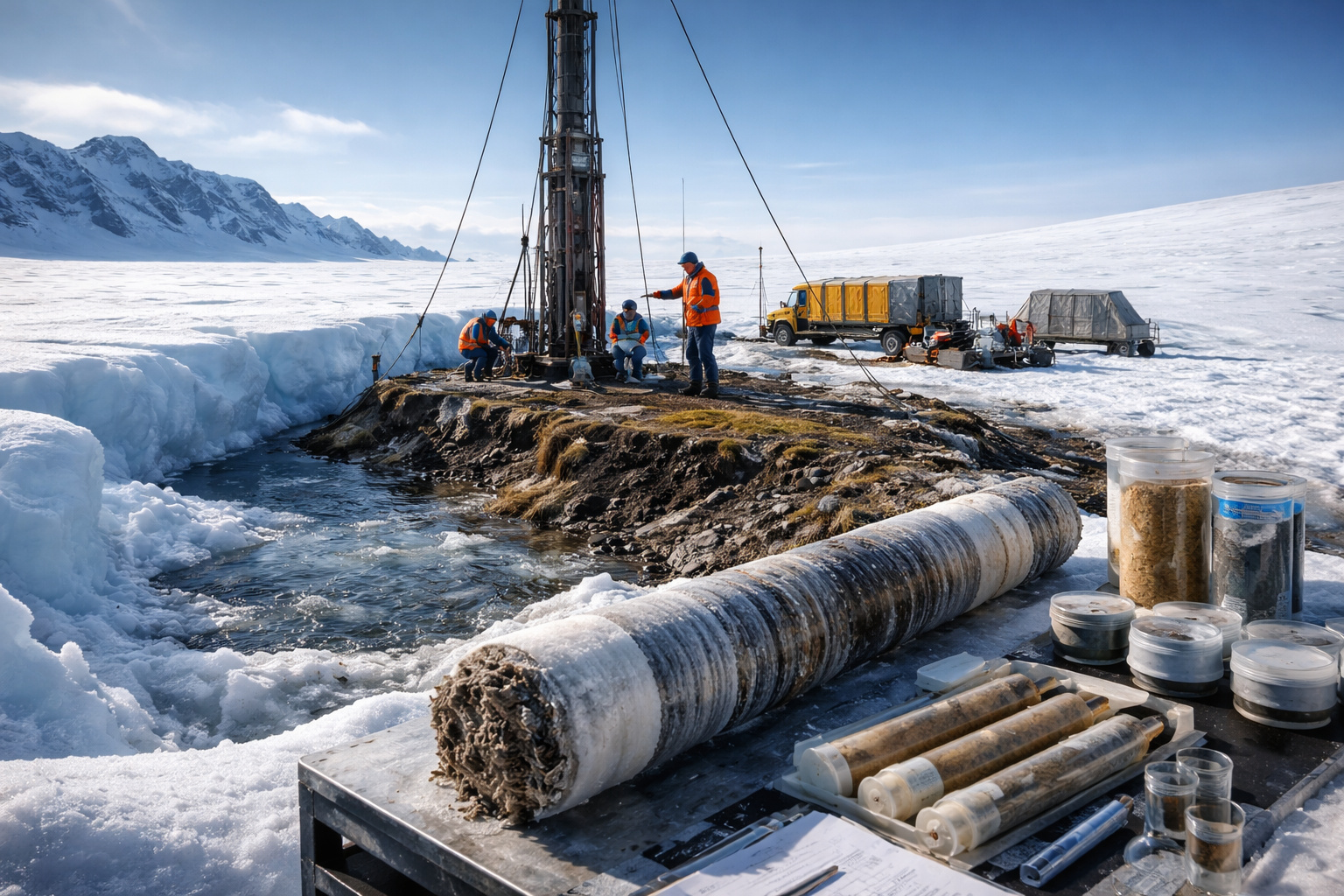


Sediment Analysis Beneath Ice Indicates That the Region Was Once Ice-Free, Changing the Historical Reading of Dome Dynamics
A significant scientific discovery relevant to the study of ancient climate was recently revealed and has begun to attract the attention of the international academic community.
Researchers identified evidence that the Greenland ice dome was exposed to sunlight approximately 7,100 years ago, contradicting the perception of continuous glacial coverage over millennia.
The finding results from deep drilling conducted in 2023, which allowed direct access to sediments preserved beneath the current ice.
This discovery reorganizes the understanding of climatic variability in the region during the mid-Holocene and reinforces the importance of long-term geological analyses.
Technical Analysis Beneath Ice Reveals Historical Change
The discovery was conducted by the GreenDrill research group, affiliated with the University of Buffalo, during a drilling operation of approximately 500 meters in the area known as Prudhoe Dome, in the interior of Greenland.
Currently covered by a thick layer of ice, the region previously exhibited environmental conditions compatible with the presence of vegetation.
According to the researchers, the sediments indicate that green grass grew in the area, highlighting a climatic interval distinct from the current scenario.
The fieldwork occurred under extreme conditions, yet still allowed for the collection of essential material for chronological analysis.
Luminescence Dating Indicates Ancient Solar Exposure
After the extraction of the samples, the scientists applied the luminescence dating technique, a method used to determine when minerals were last exposed to sunlight.
The results indicated that the analyzed rock had remained exposed for about 7,100 years, before being covered by ice again.
This period corresponds to the mid-Holocene, a phase marked by natural temperature variations in various regions of the planet.
The analysis confirms that Greenland’s glacial coverage experienced significant oscillations over recent geological time.
-
A nutritionist reveals that the real villain of your breakfast is not butter or eggs, but rather the excess of white bread, cookies, and refined sugar that you consume every day without realizing the damage it causes.

-
The Android as we know it has its days numbered after a new rule from Google that could end free APKs and completely transform the system by 2027.

-
Archaeologists use satellite technology and find a mysterious structure of 500 m² buried up to 6 meters beneath an ancient city in Egypt.

-
Supercomputer calculates when humanity may disappear from Earth, predicts a scorching supercontinent, temperatures of up to 70 degrees, and a planet moving towards becoming uninhabitable.



Scientific Publication Consolidates the Finding
Subsequently, the researchers organized the data and submitted it for scientific review.
As a result, the journal Nature Geoscience published the study on January 5, 2026, reinforcing the credibility of the work.
Furthermore, the publication details a transparent methodology, rigorous analysis, and consistent results.
Thus, the study clarifies that the finding describes a historical record and not a recent event.
Implications for Understanding Past Climate
At this point, the identification of ancient solar exposure does not indicate an immediate return of this scenario.
Nonetheless, the finding contributes to refining climate models and environmental reconstructions based on physical evidence.
By understanding when and how the ice advanced or retreated, science can contextualize natural changes in the climate system.
Consequently, this type of analysis strengthens the distinction between historical variations and contemporary phenomena.
Scientific Importance and Next Steps
Finally, the researchers emphasize that studies of this nature assess the resilience and sensitivity of ice layers over time.
At the same time, the discovery encourages further drilling and comparative analyses in other regions of Greenland.
Thus, knowledge of the climatic past becomes more robust, technical, and grounded in measurable data.
In light of this scenario, to what extent can the detailed reconstruction of ancient climate redefine how science interprets the stability of the planet’s major ice domes?









E lá se vai a teoria fuleira do aquecimento global provocado pelo sapiens!
Nem tanto Valdemir. A reportagem não leva a essa conclusão, mas sim que há 7100 atrás houve uma elevação da temperatura que derreteu o gelo local. Não significa que o aumento atual, já comprovado, esteja ocorrendo pelo mesmo motivo.
Não há nada comprovado. Existiram sim muitas previsões categóricas de mudanças drásticas que JAMAIS se confirmaram. Gente que nunca se retratou.
Antônio, significa que a natureza dá suas voltas, que o ser humano é muito pequeno em suas alterações.
Tenho amigo que morou na Noruega, por anos, dizendo que o gelo está derretendo, porém estão encontrando matéria orgânica, como folhas sob o gelo derretido.
Você não tem ideia do quanto querem fazer-nos acreditar, que as mudanças climáticas, são por interferência humana.