





 Portuguese
  English
  Spanish
  3 min of reading
  0 comments


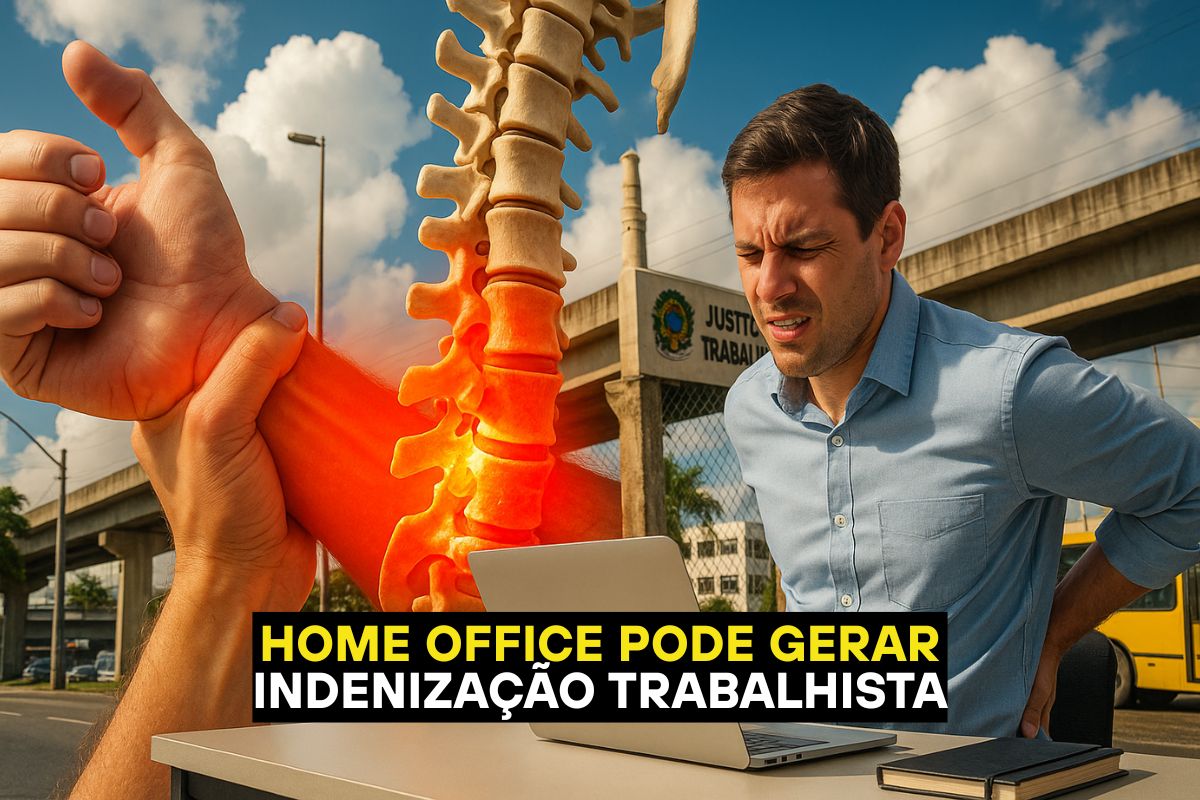
When Causal Link Is Proven, The Employee Dismissed Due To Occupational Illness Has The Right To 12 Months Of Job Security And Even Labor Compensation In Court.
Labor Compensation for occupational illness is not exclusive to those who work in factories or environments with obvious physical risks. Home office, increasingly present in the lives of Brazilians, can also be the scene of injuries that lead to leave, job security, and even financial compensation.
Cases of wrist pain, carpal tunnel syndrome, and lower back pain, when directly related to remote work, are recognized by the Justice System and the INSS as occupational illnesses. The key is to prove the so-called causal link, that is, demonstrate that the activity at work was responsible for the onset or worsening of the condition.
What Characterizes An Occupational Illness In Home Office
Even outside the physical environment of the company, the worker remains protected by legislation. Ergonomic diseases such as RSI/Cumulative Trauma Disorders, lower back pain, and shoulder and arm problems can be classified as work-related.
-
The Senate approves a bill that criminalizes misogyny, hatred, or aversion towards women, and includes the crime in the Racism Law with a penalty of up to 5 years.

-
Chamber Approves Bill That Allows Pepper Spray for Women Over 16 and Imposes Strict Rules for Purchase, Possession, and Use as Self-Defense

-
Chamber Approves Law to Combat Leucaena, Fast-Growing Plant That Dominates Land and Threatens Native Species in Various Regions of the Country

-
Asset Division: Know What Cannot Be Divided in Case of Divorce


To prove this, it is necessary to demonstrate that the problem arose or worsened due to activities performed at home, such as long hours in front of the computer without breaks, inadequate furniture, and lack of ergonomic guidelines. Home office does not eliminate the employer’s responsibility for the employee’s health.
Guaranteed Benefits And Rights
By proving the causal link, the worker can access different benefits:
- Sick leave: paid by the INSS in cases of temporary incapacity.
- Pension for permanent incapacity: granted if the inspection finds that the worker can no longer perform the activity.
- 12-Month Job Security: upon returning from leave, the employee cannot be dismissed without just cause during this period.
- Labor Compensation: in cases of negligence by the company, the employee can obtain compensation for material and moral damages in court.
These rights do not apply automatically. The burden of proof rests on the worker, who needs to gather consistent evidence.
How To Prove The Causal Link
Proof is the central point of the process. Among the most accepted evidence are:
- Medical reports and exams that describe the relationship between the disease and work.
- Issuance of the CAT (Communication of Work Accident), which can be done by the company, the union, or the worker themselves.
- Ergonomic Work Analysis (EWA), showing that the home setup did not meet basic requirements.
- Photos, videos, and activity records that evidence the inadequate conditions of the home office.
- Testimonials from colleagues or managers who can confirm symptoms or limitations during the work period.
With these elements, the worker strengthens the link between illness and professional activity, increasing the chances of recognition by the INSS and the Labor Court.
The Role Of The Employer
Even in remote work, the employer has the obligation to ensure the health of the employee. This includes providing ergonomic guidance, support for adapting the workspace, and medical follow-up when necessary.
Companies that ignore these responsibilities can be ordered to compensate the worker, especially if there is proof of omission. Brazilian justice has already recognized that the lack of ergonomic support is an indication of employer liability.
The increase in occupational diseases linked to home office shows that remote work has brought new challenges to social security and labor rights. Labor compensation can be achieved when the worker can demonstrate that their illness resulted from inadequate conditions at home.
And you, do you believe that companies are fulfilling their duty to ensure the health of employees in home office? Or do you think that workers are still unsupported? Share your perspective in the comments; your experience can enrich this debate.










-

Uma pessoa reagiu a isso.