





 Portuguese
  English
  Spanish
  3 min of reading
  0 comments


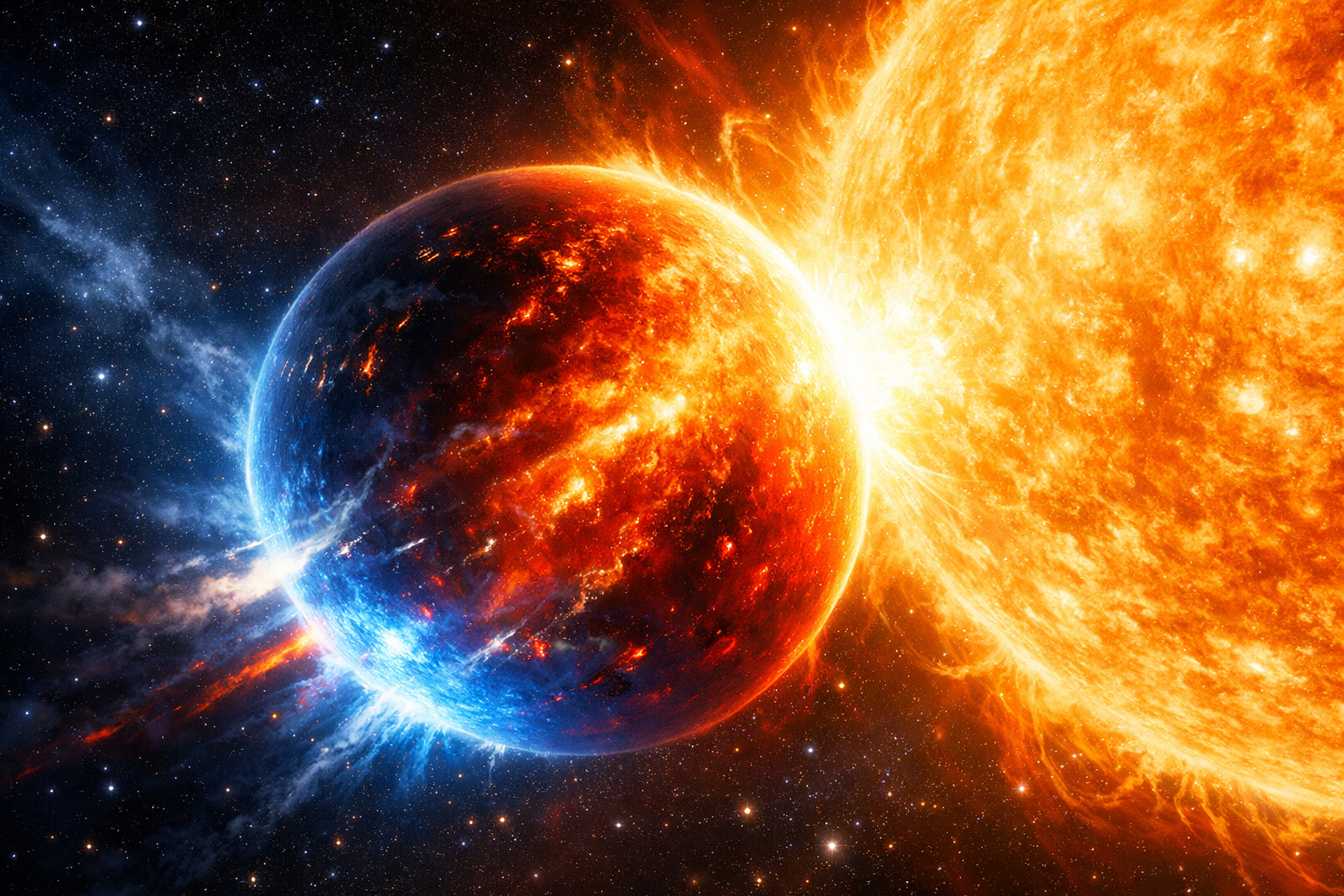
Astronomical Discoveries Reveal Worlds That Vaporize Metals, Freeze Atmospheres, and Have Survived Since the Dawn of Cosmos
Modern astronomy has been revealing a Universe that is far more extreme than previously thought.
With the advancement of telescopes and observation methods, scientists identify planets outside the Solar System that challenge known physical limits.
Furthermore, these discoveries expand the understanding of the formation and evolution of planetary systems.
At the same time, they show that the diversity of worlds is much greater than previously believed.
The information was originally published by the site The Conversation, based on data from NASA and international observatories.
Next, learn about some of the most extreme planets ever discovered, each representing an impressive record in science.
-
Friends have been building a small “town” for 30 years to grow old together, with compact houses, a common area, nature surrounding it, and a collective life project designed for friendship, coexistence, and simplicity.

-
This small town in Germany created its own currency 24 years ago, today it circulates millions per year, is accepted in over 300 stores, and the German government allowed all of this to happen under one condition.

-
Curitiba is shrinking and is expected to lose 97,000 residents by 2050, while inland cities in Paraná such as Sarandi, Araucária, and Toledo are experiencing accelerated growth that is changing the entire state’s map.

-
Tourists were poisoned on Everest in a million-dollar fraud scheme involving helicopters that diverted over $19 million and shocked international authorities.


The Hottest Planet Ever Recorded Exceeds 4,300 °C and Rivals Stars

Among all known extreme planets, KELT-9b ranks first when it comes to temperature.
This exoplanet orbits the star KELT-9 (HD 195689), which is 2.5 times more massive than the Sun.
Moreover, the star has a surface temperature close to 10,000 °C.
Due to its extreme proximity to it, KELT-9b reaches temperatures exceeding 4,300 °C during the day.
This value surpasses the temperature of many known stars.
It is only about 1,100 °C below the surface of the Sun, which registers 5,500 °C.
As a result, metals like iron and titanium vaporize in the planet’s atmosphere.
Therefore, KELT-9b behaves more like a cosmic furnace than a traditional planet.
From Almost Absolute Zero to the Largest Planet Ever Cataloged by NASA

On the opposite extreme, the exoplanet OGLE-2005-BLG-390Lb is the coldest ever identified.
Its temperature reaches –223 °C, just 50 degrees above absolute zero.
Although it has 5.5 times the mass of Earth, it orbits a low-energy red dwarf star.
As a result, almost all gases in its atmosphere have solidified on the surface.
Not surprisingly, researchers have nicknamed it “Hoth”, in reference to the icy planet from Star Wars.
Meanwhile, the largest known planet is DENIS-P J082303.1-491201 b.
It has 28.5 times the mass of Jupiter, according to NASA’s exoplanet archive.
This value is so high that scientists are debating whether it can still be classified as a planet.
Curiously, its host star is also a brown dwarf.
The Smallest Detected Planet and the Oldest Known in the Universe

The smallest exoplanet ever discovered is Kepler-37b.
It is only slightly larger than the Moon and smaller than Mercury.
Because it orbits very close to its star, the planet has high temperatures.
Thus, it cannot maintain liquid water on its surface.
The oldest known planet is PSR B1620-26 b.
It has an estimated age of 12.7 billion years.
This means it formed when the Universe was still young.
It’s worth noting that the total age of the cosmos is calculated at 13.8 billion years.
Additionally, the planet orbits a rare system composed of a pulsar and a white dwarf.
This configuration challenges traditional models of planetary survival.
Conclusion
Together, these planets demonstrate how extreme and unpredictable the Universe is.
Some burn like failed stars, while others freeze completely.
Moreover, there are worlds that have existed since almost the beginning of the cosmos.
Each discovery pushes the boundaries of scientific knowledge.
At the same time, these observations raise new questions about the origin of planets.
In the face of such extreme planets, how far do you think science can go in discovering new worlds?










-

-

-

-

6 pessoas reagiram a isso.