





 Portuguese
  English
  Spanish
  6 min of reading
  0 comments


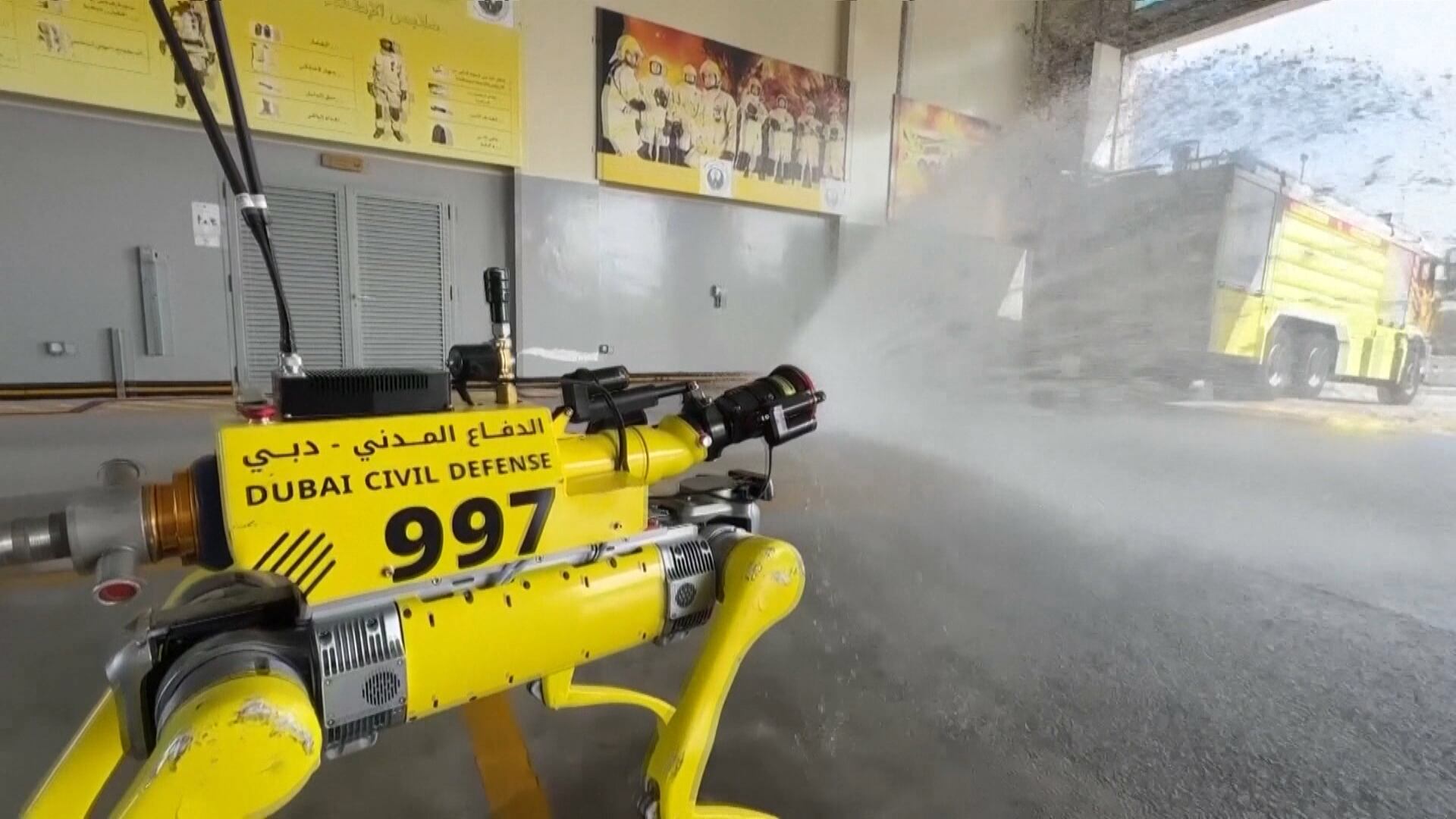
Dubai uses robots to fight fires with jets of 2,400 L/min, reducing human risks and inaugurating a new era of AI in firefighting.
In February 2026, Dubai Civil Defence confirmed the operational adoption of ground robots in firefighting in high-risk environments, marking a significant change in how emergencies are faced in the emirate. According to a report by GDnonOnline, the equipment, operated remotely, had already been used in real fires since the beginning of the year, including scenarios with toxic gases, chemical fires, and extreme heat. The technology was publicly presented at Intersec 2026, where the corporation detailed that the system can launch water at up to 60 meters and pump 2,400 liters per minute, creating a new layer of protection for operations in areas where human presence poses a high risk.
The initiative is part of the broader movement of the United Arab Emirates to incorporate automation, robotics, and artificial intelligence into critical public services. In this context, robots do not replace firefighters but instead act on the front lines of incidents in warehouses, industrial facilities, and contaminated environments, taking on direct exposure to fire, extreme heat, and hazardous substances. According to authorities and technical reports released in 2026, the main change is operational: humans no longer enter the most dangerous areas first, while machines take on the initial exposure, enhancing safety and response capacity in complex emergencies.
Firefighting robots operate with jets of 2,400 liters per minute
One of the most impactful aspects of this technology is the hydraulic capacity of the robots used in Dubai. Equipped with high-pressure cannons, these systems can launch up to 2,400 liters of water per minute, a volume comparable to that of large industrial equipment.
-
The rain has already exceeded the limit in Rio Grande do Sul, and now the worst is coming: an extratropical cyclone and gusts of 80 to 100 km/h, with a risk of flooding, power outages, and high waves on the coast of Rio Grande do Sul tomorrow.
-
The Brazilian Air Force brings together 13 countries and over 1,200 military personnel in Campo Grande for the largest multinational natural disaster response exercise ever held in Brazil, featuring simulations of forest fires and high-complexity aerial rescues.
-
Sony is preparing the best video game in history with the PS6 expected in 2027, a native handheld running current games, a PlayGo system similar to Smart Delivery, savings of up to 70% in storage, and a new architecture based on the unified SDK 13.

-
The day when 1,825 mm of rain fell in 24 hours: a world record recognized by the WMO on Réunion Island shows how tropical cyclones and extreme terrain can produce absurd amounts of precipitation.

This power allows for efficient firefighting in large-scale incidents, especially in environments where the intensity of the flames and temperature make direct human intervention unfeasible. In addition to the water volume, the jet’s reach can extend to about 60 meters, allowing the robot to operate from a distance from the main fire source.
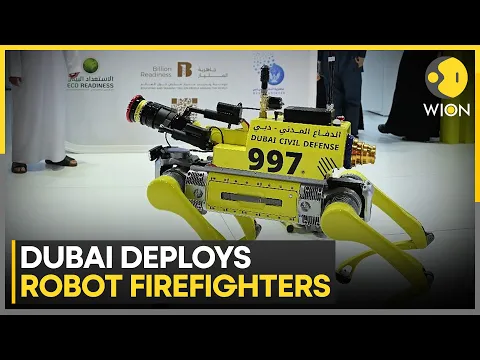

This level of performance transforms the robot into a direct attack tool against fire, capable of containing intense flames without exposing human teams to immediate risk, something that just a few years ago relied exclusively on manual operations.
Thermal sensors and intelligent systems allow for precise identification of heat sources
The operation of these robots does not depend solely on mechanical force. They are equipped with advanced sensors that enhance the ability to analyze the environment in real-time. Among the embedded systems are thermal cameras, temperature sensors, and gas detection devices.
These resources allow for the identification of critical points of the fire, even in low visibility conditions caused by dense smoke. Based on this information, human operators can direct the water jet with greater precision, directly attacking the hottest areas and reducing the spread of flames.
The combination of sensors and remote control creates a kind of “augmented vision” of the fire, allowing for quicker and more assertive decisions, which is essential in scenarios where every second influences the outcome of the operation.
Robots have already been used in real fires in industrial areas of Dubai
The use of this technology is not limited to tests or demonstrations. In 2026, firefighting robots were employed in real incidents, including fires in industrial warehouses in the Ras Al Khor region, one of Dubai’s most important logistics areas.
During these operations, the robots acted directly in combating the flames while human teams coordinated the strategy from a distance. The result was the containment of the fire without any reported injuries among the firefighters involved.
The application in real scenarios is one of the main indicators of technological maturity, showing that robotics has already surpassed the experimental stage and is now integrated into critical emergency operations.
High-risk environments drive the adoption of robotics in firefighting
The decision to use robots in this type of operation is directly linked to the level of risk present in certain scenarios. Industrial fires, for example, may involve chemical substances, flammable gases, and unstable structures, significantly increasing the danger for human teams.
Moreover, extreme heat and toxic smoke limit firefighters’ operational time, requiring constant rotations and increasing the complexity of the operation. In this context, robots offer a clear advantage.
They can operate for extended periods in conditions where human presence would be unfeasible, maintaining the continuity of firefighting without interruptions caused by physical limitations, which increases the efficiency of the response.
Resistance to extreme heat and continuous operation enhance response capacity
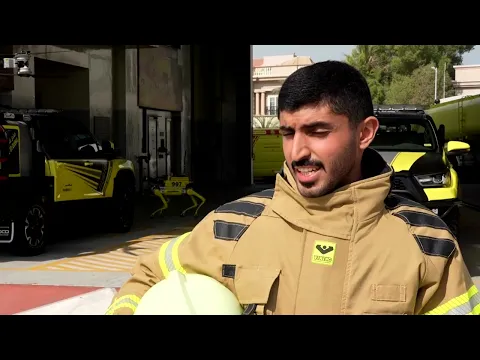
The robots used by Dubai Civil Defence are designed to withstand extreme conditions. They have thermal protection systems, fire-resistant components, and structures capable of operating in high-temperature environments.
Additionally, they feature cooling and sealing systems that allow for continuous operation even under intense exposure to water and heat. This resistance increases operational time and reduces the need for frequent replacements during prolonged operations.
The operational durability of this equipment allows for maintaining constant pressure on the fire, preventing the flames from gaining strength again, something common in situations where human intervention needs to be interrupted for safety.
Hybrid model combines human decision-making with robotic execution
Despite technological advancements, robots do not operate completely autonomously. The strategy adopted in Dubai follows a hybrid model, where decision-making remains under human control, while the execution of the most dangerous tasks is delegated to machines.
Operators remotely control the robots, adjusting positioning, jet direction, and intensity of operation according to the evolution of the fire. This model ensures flexibility and keeps the human factor at the center of decisions.
The technology acts as an extension of the team, enhancing capabilities without replacing human command, which reduces risks and increases the overall safety of the operation.
Emirates strategy expands the use of artificial intelligence in public services
The use of robots in firefighting is part of a broader strategy of the United Arab Emirates to integrate advanced technology into public services. The country has invested in automation, artificial intelligence, and autonomous systems in various areas.
In addition to civil defense, projects include policing with robots, autonomous vehicles, and intelligent urban monitoring systems. The goal is to increase efficiency, reduce risks, and position the country as a global reference in innovation applied to public management.
The incorporation of robotics into critical operations reinforces this positioning, showing that technology is already being used in high-complexity scenarios with a direct impact on public safety.
Technology marks the transition of AI from the digital to the physical world
For years, artificial intelligence has evolved mainly in digital environments, with applications focused on data analysis, process automation, and content generation. The use of robots in firefighting represents a significant change in this scenario.
AI now acts directly in the physical world, controlling machines capable of interacting with real environments and performing tasks that require strength, precision, and endurance.
This transition expands the reach of technology and paves the way for applications in areas where human risk is high, such as construction, mining, and rescue operations.
Current limitations still require constant human supervision
Despite advancements, technology still presents significant limitations. Robots depend on human control for decision-making and do not have complete autonomy to handle complex and unpredictable situations.
Moreover, the high cost and need for specialized maintenance may limit large-scale adoption, especially in countries with lower investment capacity.
These limitations indicate that robotics in firefighting is still in an expansion phase, with growth potential as technology becomes more accessible and advanced.
Firefighting enters a new phase with the integration of humans and machines
The use of robots by Dubai Civil Defence signals the beginning of a new phase in firefighting, marked by the integration of human teams and automated systems. This combination allows for faster, safer, and more efficient responses in high-risk scenarios.
By taking on dangerous tasks, robots reduce firefighters’ exposure and enhance operational capacity in extreme environments. At the same time, human control ensures flexibility and adaptation to unforeseen situations.
The trend is for this model to expand to other regions of the world as technology evolves and becomes more accessible, transforming the way emergencies are managed.
And you, do you believe that robots should take on more and more dangerous functions instead of humans?
Leave your opinion in the comments and tell us if this technology could become standard in firefighting in other countries in the coming years.




Seja o primeiro a reagir!