






 Portuguese
  Spanish


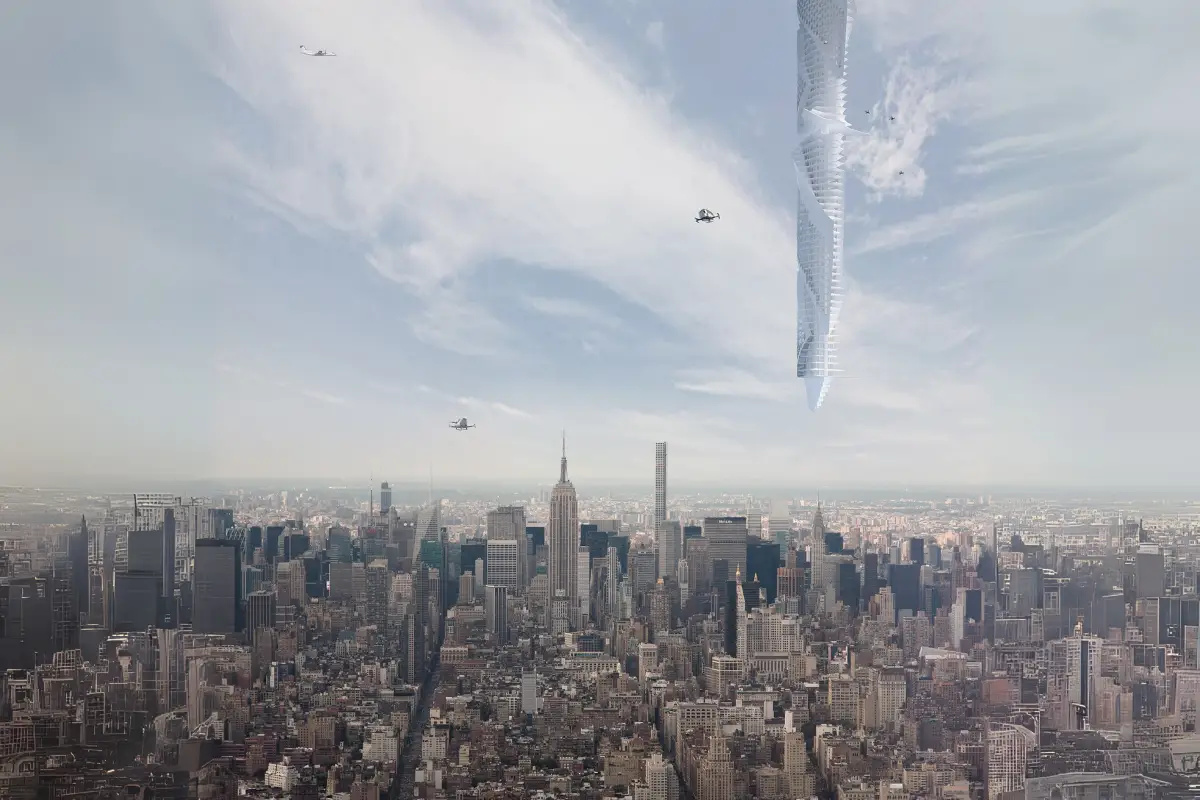


Analemma Tower: The Skyscraper That Would Defy Gravity and Hang in the Sky. Dubai Could Be the Stage for the Most Audacious Work in the History of Modern Construction.
The craziest construction project in the world! Imagine looking at the horizon of Dubai and seeing, above the Burj Khalifa, a new structure that doesn’t start from the ground, but descends from space. This is the vision proposed by the New York-basedClouds Architecture Office, responsible for a concept that has sparked debates in the world of engineering and architecture: the Analemma Tower, askyscraper that would be tethered to an asteroid in orbit.
The project sounds futuristic and even fanciful, but raises real questions about the future of construction and urban life on the planet.

A Foundation That Starts in Space
Unlike any structure ever imagined on Earth, the Analemma proposes to completely invert the logic of civil engineering.
-
Billionaire says the most valuable skill will help overcome job elimination caused by AI, following Bill Gates’ fears

-
A Dutchman created a ‘box’ that makes trees grow in the desert almost without water and without irrigation: the invention has already brought seedlings to dozens of countries and achieves up to 90% survival where common planting did not exceed 10%.

-
Abandoned warehouse hid a giant collection of rare computers, with over 2,000 artifacts from the 1930s to the 1980s.
-
Scientists warn that melting ice is triggering an alarming chemical transformation in preserved areas, and the first signs are already concerning researchers worldwide.




The building would not have foundations embedded in the ground, but would instead be suspended by high-strength cables connected to an asteroid placed in ageosynchronous eccentric orbit.
This system, dubbed theUniversal Orbital Support System (UOSS), utilizes principles similar to those of the space elevator, but in a reversed manner.
“The Analemma Tower inverts the traditional diagram of a foundation based on Earth, relying on a space foundation from which the tower is suspended,” explains the official website of Clouds Architecture Office.
The Orbital Trajectory and The Chosen Destination
The movement of the building would be as spectacular as its conception. The asteroid would trace a figure-eight orbit around the planet, allowing the tower to travel daily between the northern and southern hemispheres.
At points where the speed is lower, occupants would have the chance to interact with the surface.
The route was designed so that the slowest point occurs over New York, but the initial construction was planned for Dubai, where engineering costs for large buildings can be up to five times lower than in Manhattan, according to the New York Post.
Continuous Solar Energy and Recycled Water
One of the project’s advantages would be its self-sufficiency. As the tower would be positioned above the atmosphere, solar panels would have continuous access to sunlight, ensuring much higher energy efficiency than conventional power plants.
Water would also be managed sustainably, through a semi-closed recycling system, with replenishment from cloud condensation and rain collection.
In practice, the structure would function as an independent ecosystem, capable of sustaining its inhabitants without relying on external resources.
The Challenge of Extreme Height: Construction Could Reach Impressive 32,000 Meters
The structure could achieve an impressive altitude of 32,000 meters, surpassing any limits previously imposed by engineering. This height would provide advantages, such as about 45 extra minutes of sunlight per day, but would also bring considerable challenges.
The highest levels of the tower would be exposed to temperatures of up to -40 °C and near-zero atmospheric pressure, conditions that would require special protection for occupants.
For internal transportation, the proposal includes the use of cable-less electromagnetic elevators, a technology that would eliminate the physical limitations of current constructions.
A Futuristic Vision of Construction Still in the Theoretical Realm
Despite the fascination, the Analemma Tower remains a conceptual exercise. Engineer Ahmad Sabirin Arshad of SIRIM Berhad stated to the Gulf News that the project “is a radical idea but remains in the conceptual field as it depends on technologies that are still unavailable on a practical scale” (Gulf News).
Among the main obstacles is the need to capture and reposition an asteroid in a stable orbit, something NASA studied through the Asteroid Redirect Mission but ultimately canceled.
Additionally, the cables needed to support the weight of the structure would only be viable with materials like carbon nanotubes or graphene, substances that cannot yet be produced on an industrial scale.
A Manifesto on the Future of Construction
Even if it never comes to fruition, the proposal from Clouds Architecture Office should not be seen only as fantasy. Just as skyscrapers redefined cities in the 20th century, ideas like the Analemma Tower serve as conceptual laboratories that push the boundaries of what is possible.
The vision of Clouds is, above all, a manifesto about human capacity to imagine and plan radical ways to inhabit the planet or even space.
And you, would you live in a skyscraper hanging in the sky? The future of architecture may seem distant, but projects like this compel us to rethink our very notion of city and housing. What sounds impossible to many is just a matter of time for others.
Leave your comment: would you live in a tower hanging from an asteroid? Share this article and take the discussion further.





ESSA **** DE PAIS NAO TEM ESGOTO, QUE É O MINIMO NESCESSÁRIO….IMAGINA FAZER ESSA PERIPÉCIA….FACAM ME O FAVOR NÉ ….BANDO DE **** …
Já saem do planeta com dificuldade, e acham que isso vai funcionar? 🤦🏻♂️
Bom pra ser sugestão pra um tema filme 🙂 futurista… Mais antes criar uma estação espacial tipo um residencial de auto luxo…e ficar orbitando o planeta…