





 Portuguese
  English
  Spanish
  4 min of reading
  0 comments


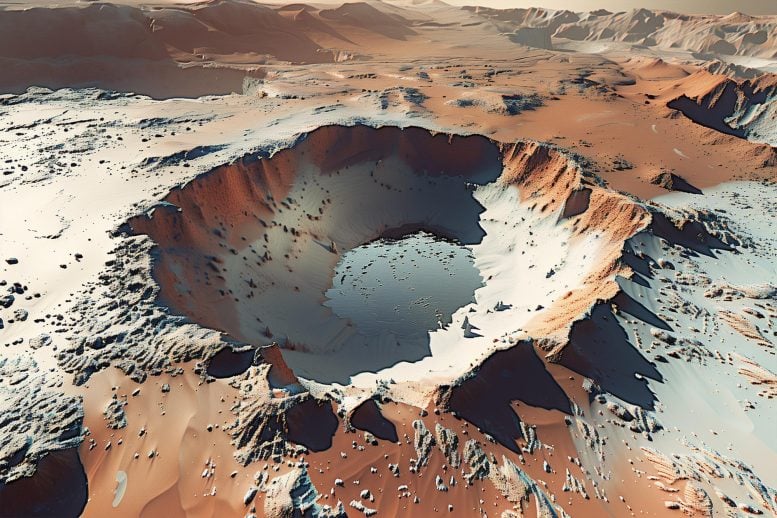
Scientists Explain The Reasons That Make The Search For Liquid Water On Mars A Great Challenge, Despite Promising Signs On Its Surface And Atmosphere.
The search for water on Mars has always sparked the imagination of scientists and the general public. Despite advances made over the decades, recent studies suggest that the presence of liquid water on the Red Planet may be even rarer than previously thought.
Recent research indicates that intriguing characteristics, such as the so-called recurring slope lineae (RSLs) and brines, may not be as promising as once imagined.
First Theories About Water On Mars
Over a century ago, the astronomer Percival Lowell speculated that Mars harbored artificial canals designed by intelligent Martian civilizations.
-
While the world looks at oil, the war with Iran is already disrupting helium supply from Qatar, affecting car and iPhone chips, threatening AI expansion, and putting pressure on aluminum packaging at the highest value in four years.

-
Global warming will expose a treasure hidden under the ice of Antarctica and may spark an international dispute over gold and valuable minerals.

-
A street vendor from Praia Grande built a robot made of scrap from scooters and washing machines that pulls his popcorn cart on the beach, emits sounds, and interacts with customers, becoming an attraction on the coast of São Paulo.

-
The specifications of the Xiaomi 18 Pro Max have been leaked, and the highlight is a dual 200 MP camera with a new 22-nanometer technology that promises to consume less energy and capture details in shadows and bright areas using LOFIC HDR.


These canals would function to transport water from the polar ice caps to the drier, lower regions of the planet.
While fascinating, this idea was refuted with the evolution of telescopes, which demonstrated the nonexistence of these canals. Still, Lowell’s hypothesis solidified the search for liquid water on Mars as a priority goal of science.
Since then, the presence of water on Mars has been considered essential for the possibility of life on Mars.
However, the planet’s extreme conditions challenge this idea. With extremely low temperatures, a thin atmosphere, and little humidity, liquid water tends to freeze, evaporate, or boil quickly on Mars.
Despite this, scientists continue to explore scenarios where water could persist in liquid form.
Discoveries Of Recurring Slope Lineae (RSLs)
One of the most studied phenomena is the RSLs, which are dark streaks observed on Martian slopes. These streaks appear during the warmer seasons and disappear when temperatures drop, suggesting a seasonal pattern that may be related to water.
However, detailed studies indicate that these streaks may be the result of flows of sand and dust, without any direct connection to liquid water.
Another intriguing clue is the polygonal and striped formations in Martian permafrost, which some scientists have linked to thermal and hydric cycles.
Additionally, brines, highly concentrated salt solutions, are also often pointed to as a possible reservoir of liquid water on Mars.
New Evidence Challenges Existing Theories
Despite expectations, a study recently published in the Proceedings of the National Academy of Sciences of the United States of America (PNAS) suggests that finding liquid water on Mars in the short term is unlikely.
The paper, titled “The Elusive Nature of Martian Liquid Brines,” was led by Vincent Chevrier of the Arkansas Center for Space and Planetary Sciences and Rachel Slank, a researcher at the Lunar and Planetary Institute.
Chevrier has over 20 years of experience studying Mars and has always been committed to the search for signs of liquid water. However, he warns that the current evidence is still inconclusive. “I wanted to write this paper a long time ago because there is a lot of confusion and misinterpretations about water on Mars,” Chevrier explained.
The researchers analyzed the RSLs and concluded that these formations are more consistent with movements of sand and dust than with flows of water.
Furthermore, data provided by Martian orbiters do not support the hypothesis that water plays a significant role in the creation of these structures.
Martian Brines: The Key To Liquid Water?
Many scientists believe that brines, highly saline solutions, may be the best chance of finding liquid water on Mars. These liquids freeze at much lower temperatures than pure water, making them a viable alternative on a planet with such extreme average temperatures.
On Mars, salts known as perchlorates are especially promising. For example, a calcium perchlorate brine can remain liquid down to -75ºC.
With the average temperature at the Martian equator hovering around -50ºC, these solutions could theoretically exist underground.
However, the study by Chevrier and Slank highlighted several limitations that make this hypothesis less optimistic. They pointed out that the available quantities of salts, vapor pressure conditions, and the location of ice significantly hinder the formation of brines in relevant amounts.
In addition, even if these solutions exist, they would be highly inhospitable to any known form of life on Earth.
Implications For Life On Mars
Despite the limitations, researchers do not entirely dismiss the possibility of biological adaptations. Martian organisms, if they exist, may have developed mechanisms to survive in such extreme conditions. However, this idea remains speculative.
Scientists also emphasize the importance of continuing to investigate the presence of brines. Aside from their implications for life, these solutions directly impact planetary protection.
Inadvertent contamination by terrestrial microorganisms could compromise the search for native Martian life.
The next steps in Mars exploration include developing more sensitive instruments to detect small amounts of brines and accurately identifying the most promising locations to investigate them.
Laboratory experiments under Martian conditions will also be necessary to simulate real scenarios and refine search techniques.
Chevrier concluded: “Despite our best efforts to prove otherwise, Mars remains a cold, dry desert that is completely uninhabitable.” His statement reflects the challenges and reality of space exploration.










Seja o primeiro a reagir!