





 Portuguese
  English
  Spanish
  5 min of reading
  0 comments



A New Type of Wood Promises to Rival Steel by Combining Lightness, High Strength, and Lower Environmental Impact, Emerging as an Innovative Alternative for Civil Construction and Industrial Design.
A startup from the United States has commercially launched a type of engineered wood that promises strength-to-weight ratio up to ten times greater than steel and mass up to six times lighter.
Named Superwood, the material is manufactured by InventWood, a company co-founded by materials scientist Liangbing Hu, a global reference in cellulose research.
The aim is to compete with metals in architectural applications and furniture, offering high mechanical performance and a better environmental footprint.
-
Friends have been building a small “town” for 30 years to grow old together, with compact houses, a common area, nature surrounding it, and a collective life project designed for friendship, coexistence, and simplicity.

-
This small town in Germany created its own currency 24 years ago, today it circulates millions per year, is accepted in over 300 stores, and the German government allowed all of this to happen under one condition.

-
Curitiba is shrinking and is expected to lose 97,000 residents by 2050, while inland cities in Paraná such as Sarandi, Araucária, and Toledo are experiencing accelerated growth that is changing the entire state’s map.

-
Tourists were poisoned on Everest in a million-dollar fraud scheme involving helicopters that diverted over $19 million and shocked international authorities.


What Is Superwood and Why Is It Noteworthy
According to InventWood, Superwood remains wood “from a chemical and practical perspective,” but undergoes a treatment that reorganizes cellulose and reduces internal porosity.
The process combines controlled chemical bathing and hot pressing, stages that collapse cells and significantly increase density and fiber bonding.
In engineering terms, the gain comes from the maximum utilization of the “most abundant biopolymer on the planet”, cellulose, the structural basis of plants.
The technology derives from studies initiated over a decade ago when Hu’s team demonstrated that densifying common woods multiplies strength and toughness.
At that time, the researchers also created transparent versions of the material by removing part of the lignin, a component that gives color and some rigidity to natural wood.
The ultimate goal, however, was different: to make wood significantly stronger without losing identity, appearance, and workability.
From Bench to Market: The Leap from Research to Production
The decisive breakthrough occurred in 2017, with a treatment that increased wood strength and improved its stability.
From there, Hu and collaborators refined the process, accumulating over 140 patents and structuring InventWood to scale production.
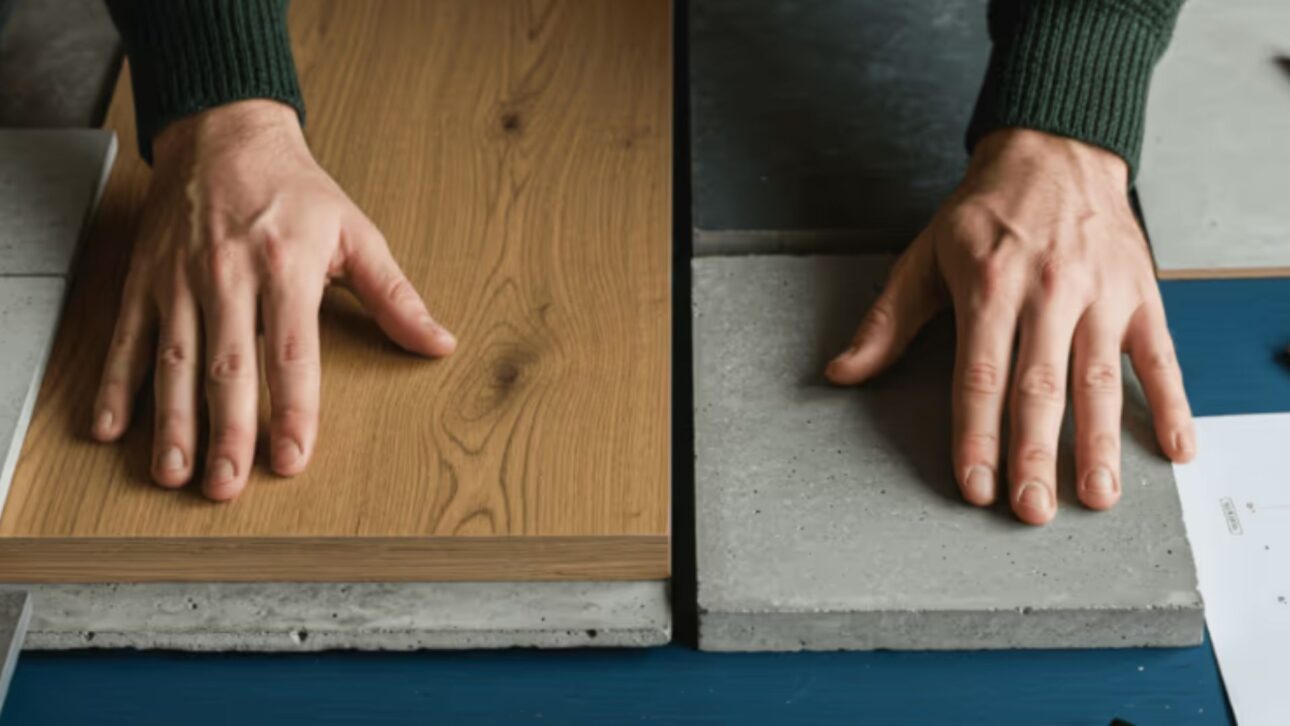
Today, production takes place in Frederick, Maryland, with cycles measured in hours, and the company claims it is scaling capacity as demand grows.
For CEO Alex Lau, the main virtue is the combination of lightness and performance.
“From a chemical and practical standpoint, it is wood,” he stated.
In buildings, this could enable structures potentially up to four times lighter than current ones, relieving foundations and increasing resistance to seismic shocks.
In internal tests, the company claims Superwood is up to 20 times stronger than common wood and ten times more resistant to dents, thanks to the collapse and hardening of the cellular network.
Fire Resistance and Durability: What Has Been Measured
The company reports that the material achieves Class A in standardized fire reaction tests, the highest rating in the reference protocol, without relying on added chemical retardants.
Densification reduces the availability of oxygen in the pores and hinders the spread of flames.
The treatment also creates a barrier to fungi and insects, and reduces moisture expansion and contraction, typical weaknesses of traditional wood.
Although they cost more than conventional boards and have a higher manufacturing carbon footprint than untreated wood, Superwood panels, according to InventWood, emit about 90% less CO₂ than steel in equivalent production.
The industrial goal, says Lau, “is not to be cheaper than wood, but to be competitive with steel” as scale progresses.
First Uses and Plans to Expand Scope
InventWood prioritizes external applications at the outset, such as facade cladding and decks.
Next, the plan is to expand offerings for internal uses, such as panels, flooring, and furniture.
In the CEO’s assessment, the performance opens up the possibility to replace metal components that are currently critical to the lifespan of furniture.
“People always complain that furniture breaks over time, and that usually happens because they give way or break at the joints, which are currently made of metal because wood is not strong enough,” he said.
Superwood, he adds, can act in joints, screws, nails, and other fasteners, reducing failure points.
Large-scale structural projects are still on the horizon.
An entire building made of Superwood, the company acknowledges, will require more tests and certifications before becoming a reality.
The point, however, is that the material “looks like wood and, when you test it, it behaves like wood”, says Lau, “except it’s much stronger and better than wood in practically every aspect we’ve tested.”
How It Differs from Known Engineered Woods
The market has dealt with reconstituted wood products for decades, such as MDF, plywood, and CLT.
In these, the strength gain comes from the rearrangement of layers or particles and the use of adhesives.
In Superwood, the approach is distinct: it is not about gluing pieces together, but rather altering the microstructure of the wood itself, reinforcing the cellulose matrix.
In terms of design and construction, this preserves grain, texture, and workability, but with mechanical properties that approach those of metals and alloys in scenarios where strength-to-weight ratio is decisive.
Raw Material and Process Adaptability
In theory, any woody species can enter the line.
In practice, InventWood has already tested 19 types of wood and also bamboo, with positive results according to the company.
This flexibility tends to facilitate the use of underutilized species and localized production, without tying performance to a single type of tree.
From an environmental standpoint, the possibility of storing carbon for long periods in high-performance panels and components appears as an additional attractive factor compared to emission-intensive materials.
What Is Needed to Compete with Metals in Construction
To gain widespread acceptance, Superwood will need to navigate technical standards, prove durability in the field, and demonstrate total cost competitiveness in real projects.
Scale gains could reduce prices, while longer life cycles and lighter installation could offset the initial investment.
Validation through independent testing and pilot projects in different climates will be critical to define the limits and best uses of the material.
In the meantime, InventWood is ramping up production and organizing its portfolio for the commercial phase.
The company claims that demand already exceeds initial supply, and that expansion will include lines dedicated to external products and, later, internal solutions, with early communication to customers who made reservations.
If reinvented wood can indeed replace steel in significant parts of construction, what applications do you consider most promising to prove this transition in the everyday life of construction sites?









-

Uma pessoa reagiu a isso.