





 Portuguese
  English
  Spanish
  3 min of reading
  0 comments


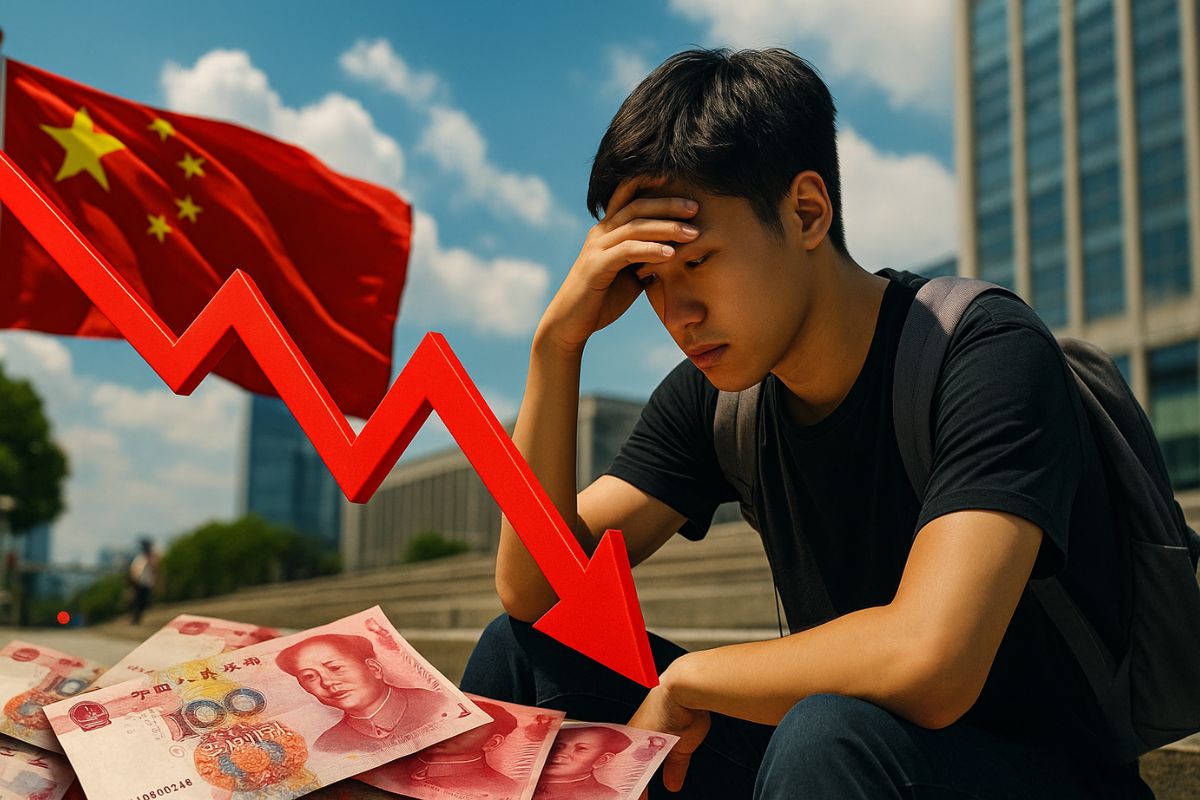
Deflation, Crisis in the Real Estate Sector, Youth Unemployment, and Fall in Internal Consumption Sound Global Alert
The Chinese economy, the second largest in the world, is showing increasingly clear signs of collapse. The current scenario combines factors such as decline in internal consumption, growing deflation, real estate crisis, and high household savings, which has led to direct comparisons with the “lost decade” experienced by Japan in the 1990s.
According to analysis by UVP Capital, despite China’s GDP growing by 5.3% in the first half of 2025, this growth is unsustainable in the long term, as it heavily relies on exports. Internally, consumer confidence continues to decline, domestic economic activity is cooling, and the stimuli adopted by Xi Jinping’s government are not having an effect.
What Are the Warning Signs of the Chinese Economy?
Deflation is currently the biggest fear among economists monitoring China’s performance. Unlike inflation, which raises prices, deflation indicates a widespread decrease in prices, which discourages consumption and paralyzes the economy. The Chinese people have opted to save rather than spend, which contradicts the government’s efforts to encourage consumption.
-
The largest food company on the planet, JBS, has just opened a 4,000 square meter laboratory in Florianópolis to develop customized proteins that modulate muscle mass gain, immune response, and metabolic performance.

-
After nearly 30 bids and competition among industry giants, a Spanish company purchases one of the largest airports in Brazil for almost R$ 3 billion and takes over the management of Galeão in a concession that will last until 2039.

-
The Federal Revenue Service now automatically cross-references everything you declare with data from banks, credit cards, brokerage firms, and insurance companies, and any discrepancy between your income and your expenses triggers an alert in seconds.

-
Amid global tensions, Brazil blocks the United States’ proposal at the WTO and paves the way for a trade crisis and possible retaliations.

In the first six months of 2025, the Chinese deposited more than 10.7 trillion yuan, while new loans totaled only 1.17 trillion. As a result, net savings reached 78 trillion yuan, an absolute record and a clear sign of aversion to consumption.
Why Is This Happening?
Even with stimulus attempts such as subsidies for vehicle exchanges and increased pensions, the population remains retracted. Furthermore, the real estate market, historically the engine of Chinese growth, has faced depreciation of up to 15% in used properties since 2021.
It is estimated that the total loss of household wealth is 103 trillion yuan, equivalent to 77% of the 2024 GDP.
This feeling of paper wealth loss leads consumers to hold back even more on spending. At the same time, youth unemployment among those aged 18 to 25 is on the rise, with more than 6 million out of the labor market, further reducing the potential for recovery through domestic means.
Is the Economic Model Running Out?
Despite good performance in exports, China shows structural imbalances. Internal consumption does not keep pace with external growth, making the model vulnerable to global shocks, such as trade wars and sanctions.
If the United States or Europe decide to raise tariffs, China’s dependence on exports could become an even greater bottleneck.
Furthermore, the rapid aging of the population is concerning: one-third of Chinese will be over 60 by 2050. The government is already trying to encourage families to have more children, but without success so far.
What Does This Have to Do with Japan?
The similarities with the Japanese crisis of the 1990s are striking. Both countries faced real estate bubbles, price collapses, and consumer reactions based on saving.
The consequence in Japan was a decade of stagnation, with meager growth and persistent deflation, and analysts fear that China is following the same path.
According to UVP Capital, the Chinese problem could be reversed with vigorous and swift stimuli, but time is running out. Public confidence needs to be restored for the consumption cycle to start turning again.
What Are the Global Impacts?
China represents 18% of global GDP. If it slows down, the entire international trade feels it. Commodity-exporting countries like Brazil are already closely watching the developments.
The decline in Chinese appetite could affect prices of iron ore, soybeans, oil, and reduce revenues for giants like Apple, Nike, and luxury conglomerates that depend on Chinese consumption.
Do you believe that China will manage to escape this economic trap? Does the current situation remind you of the Japanese crisis of the 1990s? Leave your analysis in the comments; we want to hear your views on the direction of the global economy.








-

-

2 pessoas reagiram a isso.