





 Portuguese
  English
  Spanish
  4 min of reading
  0 comments


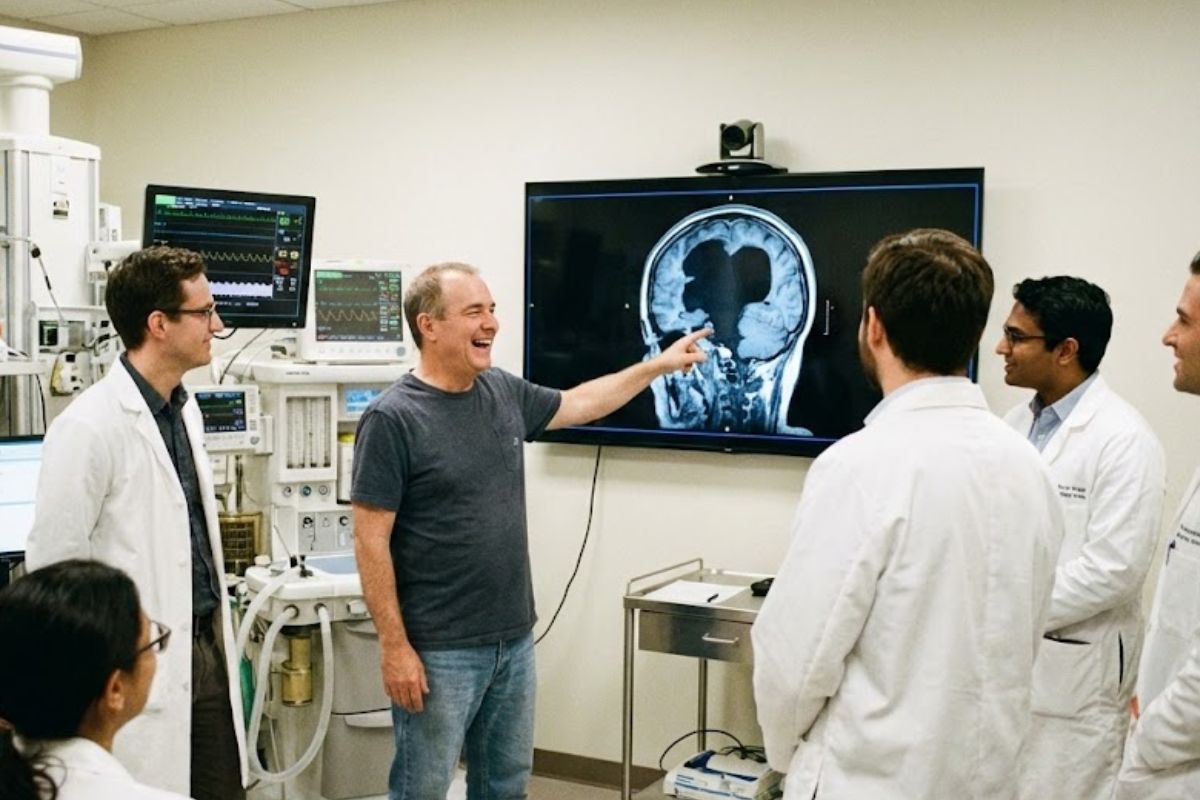
The Brain of This Man, Examined After Weakness in the Leg, Seemed Reduced to a Thin Layer Compressed by Fluid, Typical of Hydrocephalus, but His Routine Remained Stable: Family, Job, and Driving. Since Images Published in The Lancet in 2007, the Episode Pressures Theories of Plasticity and Consciousness on a Rare Scale Today.
At 44 years old, a Frenchman sought a hospital after noticing weakness in his leg and ended up on a tiny list of cases that challenge common sense about the brain. Tests showed the skull was largely filled with fluid, with only a thin layer of brain tissue preserved, a condition described as hydrocephalus.
The data supporting the perplexity is not just anatomical: he continued with a life considered normal, with family, work, and driving. An IQ test administered at the time recorded 84, a result below average, but compatible with social adaptation and autonomy, according to cognitive psychologist Axel Cleeremans from the Free University of Brussels.
What Doctors Saw in the Exam and Why the Brain “Disappeared” Almost Entirely

Hydrocephalus is a condition in which there is abnormal accumulation of fluid within the skull, which can compress the brain over time.
-
With a cost per shot close to zero, the DragonFire laser could change naval warfare in 2027 and provide British ships with nearly unlimited defense against drones.

-
A British startup creates tires that generate electricity in electric vehicles when passing over potholes, speed bumps, and cracks.

-
Scientists have created robots made with living cells that have their own nervous system, swim on their own, explore the environment, and self-organize without any genetic engineering, and now they want to do the same with human cells.

-
Students create a solar-powered ambulance that operates without a plug, without fuel, and still keeps medical equipment running in remote areas.

In the described case, the image that shocked researchers was precisely the disproportion: much fluid, little visible brain tissue, yet with everyday functioning preserved.
The story gained traction because the brain, in most popular narratives, is treated as “hardware” with little margin for structural loss.
Here, the most plausible hypothesis presented by researchers is that the compression occurred slowly, allowing for gradual functional reorganization, rather than acute and abrupt damage that would immediately impair capabilities.
The “Normal” Routine and the Detail That Prevents a Fantastical Reading of the Brain
The case does not describe superperformance: an IQ of 84 suggests cognitive limits and reinforces that the central point is adaptation, not genius.
Nonetheless, marrying, working, and driving with such a compressed brain challenges expectations about how much “mass” would be indispensable for autonomy.
This contrast also prevents easy shortcuts, such as turning the episode into a miracle without criteria.
What appears, more consistently, is a brain operating with less available tissue than the standard, but probably with circuits reorganized over time.
In technical terms, the question shifts from “how is this possible?” to “which functions were preserved, which were lost, and what compensations existed?”.
Human Plasticity at the Limit and the Real Dispute Over Consciousness
Axel Cleeremans interpreted the case as an extreme example of plasticity, the brain’s ability to adapt.
At the same time, he pointed out the theoretical impact: such episodes challenge consciousness models that depend on very specific neuroanatomical regions as a mandatory condition for conscious experience.
The discussion is especially sensitive because “consciousness” is often treated as something that should “turn off” when large parts of the brain become unavailable.
The case suggests another path: consciousness might depend more on learning and functional reorganization than on a single fixed “center.”
Therefore, the episode was cited by Cleeremans at a conference of the Association for the Scientific Study of Consciousness in Buenos Aires as an open problem for current theories.
What This Case Changes in the Public Conversation About the Brain and What It Does Not Prove
The case changes the debate by showing that the relationship between structure and function in the brain may be less linear than it seems, especially when the alteration is slow.
It also reinforces a methodological caution: looking only at an image and inferring cognitive capacity can be misleading, because the brain is a dynamic system, with multiple possible routes to sustain skills.
At the same time, it does not prove that “any brain works” nor that consciousness is independent of biology. It shows that, under specific conditions, the brain can surprisingly redistribute functions.
The unsettling question remains precisely because it is narrow and technical: what is the necessary functional minimum to maintain identity, autonomy, and conscious experience, and under what conditions does this minimum sustain itself?
In the end, the story disturbs because it does not deliver a comfortable answer about the brain and consciousness, only a real limit that forces everyone to recalibrate certainties. If you had to bet, do you think what keeps us “ourselves” lies more in the amount of brain, in the way it learns throughout life, or in the combination of both? And what kind of evidence would genuinely convince you?








-

-

-

-

7 pessoas reagiram a isso.