





 Portuguese
  English
  Spanish
  5 min of reading
  0 comments


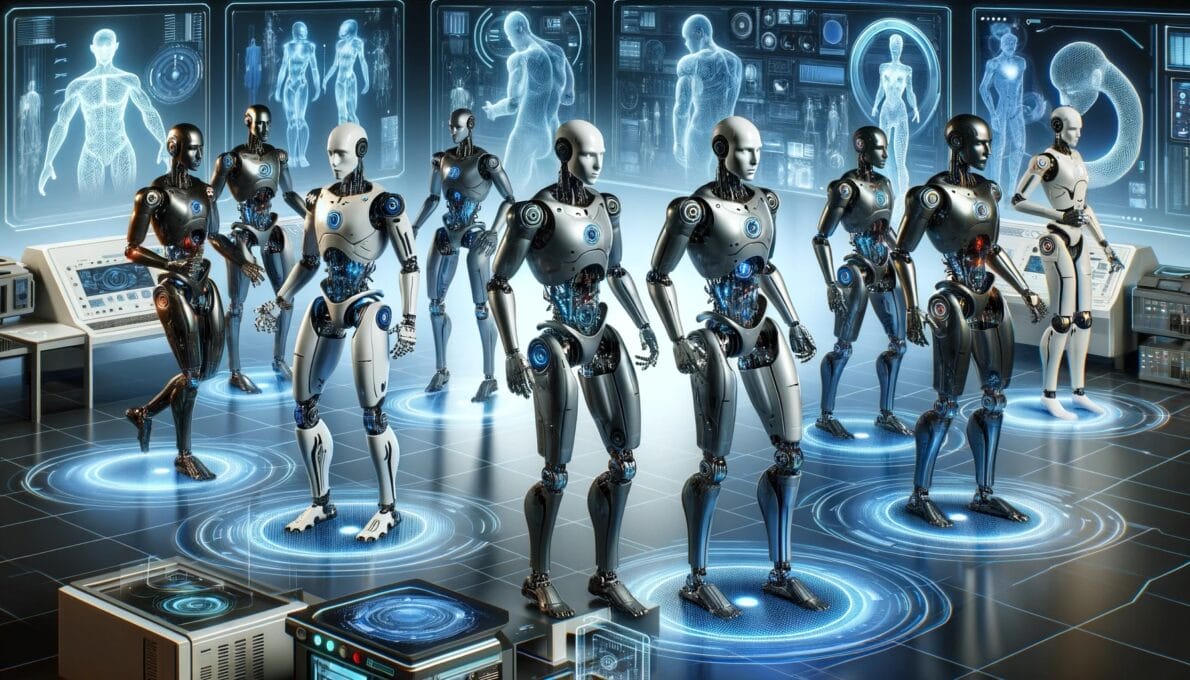
Robotics Advances Rapidly: Meet 8 New Humanoid Robots That Look Like They Came Out of Sci-Fi Movies. In Recent Years, the Field of Robotics Has Made Significant Progress, with Companies Investing Billions of Dollars.
In this article, we will explore the innovations that are revolutionizing the world of robotics. Leading companies are developing humanoid robots that seem to have come out of science fiction movies. Surprisingly, some companies are already employing robots in their logistics centers. Discover 8 new humanoid robots that are attracting a lot of attention and redefining the future of technology.
1st – Mesmer


Let’s start by talking about the world of robotics and artificial intelligence, specifically about Mesmer, which stands out as a platform that brings to life a new generation of incredibly realistic humanoid robots.
Combining cutting-edge technology in animatronics, software, and sensors, Mesmer enables the creation of artificial characters with smooth movements, as well as complex facial expressions and natural interactions with the environment.
-
A “silent skill” is allowing Brazilians to earn up to R$ 22,000 per month without a degree and become indispensable for companies that rely on millions of data to survive.

-
Researchers at the Toyota Research Institute found that if a human uses robotic arms to flip a pancake 300 times in an afternoon, the robot learns to do it on its own the next morning, and this is currently the most promising method to solve the biggest bottleneck in modern robotics.

-
Goodbye iron: a common item in households is starting to lose space to technology that smooths clothes in minutes without an ironing board and with less energy consumption.

-
Antarctica reveals an unusual clue high in the Hudson Mountains, and what appeared to be just an isolated rock began to expose a secret hidden under the ice for ages.


This technology opens up opportunities for the use of these robots in various situations. In entertainment, for example, they can become stars of movies, shows, and performances, providing immersive and enjoyable experiences for the audience.
Founded in 2015 by a group of visionary engineers and artists, Mesmer offers a comprehensive platform for the development of new customized humanoid robots through advanced hardware, intuitive software, and new development tools.
2nd- iCub

The iCub is one of the new next-generation humanoid robots that brings a new vibe to artificial intelligence and its interaction with the world itself. Developed by the Italian Institute of Technology and part of a European Union initiative, it stands out as a research tool for the world of human cognition, as well as motor skills and social interaction. With 50 degrees of freedom, the iCub moves fluidly and realistically, mimicking human movements with precision.
Its sensors allow it to see, hear, and touch, capturing information from the world around it. Inspired by neuroscience, its artificial intelligence processes this information, enabling it to learn, memorize, and perform new tasks autonomously. It not only learns but also interacts with the world in a natural and intuitive way.
3rd- Robô Popo

The Opera and Musical Theater Research Center at the University of Sussex embarks on a very interesting journey, exploring human-robot interaction in the realm of operatic performance. Through more ambitious research, the center presents the robotic opera project. In June 2021, the project brought to life two memorable performances: the robot Po and robot Op.
In the first, the robot Po flawlessly recited poems, enchanting the audience with its synchronized movements and expressive intonation. The robot Op, on the other hand, surprised everyone with its powerful voice and impeccable movements, interpreting operatic arias with great fidelity and emotion.
4th – G1

The rapid rise of Unitree in the field of new humanoid robots continues to impress. The recent launch of its H1 robot, known for its acrobatics and agility, was followed by the announcement of a new and even more advanced model: the humanoid G1.
The newly launched G1, offered at a starting price of US$ 16,000, represents a leap in both accessibility and functionality.
This price is even somewhat more accessible compared to its predecessor H1, which costs US$ 90,000. The G1, in addition to improving the price, also shows enhanced capabilities that include functional robotic hands and an advanced sensor system that includes 3D, LiDAR, and a depth camera.
The durability of the G1 is also noteworthy, with the company highlighting its ability to recover from intense physical interactions such as kicks and punches, which is a skill that will be useful in more intense environments.
5th – Abel

Forelab presents Abel, a next-generation humanoid robot that redefines realism and interaction between humans and machines. With its curious design and cutting-edge technology, Abel represents a difference in robotics, showcasing a future where artificial intelligence becomes increasingly integrated into our reality.
With the appearance of a boy between 11 and 12 years old, Abel has 42° of freedom, allowing for fluid and natural movements. Its soft and flexible skin simulates human texture, while its eyes (cameras) and ears (microphones) capture the world around it with precision.
Abel’s cognitive system, inspired by neuroscience, allows it to process information from various sources, whether through images, sounds, or sensors. This ability to learn and adapt to the environment makes Abel unique, bringing natural and intuitive interactions with humans.
6th – OOS SIM

The Institute of Robotics and Mechatronics of the German Aerospace Center (DLR) has developed something innovative in the field of space operations, the OOS-SIM, an on-orbit servicing simulator. This high-tech simulator has been designed to accurately replicate the microgravity conditions of space, greatly facilitating the training and development of critical maintenance, repair, and assembly missions for satellites in orbit.
This simulator utilizes two large industrial robots that collaborate to create a realistic simulation environment, and these new humanoid robots are equipped with highly sensitive arms capable of performing the precise and delicate movements needed for manipulating satellites and other space equipment.
The absence of gravity is simulated by these robots, which support and maneuver objects as if they were in space. Another instinctive feature of OOS SIM is its ability to simulate the complex orbital dynamics and lighting conditions found in space.
7th – David

The robot David is continually being expanded into a complete humanoid robot. Currently, it has two arms, a neck, and a head. David will be employed in a human-friendly environment, and for that, the robot must resemble a human as closely as possible.
In terms of size, strength, and flexibility, David’s mechatronic concept is based on powerful brushless motors, combined with highly integrated power and digital electronics. Its high-performance actuators are thin and lightweight, as their drives are embedded in the forearms.
8th – Astribot S1

The final humanoid robot is the Astribot S1, which emerges as the new reference in robotics, changing the ability of robots to perform the most complex household tasks, and this advancement promises to transform the landscape of domestic robotics, providing a more practical and autonomous execution of activities that were once exclusive to humans.
The arrival of the Astribot S1 signals a significant change in this landscape. This humanoid robot stands out for its enhanced skills, combining agility and speed that approach human capabilities, and what makes this robot even more remarkable is its complete autonomy, operating without any intervention or remote control.
Among its feats, the Astribot S1 can fold T-shirts, open bottles with corks and screw tops, vacuum the house, and even peel vegetables, among other tasks.







Seja o primeiro a reagir!