





 Portuguese
  English
  Spanish
  5 min of reading
  0 comments


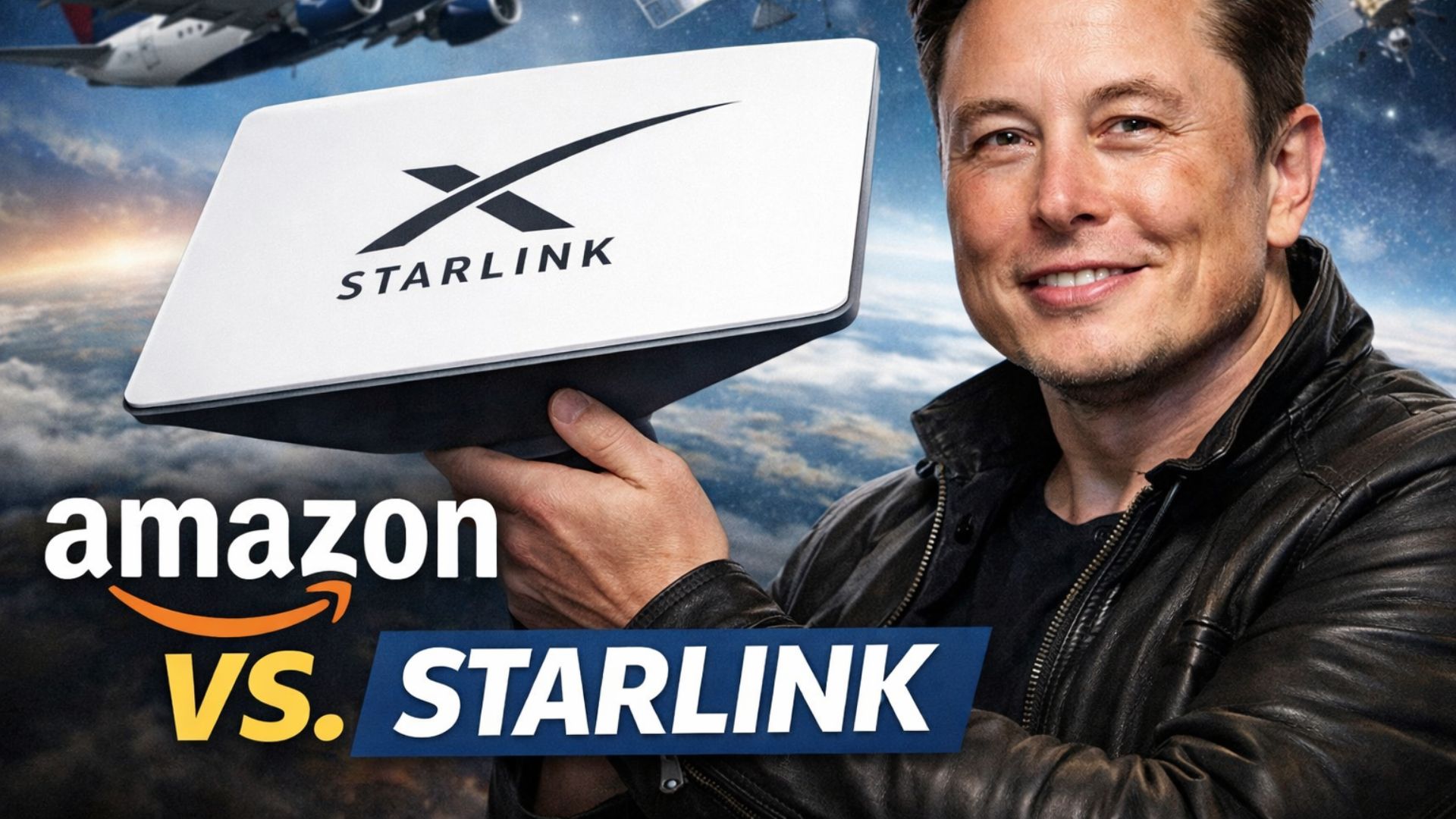
Dispute between Amazon and SpaceX reaches the cabin and redefines in-flight Wi-Fi, with billion-dollar contracts, a race for satellites, and direct impact on the experience of millions of passengers around the world.
The dispute between Amazon and SpaceX has fully entered the passenger cabin. Delta Air Lines announced on March 31, 2026, a long-term agreement to adopt the Amazon Leo network in a significant part of its fleet, with initial installation in 500 aircraft starting in 2028, a move that increases competition with Starlink, SpaceX’s service that has already made inroads into the air connectivity market.
Delta’s decision carries weight because it involves one of the largest airlines in the world and connects the next phase of in-flight Wi-Fi to a system that is still expanding.
In a statement, the company indicated that the partnership also builds on the existing relationship with Amazon Web Services, signaling that the negotiation goes beyond internet access and fits into a broader strategy of digitizing operations and personalizing the passenger experience.
-
Collapse in sight in Iraq: satellite images captured by NASA show the country’s largest reservoir dramatically drying up.

-
Archaeologists open a tomb in Luxor and find 3,000-year-old papyri still sealed in a ceramic vessel, alongside colorful coffins stacked in 10 rows and linked to the mysterious singers of Amon.

-
Before the space shuttle existed, NASA put a “wingless airplane” made of wood to fly at over 190 km/h towed by a car and then launched from a C-47, and this strange experiment practically proved that it was possible to re-enter the atmosphere and land on a runway like a conventional airplane.

-
In Japan, a 150 kg humanoid robot named AIREC has begun testing to assist patients, change diapers, and alleviate a crisis where there is only 1 candidate for every 4.25 positions for elderly caregivers.

Delta’s turnaround in the Wi-Fi game
With Delta, Amazon secures a contract with global visibility in a segment where Starlink had taken the lead.
Reuters reported that Jeff Bezos’s company had already closed a deal with JetBlue, the first airline to adopt the then Project Kuiper service, and is now competing more aggressively in a market where speed, low latency, and stability have become not just technical advantages but also influence brand positioning.
This shift helps explain why in-flight connectivity has become such a sensitive showcase for satellite internet companies.
For years, in-flight Wi-Fi was associated with unstable connections, irregular coverage, and extra fees.
With low-orbit networks, the expected standard has changed, and the service has begun to be treated by several companies as part of the value proposition to passengers, rather than just an ancillary revenue source.
Delta’s strategy fits into this new scenario.
By linking the agreement with Amazon Leo to the expansion of Delta Sync Wi-Fi and digital experiences at the seats, the company indicates that it sees connectivity as a central element of the customer journey.
Instead of functioning solely as a convenience, access to the network becomes integrated into the logic of loyalty, content personalization, and real-time operational data collection.
Why Starlink got there first
While Amazon tries to carve out space, SpaceX has already built a more mature position in the sector.
Reuters reported that Starlink has agreements with companies like United, Alaska, and Southwest, in addition to negotiations on various fronts in commercial aviation.
This advantage is not only explained by Elon Musk’s brand strength but also by the network’s stage, the scale of the constellation, and the ability to place satellites in orbit at a higher cadence.
In the case of United, the company itself announced that it accelerated the deployment of Starlink and reiterated its intention to bring the system to its entire fleet.
The company also stated that access will be free for customers enrolled in MileagePlus, reinforcing a trend already observed in the sector: transforming connectivity into a loyalty benefit, rather than just a separately charged item during the flight.
The scale of Starlink also remains an important differentiator.
According to Reuters, the service surpassed 6 million customers in at least 140 countries, serving consumers, businesses, governments, and operations related to U.S. national security.
This reach helps consolidate the perception that SpaceX is not just competing for isolated contracts but is trying to transform its network into an operational reference for different markets, including aviation.
Where Amazon tries to balance the race
Amazon’s response involves combining orbital infrastructure with its corporate strength in cloud and technology.
In the annual letter to shareholders published on April 9, 2026, CEO Andy Jassy stated that Amazon Leo already has significant revenue commitments from companies and governments and mentioned Delta among the clients expected to boost the operation.
He also indicated that the broader commercial launch of the service is expected in mid-2026.
Still, progress depends on a concrete challenge: gaining scale in space.
Reuters reported at the end of March that Amazon had 214 satellites in orbit, after starting operational launches in April 2025.
A few days later, a new launch raised the total to 241 satellites, a number still far from the target needed to sustain a constellation of 3,236 satellites authorized by the FCC.
The company also requested a two-year extension from the Federal Communications Commission to meet the regulatory obligation of positioning half of the initial network by July 2026.
The request shows that Amazon’s commercial ambition has already gained significant clients but remains contingent on the pace of launches and the ability to close the gap with Starlink, which operates at a much larger scale.
The divergent choices of airlines
Not all companies in the sector, however, have reached the same conclusion about the best model.
In January 2026, Ryanair publicly rejected Starlink.
In an interview with Reuters, CEO Michael O’Leary stated that installation would incur fuel penalties due to weight and drag, as well as high costs for an operation focused on short flights, an assessment that triggered a public exchange of criticisms with Musk.
On the other hand, other carriers have gone in the opposite direction.
The Lufthansa Group announced in January 2026 an agreement to gradually introduce Starlink starting in the second half of the same year, with the goal of equipping the entire fleet by 2029.
SAS also reported on March 24, 2026, that it became the first airline in Europe to implement the service on an Airbus A320, with expansion subject to regulatory approvals.
This contrast reveals that satellite connectivity is not a uniform solution.
The decision depends on the profile of the air network, the duration of routes, the type of passenger, and the operational calculations of each company.
On longer flights and in companies competing for premium customers, fast internet tends to gain weight as a perceived differentiator.
In low-cost models and short segments, the calculation may be different.
What is at stake above the clouds
That is why the agreement between Amazon and Delta has an impact beyond the number of aircraft.
The airline is not just switching internet providers.
It is giving Amazon a showcase on a global scale in an environment where passengers quickly perceive the difference between technological promise and delivered service, and where connectivity has begun to influence reputation, loyalty, and commercial competitiveness.
At the same time, Amazon’s offensive prevents Starlink from turning its lead into uncontested dominance in commercial aviation.
The battle for in-flight Wi-Fi has effectively become an industrial maturity test for low-orbit constellations.
Each new contract requires robust coverage, continuous launches, technical integration with aircraft, and a financial model capable of convincing companies that operate under constant pressure for costs and efficiency.







Seja o primeiro a reagir!