





 Portuguese
  English
  Spanish
  5 min of reading
  0 comments


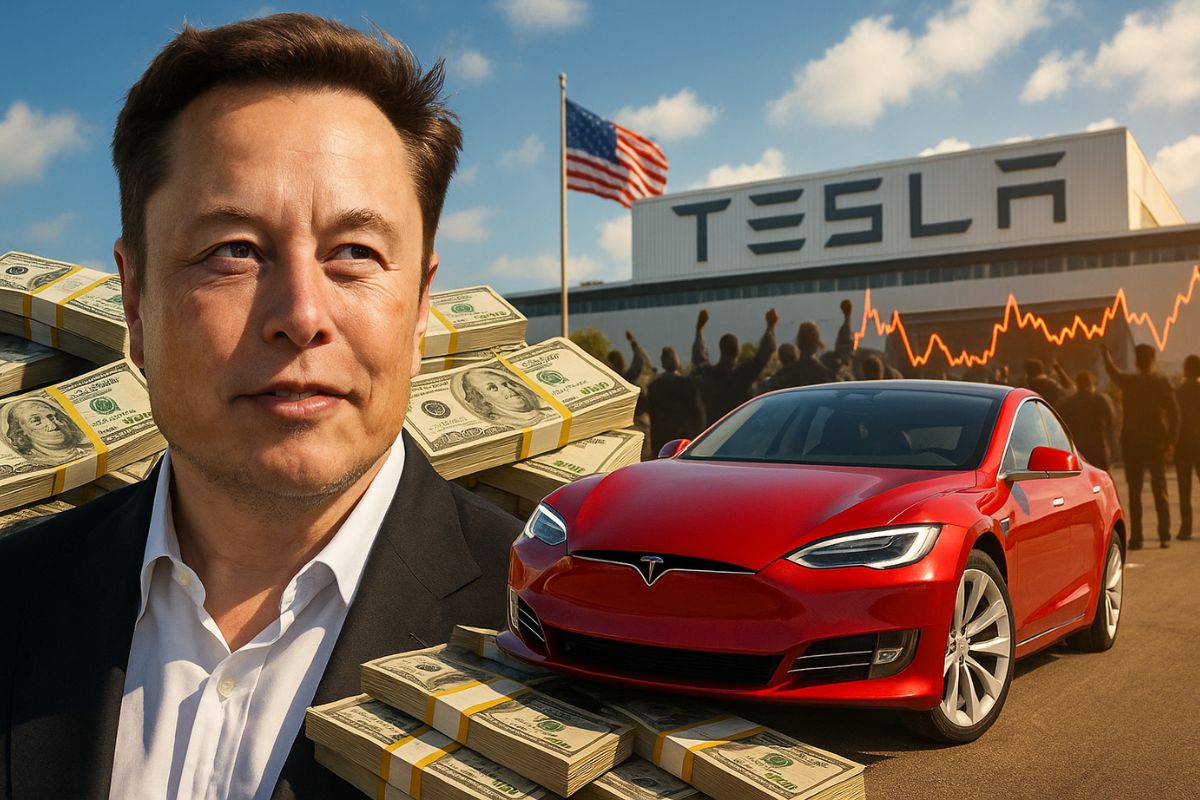
Shareholders Validate Long-Term Compensation Plan That Could Make The Executive The World’s First Trillionaire If Appreciation Goals, Vehicle Autonomy, And New Products Are Met Over The Next Decade
According to the G1 portal, Tesla approved an unprecedented compensation package for Elon Musk that, if fully realized, could make the executive the world’s first trillionaire. The proposal received significant support from shareholders and was presented as a way to keep the founder at the forefront of the company’s growth strategy at a time when the electric vehicle market is experiencing a slowdown and increasing competition.
The plan ties most of the earnings to Tesla’s future performance. Musk will only reach the level of the world’s first trillionaire if he delivers on a combination of aggressive goals, which involve a significant increase in the company’s market value, concrete progress towards full autonomy, positioning in robotics products, and expansion of the technological base. It is a compensation marked by risk, dependent on regulatory decisions and investor behavior.
How The Compensation Package Was Approved
The shareholder vote recorded approximately 75 percent support for the package, showing that the majority of investors still see Elon Musk as a central figure for Tesla’s expansion. The meeting took place in a celebratory atmosphere, with the executive emphasizing that the company is entering a new cycle of growth and innovation and not just an additional phase of the same plan.
-
Brazilian city bets on the business environment to generate jobs and attract investments in the energy sector — secretary reveals strategy at Macaé Energy 2026.

-
50 viaducts, 4 tunnels, 28 bridges, and 40 kilometers of bike paths: BR-262 in Espírito Santo will receive 8.6 billion reais for the largest engineering project in the state’s history, inspired by the Immigrant Highway in São Paulo.

-
Brazil produces too much clean energy and doesn’t know what to do with it: over 20% of solar and wind capacity was wasted in 2025 while investors flee and 509 renewable generation projects were abandoned in the last year.

-
Piauí will produce a new fuel that replaces diesel without needing to change anything in the truck’s engine and reduces pollutant gas emissions by half: truck drivers from all over the Northeast are already celebrating the news that will arrive later this decade.


The package is described as long-term; it is not an immediate payment nor guaranteed. To receive the total amount projected, Musk will need to lead Tesla through a ten-year cycle of results and stock appreciation.
The compensation is tied to deliveries and not merely to the fact that he occupies the position of CEO. This means that the potential for him to become the world’s first trillionaire is conditioned on the success of the corporate strategy.
Goals That Could Make Musk The First Trillion
Among the main conditions is the requirement to raise Tesla’s market value from about $1.4 trillion to the vicinity of $8.5 trillion over the decade. This is a rare escalation in the automotive sector and even in the technology sector. For the investor, this point is critical because it ties Musk’s potential fortune to the gains of the shareholders themselves.
Another point is the delivery of products and services related to automation. Tesla has set a goal to put into commercial operation a fleet of one million autonomous robotaxis. This move has the potential to change the company’s business model, which would no longer rely solely on car sales to explore recurring mobility revenue.
Reaching this level would bring Musk closer to the status of the world’s first trillionaire.
Why The Plan Generates Criticism And Resistance
Despite the broad approval, the package is not consensual. Major institutional investors in mature markets have expressed opposition to the current design, arguing that the projected value is high and that Tesla’s board has a high degree of proximity to the executive. This group advocates for stricter governance practices and greater distance between decision-makers and those who benefit from the decision.
There is also a legal component. A previous compensation agreement for Musk was blocked by the Delaware courts on the grounds that the board had not adopted sufficient safeguards. The new approval by shareholders aims to reinforce the legitimacy of the payment, but the history shows that the issue remains sensitive and may be re-evaluated in higher instances. Meanwhile, Musk’s potential as the world’s first trillionaire remains a possibility and not a fact.
The Role Of AI And Tesla’s New Products
During the meeting with shareholders, Musk took time to discuss initiatives that go beyond the traditional electric car. He highlighted the humanoid robot Optimus as a strategic piece. The message is that Tesla aims to be seen as a technology and artificial intelligence company, rather than just a car manufacturer.
This framing is essential for the market to accept higher multiples and, consequently, allow the necessary appreciation for the trillion-dollar plan.
The executive also mentioned advancements in the fully autonomous driving system. According to him, Tesla is close to a level of safety and comfort that will allow drivers to be distracted while the vehicle drives. This point is still under evaluation by U.S. regulators due to reports of incidents.
In other words, part of the path to becoming the world’s first trillionaire involves regulatory validation and real technical performance in urban environments.
Financial And Governance Implications
From a financial standpoint, the approved package signals to the market that shareholders accept paying a high price to keep Elon Musk in charge. Tesla’s internal reading is that the executive remains the company’s greatest asset and that his departure could jeopardize AI, robotics, and autonomous mobility projects. Therefore, the compensation was designed as an incentive for retention.
In terms of governance, however, the case reinforces a debate that has been taking place. When an executive’s compensation depends on extremely ambitious targets, the pressure for results and for narratives of accelerated growth increases.
Tesla will have to demonstrate quarter after quarter that the targets are feasible. Otherwise, the thesis of the first trillionaire in the world may be seen merely as a retention argument rather than as a sustainable business plan.
The approval of the package places Elon Musk in an unprecedented position in the corporate world. There is no other executive with such an aggressive combination of market goals, innovation in AI, robotics, and autonomy, yet at the same time so dependent on the mood of shareholders and regulatory bodies.
The possibility for him to become the world’s first trillionaire exists, but it is tied to a decade of impeccable execution.
For those following the market, technology, and governance, it is a rare case study. Now I want to hear from you, reader, who follows the sector.
In your opinion, does it make sense for a company to tie its strategy to a single executive even if this means paving the way for him to become the world’s first trillionaire?








Seja o primeiro a reagir!