





 Portuguese
  English
  Spanish
  3 min of reading
  0 comments


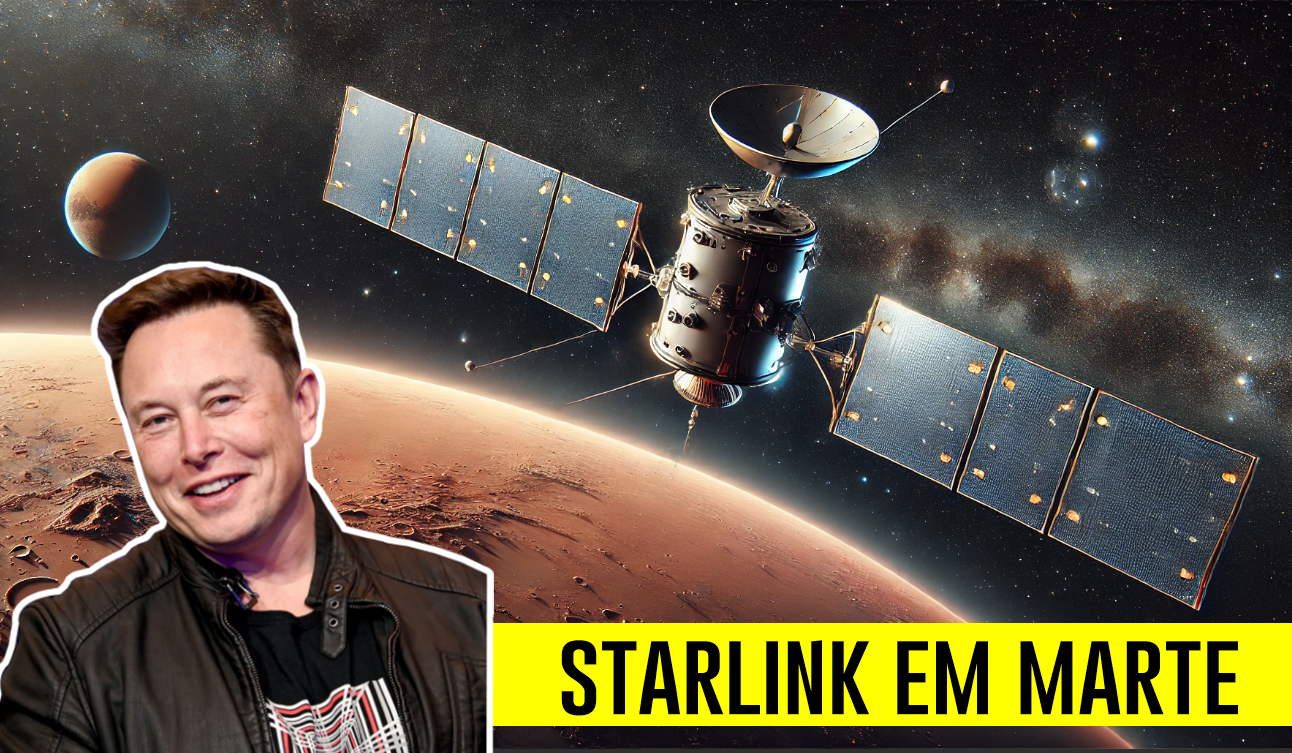
Elon Musk Is Developing Plans to Create an Interplanetary Communication System That Will Bring Starlink Internet to Mars
Imagine a future where you can send a message to Mars with the same ease as sending an email to another continent. Ambitious? No doubt. But that is exactly what SpaceX, led by Elon Musk, is proposing with its new initiative, Marslink.
This project promises to revolutionize communication on the Red Planet and lay the groundwork for human colonization. Marslink was presented during a NASA meeting by the Mars Exploration Program Analysis Group, as part of Musk’s vision to transform Mars into a second home for humanity.

How the Plan to Put Starlink Internet on Mars Works
The plan is to create a network of satellites orbiting the planet, ensuring efficient communication for future missions and, eventually, human settlements.
-
The bizarre train that uses Cold War jet fighter engines to blast air at over 1,000 km/h, melting ice walls and freeing frozen tracks in minutes where ordinary machines would take hours.

-
Japan is transforming dirty diapers from babies and the elderly into an ambitious and surprising project that could forever change the way the world deals with one of the most difficult types of waste to dispose of.

-
Goodbye to waste: a Brazilian created a revolutionary brick that uses construction debris, has already entered the markets of the United Kingdom and the USA, and promises to shake up the global construction industry.

-
China has created a mass-produced hypersonic missile that costs the same as a Tesla, and this is changing everything in modern warfare because the United States cannot defend itself without spending millions.


The inspiration comes from the success of Starlink, a SpaceX network composed of thousands of satellites that already provides internet to more than 102 countries. If on Earth Starlink connects remote areas and regions without infrastructure, imagine what its Martian version could do: facilitate data enhancement between rovers, astronauts, and command centers on Earth, making continuous and sustainable exploration of Mars possible.
However, the race for this interplanetary connectivity is not exclusive to SpaceX. Other giants are entering the game with innovative proposals. Jeff Bezos’s Blue Origin introduced the Blue Ring, an orbital tug that promises data relay and cloud computing directly from space. Although still in testing, this project could offer a versatile solution for interplanetary communication.
Meanwhile, Lockheed Martin is betting on something more economical: repurposing NASA’s MAVEN spacecraft, which has been studying the Martian atmosphere since 2013. The idea is to transform this spacecraft into a communication hub, similar to the Deep Space Network that already operates on Earth.
With so many initiatives, the race to establish a communication infrastructure on Mars is intensifying. NASA is evaluating all available options, but SpaceX’s Marslink seems to be the favorite. If successful, it will not only be a game-changer for future missions but could also accelerate our journey towards becoming a multiplanetary species.
Just as the internet transformed how we connect on Earth, Marslink promises to do the same on Mars. And who knows? In the near future, sending a “hello” to Mars could be as common as a video call. The future is closer than we imagine.
Elon Musk’s Projects on the Red Planet
Elon Musk is widely known for his vision of colonizing Mars, one of the most ambitious projects of SpaceX, the company he founded. Musk believes that the long-term survival of humanity depends on colonizing other planets, and Mars is the primary candidate for this.
His strategy involves developing powerful reusable rockets, like the Starship, designed to transport large payloads and humans to the Red Planet. SpaceX is working on advanced technologies, including life support systems, to make it possible to build a self-sustaining city on Mars, with enough infrastructure to house and support millions of people in the future.
In addition to transportation, Elon Musk emphasizes the importance of creating a functional ecosystem on Mars. His plans involve generating renewable energy through solar panels, producing oxygen and fuel from Martian resources, and building safe habitats to withstand the planet’s hostile environment.
Elon Musk predicts that the first crewed mission to Mars will happen in the next decade, marking the beginning of a new era in space exploration. He believes that colonizing Mars will not only ensure humanity’s survival but also inspire a new generation of scientists, engineers, and dreamers to explore the limits of what is possible.







Seja o primeiro a reagir!