





 Portuguese
  English
  Spanish
  4 min of reading
  0 comments


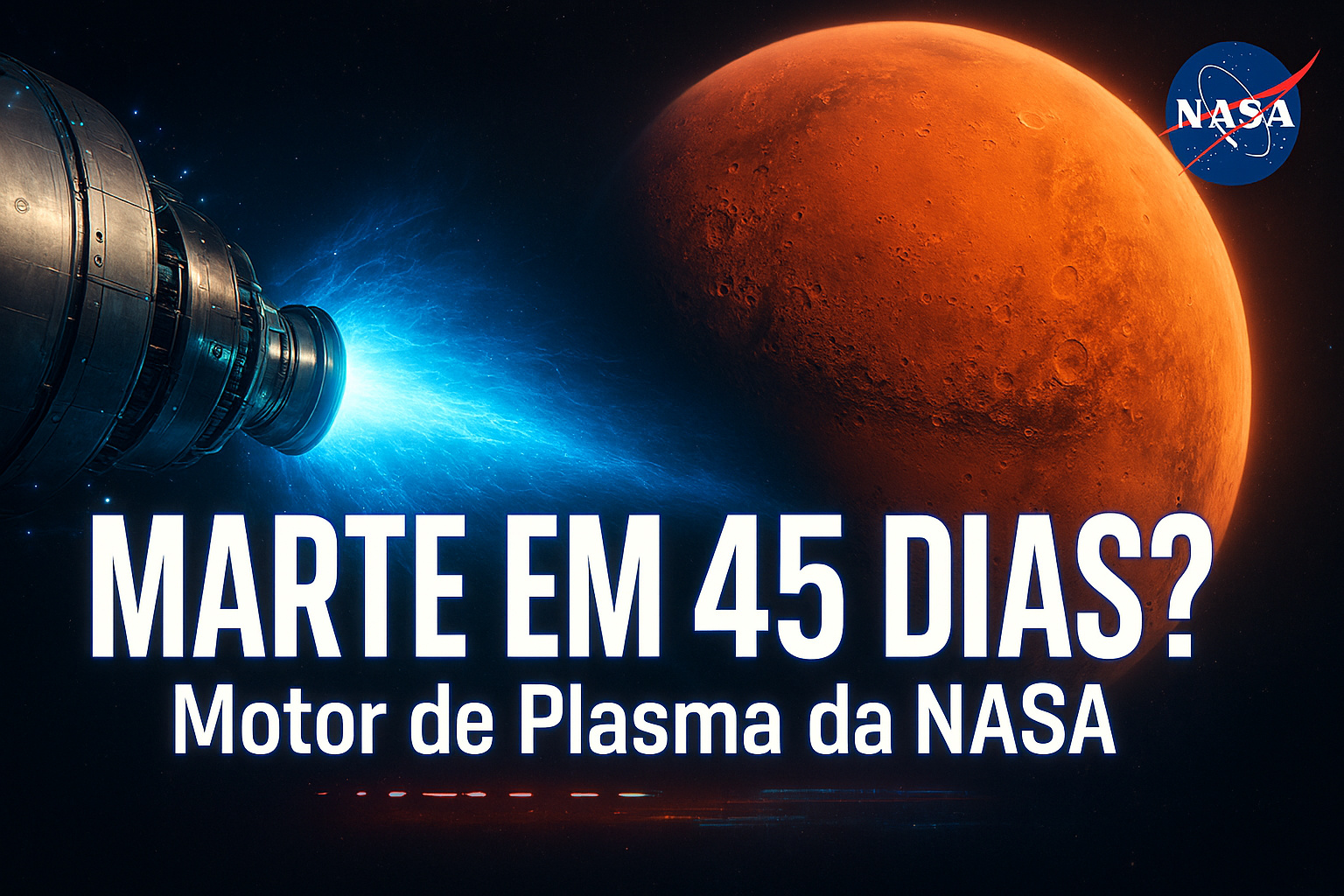
Plasma Propulsion Technology Under Study by NASA Could Enable Travels to Mars in About 45 Days, Cutting Months off Travel Time and Changing the Future of Space Exploration.
In the current context of space exploration, reducing the travel time to Mars from months to a few weeks represents a paradigm shift in propulsion engineering. Traditionally, a mission to the Red Planet takes about seven to nine months using chemical rocket technology — as evidenced by the trajectories of probes and robots sent by NASA, like Spirit, whose journey lasted about 487 million kilometers over nearly seven months.
In recent years, global attention has turned to advanced electric propulsion systems based on plasma, which promise superior performance in long-range missions. In particular, technologies like the so-called Pulsed Plasma Rocket (PPR), partially funded by NASA, and ongoing studies on engines like the Variable Specific Impulse Magnetoplasma Rocket (VASIMR) demonstrate that it is possible to envision trajectories where the time spent between Earth and Mars is drastically reduced.
This type of propulsion differs from traditional systems by using electric and magnetic fields to accelerate an ionized gas (plasma) to very high speeds, generating thrust continuously. Instead of producing thrust only through short fuel burns, like in chemical rockets, these thrusters can operate for prolonged periods, providing gradual and efficient acceleration in deep space.
-
Motorola launched the Signature with a gold seal from DxOMark, tying with the iPhone 17 Pro in camera performance, Snapdragon 8 Gen 5 that surpassed 3 million in benchmarks, and a zoom that impresses even at night.

-
Satellites reveal beneath the Sahara a giant river buried for thousands of kilometers: study shows that the largest hot desert on the planet was once traversed by a river system comparable to the largest on Earth.

-
Scientists have captured something never seen in space: newly born stars are creating gigantic rings of light a thousand times larger than the distance between the Earth and the Sun, and this changes everything we knew about stellar birth.

-
Geologists find traces of a continent that disappeared 155 million years ago after separating from Australia and reveal that it did not sink, but broke into fragments scattered across Southeast Asia.

Why Plasma Propulsion Could Cut Months off Travel
In a typical mission to Mars, a spacecraft leaves low Earth orbit with a chemical rocket and, after a long ballistic trajectory, enters the Martian gravitational influence after several months of travel. This exposes the crew and systems to cosmic radiation for long periods and increases the requirements for the longevity of the equipment.
Plasma propulsion systems, such as those being researched by NASA and partner companies like Ad Astra Rocket Company, operate in a continuous electric propulsion mode, propelling the spacecraft throughout the entire trajectory with higher specific efficiency (thrust per unit mass of propellant).
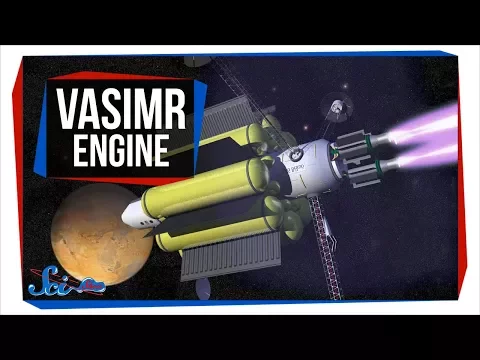

Historical records show that, although the technology is still under development, the promise of reducing total mission time has been on the research agenda for decades.
Specifically, theoretical applications of the VASIMR engine have demonstrated, in simulations, that a crewed mission could reach Mars in about 39 days if a high-power nuclear reactor were available to power the continuous propulsion system.
NASA studies on the Pulsed Plasma Rocket also highlight that, with adequate onboard electrical power development, it is plausible to imagine a mission in about two months — less than half the current duration with chemical propulsion.
What Involves Plasma Propulsion Technology
Plasma propulsion relies on ionizing a neutral gas (usually xenon or another light element) and accelerating it through electric and magnetic fields. This creates plasma — a state of matter with charged particles — that is then expelled at extremely high speeds, generating thrust.
This process requires a continuous supply of high-power electrical energy, which can come from large solar panels or, more likely, from nuclear reactor-based sources in deep space — one of the central challenges to make these missions feasible.
Another characteristic is that the thrust produced by these systems is typically lower than that of a chemical rocket but is maintained for much longer periods, allowing the spacecraft’s speed to gradually increase over weeks or months, something that is not possible with traditional systems.

Challenges That Still Need to Be Overcome
Despite the promising outlook, there are significant obstacles between research and operational application. The main limitation is the continuous power source capable of powering the engine without adding excessive mass to the spacecraft.
This leads to the need for systems like nuclear electric propulsion or large arrays of solar panels, both with technological and engineering challenges still in the research stage.
Additionally, while plasma propulsion may offer advantages in efficiency and speed, its practical implementation in a large-scale crewed mission still relies on decades of development, orbital testing, and integration with life support systems, thermal systems, radiation protection, and other critical subsystems.
How This Changes the Future of Human Space Exploration
Reducing the travel time to Mars from several months to weeks has huge implications:
• Reduction of exposure to cosmic radiation, one of the greatest risks to astronauts on interplanetary missions.
• Decrease in the mass of supplies and life support required, since the mission time is shorter.
• Possibility of more frequent missions, with less vulnerability to prolonged failures.
• Integration with Martian bases and interplanetary logistics, creating a sustainable architecture for human exploration.
Today, technologies such as plasma propulsion remain in experimental and ground testing phases, but they show that the barriers to rapid travel in deep space are being taken seriously by agencies like NASA and international commercial partners.
Plasma propulsion represents one of the most promising paths to revolutionize interplanetary space transport.
Although a crewed mission to Mars still takes about nine months with conventional systems today, contemporary studies, supported by institutions like NASA and companies involved in propulsion systems, raise the possibility of trajectories where this time can be reduced to about 45 days or less, if robust energy sources and advanced magnetic field technologies can be integrated into the space environment.
The transition from chemical rockets to electric and plasma propulsion is not just a matter of speed: it is a redefinition of interplanetary travel engineering and a step towards a future where destinations like Mars cease to be distant goals and become accessible.








-

-

-

13 pessoas reagiram a isso.