





 Portuguese
  English
  Spanish
  4 min of reading
  0 comments


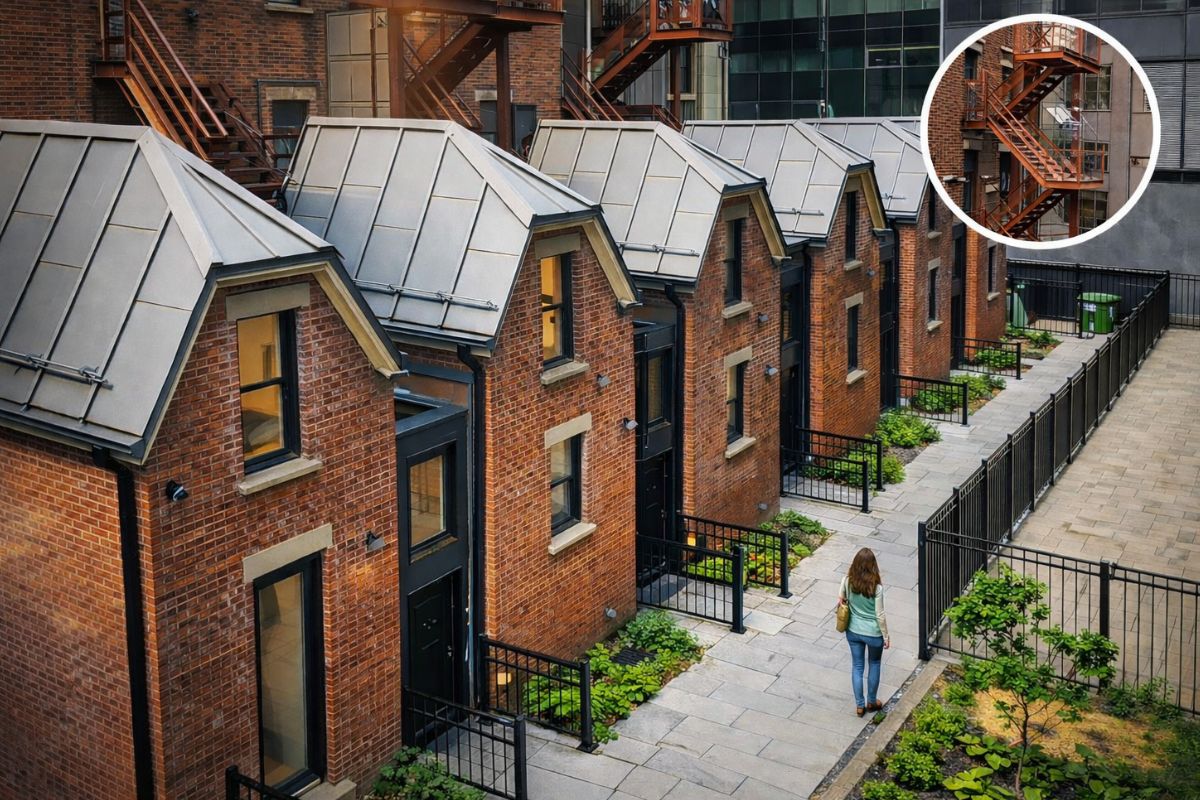
The Proposal Reuses Old Emergency Stairs Attached to a Historic Building from 1880 and Creates Compact Housing of About 350 Square Feet Distributed Over Three Levels, with Kitchen, Bathroom, and Bedroom, Transforming an Underutilized Alley into a Residential Address for Long-Term Rental Near Montreal University in Canada.
The emergency stairs that once served as an exit route from a historic building in Montreal now host six tiny three-story homes, in a project that transforms idle space into compact housing in the center. The intervention repositions a residual space of the building within the current debate on density and access to housing.
Instead of a large demolition, the proposal originated from a targeted adaptation of the existing structure, increasing the number of units from 24 to 30. The result draws attention because it combines architectural reuse, legal restriction, and long-term rental viability in an area with student demand and limited territory allowance.
From Technical Exit to Housing in the Alley

The starting point was a building from 1880, originally composed of terraced houses and later renovated by a construction company.
-
From sertanejo star to international investor: Ana Castela invests millions in a mansion in the USA, creates a themed accommodation in Orlando, and shows that the “boiadeira” also wants to grow away from the stage.

-
The 10 most stunning motorhomes in the world: a $3 million trailer with a rooftop nightclub and garage for a Ferrari, “palaces on wheels” with Italian marble, private cinema, and five-star hotel luxury for billionaires.

-
Trump wanted to spend $400 million on the White House, but the courts prohibited the million-dollar construction.

-
How the Egyptians erected giant structures like pyramids, temples, and obelisks without modern technology, cranes, or engines still amazes the world and reveals the power of engineering based on ramps, levers, ropes, and colossal organization.


In this process, the old emergency stairs of the first two floors, along with a storage section, were viewed as wasted area. The decision to convert this volume into six units changed the function of a space that was not treated as a residential asset.

The choice also aligns with the logic of densification in the urban center. Instead of expanding horizontally, the project utilizes an already incorporated void in the lot and creates sequential housing facing a landscaped alley.
It is a precise response, made within a pre-existence, not a new venture on vacant land.
Adaptation Engineering in Minimal Space

The development faced direct limits of municipal statutes. The team reports that the initial configuration planned to take advantage of internal differences was not accepted as a final solution, requiring adjustments to meet minimum area and circulation.
The technical response included an extension of approximately two feet and the maintenance of the original brick volume, with a contemporary addition in metal.
To make three habitable levels viable, it was necessary to lower the foundation. This type of intervention in an old structure often increases the complexity of the construction and the cost of compatibility.
Still, the strategy preserved the architectural reading of the historical body and inserted the new volume in a recessed manner, ensuring that the original unit remained visually identifiable. The project does not erase the building’s past; it negotiates with it.
How 350 Square Feet Were Distributed Over Three Levels

In the new units created from the emergency stairs, the internal organization prioritizes function by floor. Access leads to a compact first level, followed by a floor with kitchen, bathroom, and laundry area, and then a living room with workspace support.


On the top floor, under the sloped roof line, is the bedroom.
The internal solution bets on built-in storage, including under steps, light surfaces, and entry of natural light through preserved windows and attic openings.

The bathroom integrates a shower and toilet, with a floor drain and heating for quick drying, inspired by high space efficiency nautical arrangements. It is not a luxury of square footage; it is a design for continuous use with essential equipment for a complete routine.
Resident Profile, Urban Impact, and Limits of the Model
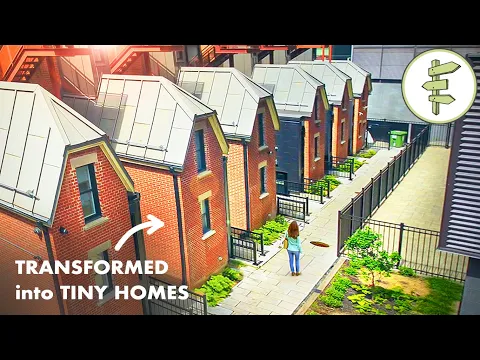

The location next to the university guides the rental profile, with a significant presence of students in long-term contracts.
Although the area is similar to that of a studio, verticalization creates a sense of separated environments for sleeping, living, and cooking. This division into levels alters the perception of comfort in reduced square footage.
At the same time, the case exposes an urban policy impasse. Professionals involved in the project argue that cities could adjust rules to facilitate reuse interventions in small volumes, avoiding the automatic logic of demolishing and rebuilding larger.
The converted emergency stairs show potential, but also make it clear that replication depends on legislation, oversight, and local technical capacity.
The conversion of emergency stairs into six three-story homes in downtown Montreal condenses a broader discussion: how to increase housing supply without expanding the urban footprint or erasing historic buildings.
The project delivers a concrete response for an underutilized alley, but also reveals that compact solutions require careful design and rules compatible with reality.
If a similar project emerged in your neighborhood, would you consider living in a vertical unit of about 350 square feet to be closer to work or university? And in your view, what should be the limit between densifying intelligently and normalizing ever smaller spaces?








-

-

-

-

-

21 pessoas reagiram a isso.