





 Portuguese
  English
  Spanish
  6 min of reading
  0 comments


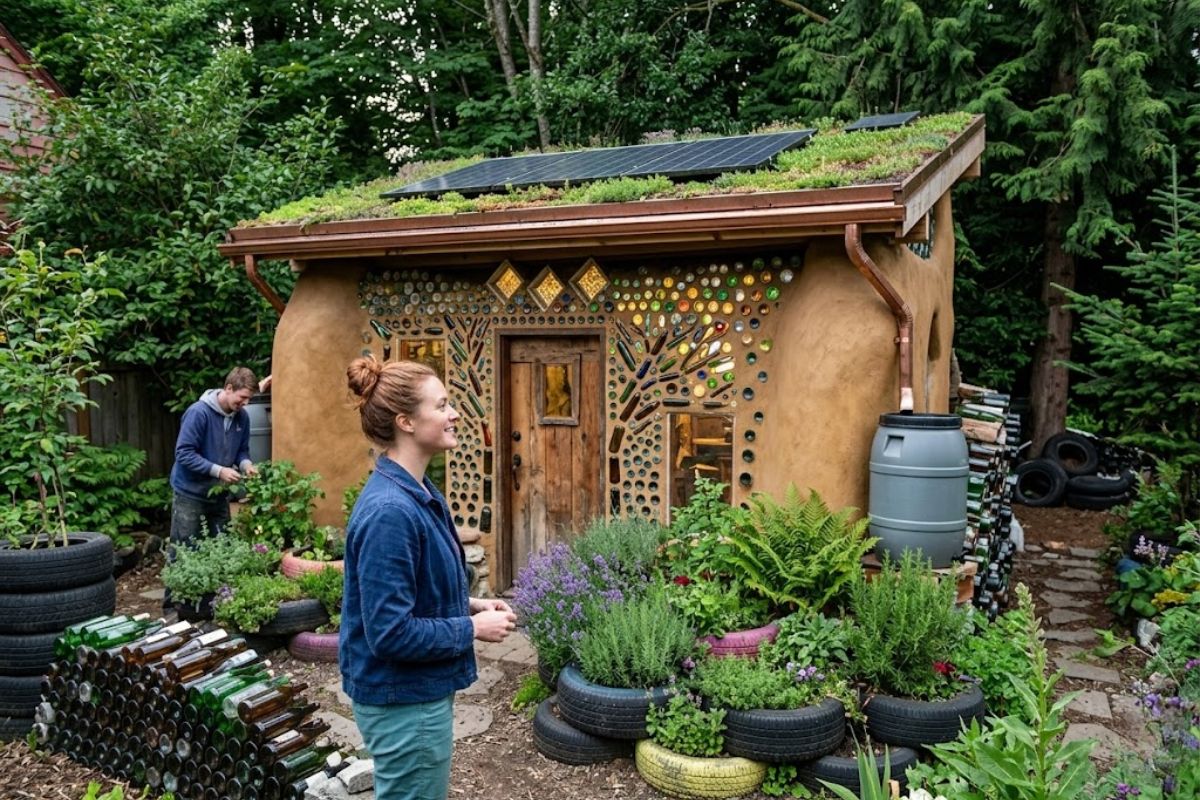
Self-Proclaimed Queen of Trash Fairies, Roxanne Fonder Reeve Travels Through Industrial Areas, Stops the Car to See Scraps, and Transforms Finds Into Earthship Laboratory at Her House Entrance in Columbia City With Neighborhood Volunteers. The Self-Sufficient Mini House Uses Tires, Bottles, and Mud to Live Off-Grid.
Roxanne Fonder Reeve did not plan to become a reference for alternative building, but she ended up doing exactly that by turning the idea of a self-sufficient mini house into a real experiment, constructed in her own backyard in Seattle. She drives around the city, observes what has been discarded, and collects items that, under normal circumstances, would be just trash.
The result of this habit is a project that mixes art, practical engineering, and conscious improvisation: a structure inspired by Earthship architecture, designed to reduce dependence on external services and demonstrate, in practice, how waste and natural materials can become walls, insulation, finishes, and even part of the “off-grid” life system.
Who Is the “Queen of Scraps” and Where the Mini House Is Born

Roxanne describes herself as “Queen of Trash Fairies” because her routine includes searching for materials in industrial areas and urban discards, stopping the car when she finds something that seems useful.
-
He found the largest gold shipwreck in the United States with tons of the precious metal at a depth of 2,400 meters in the Atlantic and recovered a treasure that no one thought possible to reach, but 500 gold coins disappeared without explanation.

-
The United States has a serious problem with its F-35s: China is already producing fighters at a pace that exceeds American capacity and could manufacture up to 300 aircraft per year before the end of the decade, shifting the global military balance.

-
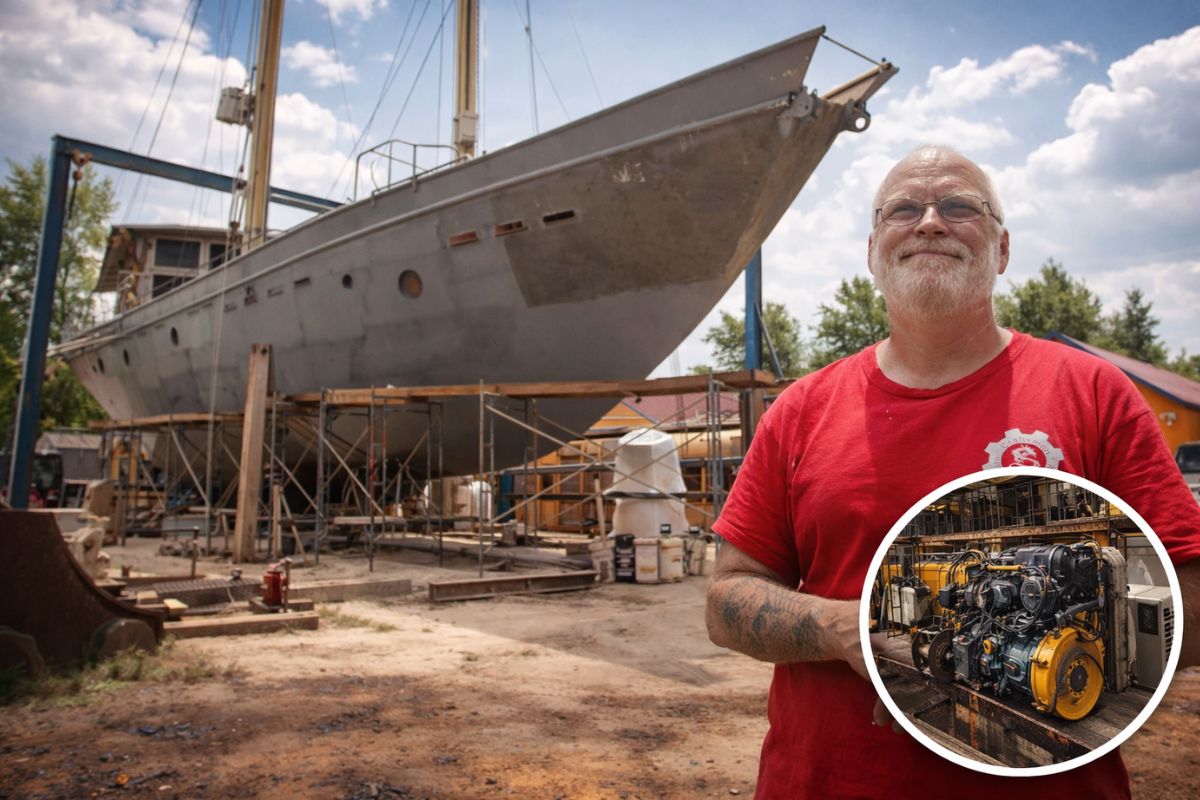
A retired IT professional built a 22-meter boat in his backyard in Oklahoma with a school bus engine, light pole masts, and handmade watertight doors to become the redneck version of Jacques Cousteau.
-
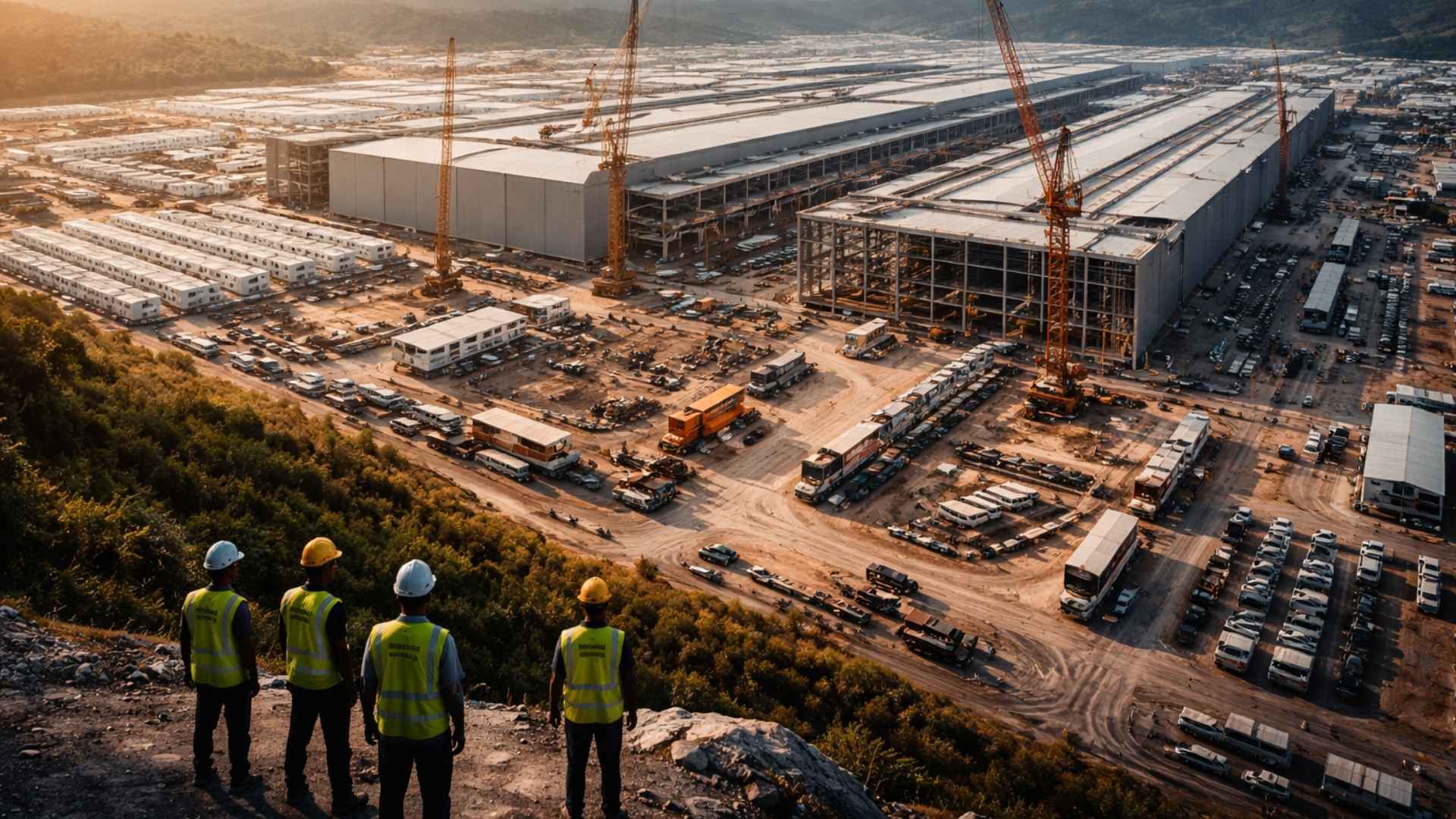
China is building a city in Brazil: a complex with an investment of R$ 5.5 billion comes to light, but allegations involving workers draw attention.


She does not present herself as someone from the “construction site”, and that is precisely why her involvement with old tires, compacted earth, and heavy tools has a symbolic effect: construction ceases to be an exclusive territory for specialists and becomes a collective learning process.
The self-sufficient mini house she erects is situated at the entrance of her home in Columbia City, a neighborhood in Seattle, functioning as an open-air laboratory.
The project took shape with the help of community volunteers, which also changes the meaning of “how much it costs”: instead of a traditional budget, the main resource becomes time, coordination, donation, and repurposing.
What Is an Earthship and Why This Self-Sufficient Mini House Breaks the Mold
Earthships are housing proposals designed to be self-sufficient, reducing dependence on utility companies and supply networks.
The logic is simple to explain and hard to execute: the house needs to produce or manage, on its own, energy, water, thermal comfort, and sanitation, using architectural design, integrated systems, and repurposed or natural materials.
The concept was described by American architect Michael Reynolds in 1971 in New Mexico, proposing to build using cans, bottles, and tires, and he completed the first Earthship in 1988.
Even with the impression of being a “1970s idea,” the vision advocated by Roxanne is one of continuous evolution: the design changes, systems become more sophisticated, but the central philosophy remains the same—living with less waste and more autonomy, especially in a climate change and economic insecurity scenario.
Trash Studio: A 120 Square Feet Laboratory, Without Money and With a Public Function
Since 2012, Roxanne and volunteers have been building what they call Trash Studio, described as a sustainable, zero-waste structure made of recycled and natural materials.
The most unusual aspect is the “terrain”: a 120 square feet space in the entrance/garage, used as an experimental bench to demonstrate Earthship principles and provoke conversations about self-sufficient living in an urban context.
This space limitation shapes everything. Instead of a conventional house, Trash Studio functions as a scaled-down prototype—a self-sufficient mini house in the sense of testing solutions: how to build walls, how to insulate, how to incorporate glass and bottles into the facade, how to handle ventilation and temperature, and how to integrate functions (kitchen, heating, storage) within a small volume, without relying on purchases.
Tires Filled with Dirt, Bottles in the Facade, and Improvisation as Daily Engineering

The structure is born from what exists: old tires compacted with earth, repurposed bottles, and walls made from “cob” (mud/earth with fibers, in the tradition of natural building).
One of the project’s most physical challenges was filling 150 tires with dirt, pounding and compacting the material; each filled tire weighed around 200 to 300 pounds.
Here, “how much it weighs” becomes part of the project, because mass and density influence stability and thermal performance.

Improvisation clearly appears in the insulation. The initial plan of Florian Becquereau involved in the project and leading the design was to use 400 old phone books inside a curved tire wall, about two feet wide.
When they could only find five, they needed to change the solution: discarded Styrofoam boxes from a medical installation came into play. Instead of romanticizing the makeshift solution, the method is to adopt a real rule of repurposing: availability changes quickly, so the design must accept substitutions without losing function.
Energy, Water, Food, and Sewage: The Technical Package Behind a Self-Sufficient Mini House
The Earthship idea is not just “walls made of trash”: it is a set of systems. The structures mentioned in this model can combine thermal energy (utilizing mass and solar orientation), solar and wind energy, in addition to solutions for capturing water and managing waste.
A self-sufficient mini house needs to function as an ecosystem, where consumption and replenishment are in constant communication.
There are also contemporary adjustments: some projects have incorporated openings and ducts for more controlled ventilation, the possibility of using air conditioning, and greenhouse spaces that help regulate temperature and create areas for cultivation.
Florian describes the experience of living in an Earthship as greater contact with the natural world because you begin to depend on what you can obtain from the environment and, therefore, need to be more conscious of energy use and appliances—you cannot leave everything on all the time as if the grid were infinite.
From Taos to the World: Community, School, and Uses Beyond “Alternative Housing”
The presence of Earthships has not been limited to the point of origin. There are examples in all US states and in over 20 countries, with uses ranging from homesteads in Guatemala to emergency shelters in Haiti after the earthquake.
In Taos, New Mexico, there is a community with about 70 Earthship residences and even a visitor center, showing that the idea can move from the experimental field to real housing, with people living there daily.
Training has also been structured: the Earthship Biotecture Academy in Taos offers a four-week course and has educated over 1,300 students about the principles, methods, and philosophy of the model. Florian Becquereau participated in 2013 and spent six weeks living in an Earthship before leading the design of the project in Seattle.
This detail answers the “why” in a practical way: it is not just a futuristic aesthetic with bottles in the wall; there is an organized movement, with formal learning and a network of people trying to turn autonomy into infrastructure.
What This Backyard in Seattle Reveals About Housing, Resilience, and Real Limits
Roxanne connects the project to a growing perception, especially among young people: with climate change and economic insecurity, there is a sense that it will be necessary to live differently, with less impact and more capacity to sustain oneself.
At the same time, Trash Studio itself exposes the limits of the ideal: the entrance to the house defines the size, the pace depends on volunteers, and the search for materials becomes a central part of the schedule.
The ambition, however, appears without an easy promise. Florian comments that it would be interesting to reach a complete center, of about 2,000 square feet, well located in Seattle, but the current step is “only” the prototype: a self-sufficient mini house testing wall, insulation, facade, and systems integration solutions without money, with discarded material, and with the entire city as a source of inputs and also as a reminder that waste is constant.
The Trash Studio does not try to prove that everyone should live the same way; it exposes, with concrete details, that autonomy can be designed, built, and adjusted in the real world, with limitations, improvisations, and technical choices.
In the end, the question is not just “if it can be done,” but “what is worth depending on” when energy, water, and housing become more unstable.
If you had to choose a single principle for a self-sufficient mini house—reusing tires, capturing water, producing energy, or reducing consumption to the maximum—what would be your priority, and what type of discarded material do you think could be most useful for building in your city?








-

-

-

-

-

22 pessoas reagiram a isso.