





 English
  Francês
  Alemão
  Italiano
  Japonês
  Norueguês
  Portuguese
  Spanish
  4 min of reading
  0 comments


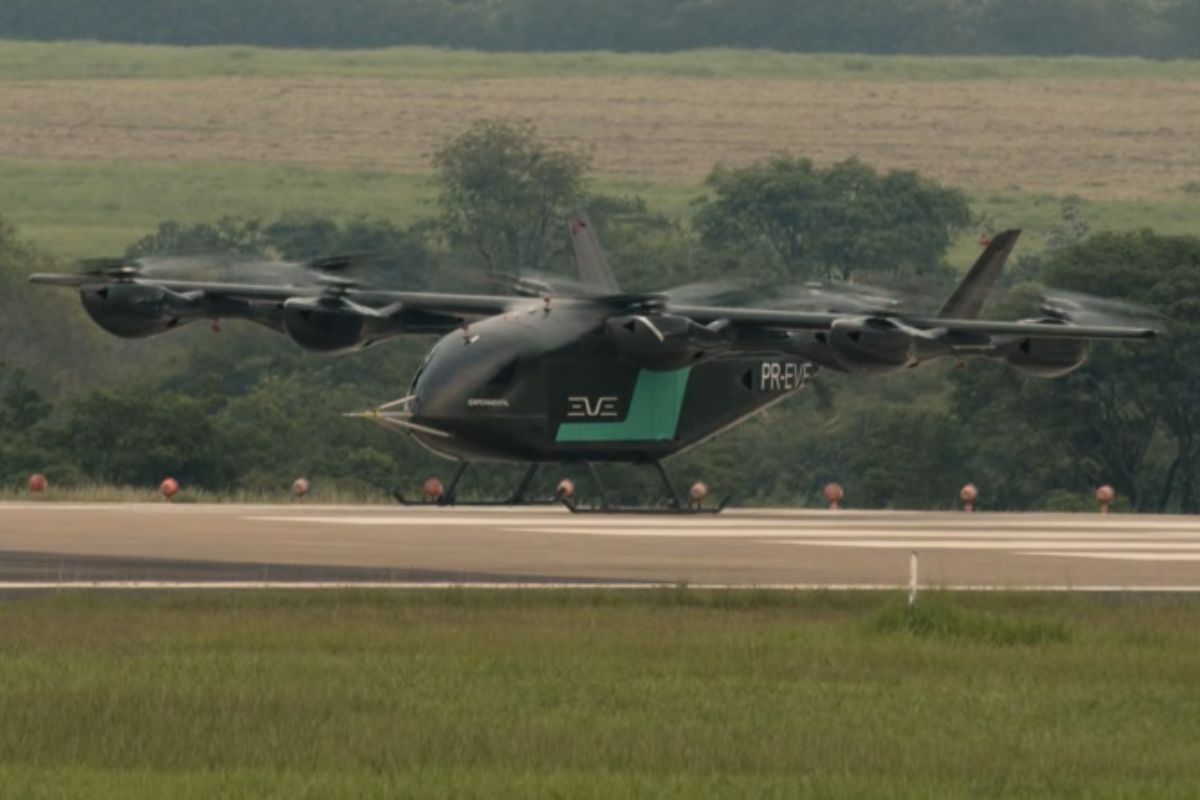
Embraer, through Eve Air Mobility, conducted a new demonstration flight in Gavião Peixoto, taking the prototype to 43 meters in height, reaching 35 flights, and reinforcing the promise to operate with significantly less noise than helicopters
Embraer took another important step in the race for urban air mobility with the successful flight of its flying car prototype in Gavião Peixoto, in the interior of São Paulo. The demonstration was conducted by Eve Air Mobility, a subsidiary of the company, and reinforced the progress of the program towards the next certification stages of the electric aircraft.
The result draws attention not only for the success of the test but also for the milestones already accumulated by the project. The prototype has accumulated 35 flights and nearly an hour and a half of total airtime since the first test, conducted in December 2025, and has already reached 140 feet, equivalent to 43 meters in height.
Flight in São Paulo reinforces the advancement of the program

The new test took place at a manufacturing unit in Gavião Peixoto and was treated as another relevant step within the development campaign.
-
350-year mystery may have been solved: remains of a soldier who inspired the hero of The Three Musketeers found beneath a church in the Netherlands.

-
NASA photographed a nearly perfect square with 3 km sides on Mars, 13 times larger than the Great Pyramid of Giza, but the official explanation is natural erosion; still, no one has explained why the four sides have almost identical lengths.

-
Starlink breaks the barrier of 10,000 satellites in orbit and takes its expansion to an unprecedented level, with a direct impact on global internet, technological competition, and the race for space.

-
Japan finds an alternative to oil amid rising prices by transforming ocean balance into electricity with a new technology that maintains efficiency even when the sea changes.


For Embraer, the flight helps validate the aircraft’s behavior in operation and consolidate important data for the next technical phases.
According to the information presented, the flight performance was consistent, which strengthens the evolution of the program.
Each successful demonstration brings the aircraft closer to a more mature evaluation phase, especially in a sector that relies on rigorous validation before reaching the market.
Prototype already accumulates 35 flights
One of the most relevant data points of the program is the volume of tests already conducted. The engineering prototype of Eve Air Mobility has reached 35 flights since the first takeoff.
This number shows that Embraer’s project has already surpassed the isolated demonstration phase and entered a more continuous evaluation cycle.
Furthermore, the aircraft has accumulated nearly an hour and a half of total flight time, which helps expand the technical foundation for development.
Height of 43 meters marks a new stage

During the testing campaign, the aircraft has already reached 140 feet, equivalent to 43 meters in height. This milestone is significant because it demonstrates the controlled progression of the program and the growing confidence in the flight parameters of the prototype.
For Embraer, this type of result serves as an indicator of technical maturity. By reaching new altitude milestones with consistent behavior, the program shows practical evolution and not just conceptual.
Efficiency and noise enter the center of the dispute
Preliminary results also indicate efficiency gains, according to the manufacturer. Another notable point is the noise level, which remained within the project’s projections.
This aspect is particularly important because the proposal for an urban flying car depends not only on performance but also on coexistence with densely populated areas.
In this scenario, Embraer emphasizes that the prototype operates with noise significantly lower than that of helicopters, a differentiator that could weigh in the future of air mobility.
Certification still depends on technical stages


Despite the progress, the project still needs to go through a validation trajectory before reaching commercial operation.
The certification of the aircraft remains conditional on the successful completion of technical stages and the approval of the competent regulatory authorities.
This means that the successful flight represents progress but not completion. The path to certification requires a sequence of tests, performance verification, and detailed regulatory evaluation, something expected in any program of this type.
Eve and Embraer accelerate the air mobility project
The actions of Eve Air Mobility show how Embraer is trying to position itself in one of the most promising segments of aviation.
The focus is on an electric vertical takeoff and landing aircraft designed to meet future demand for faster urban transportation with less noise impact.
With each new flight, the program gains data, reduces uncertainties, and strengthens its viability narrative. More than an isolated test, what is underway is the gradual construction of a project that attempts to transform a technological promise into real operation.
Project enters an increasingly observed phase
The success of the flight in São Paulo places more attention on Eve’s timeline and on Embraer’s ability to advance in a market that mixes innovation, regulation, and pressure for safety.
By reaching 35 flights, nearly 1 hour and 30 minutes of accumulated operation, and new altitude milestones, the program shows that it has already left behind the most initial phase of experimentation. Now, the competition shifts to technical robustness, reliability, and regulatory approval.
Do you believe that Embraer’s flying car could indeed become a commercial reality in the coming years?








Seja o primeiro a reagir!