





 English
  Francês
  Alemão
  Italiano
  Japonês
  Norueguês
  Portuguese
  Spanish
  5 min of reading
  0 comments


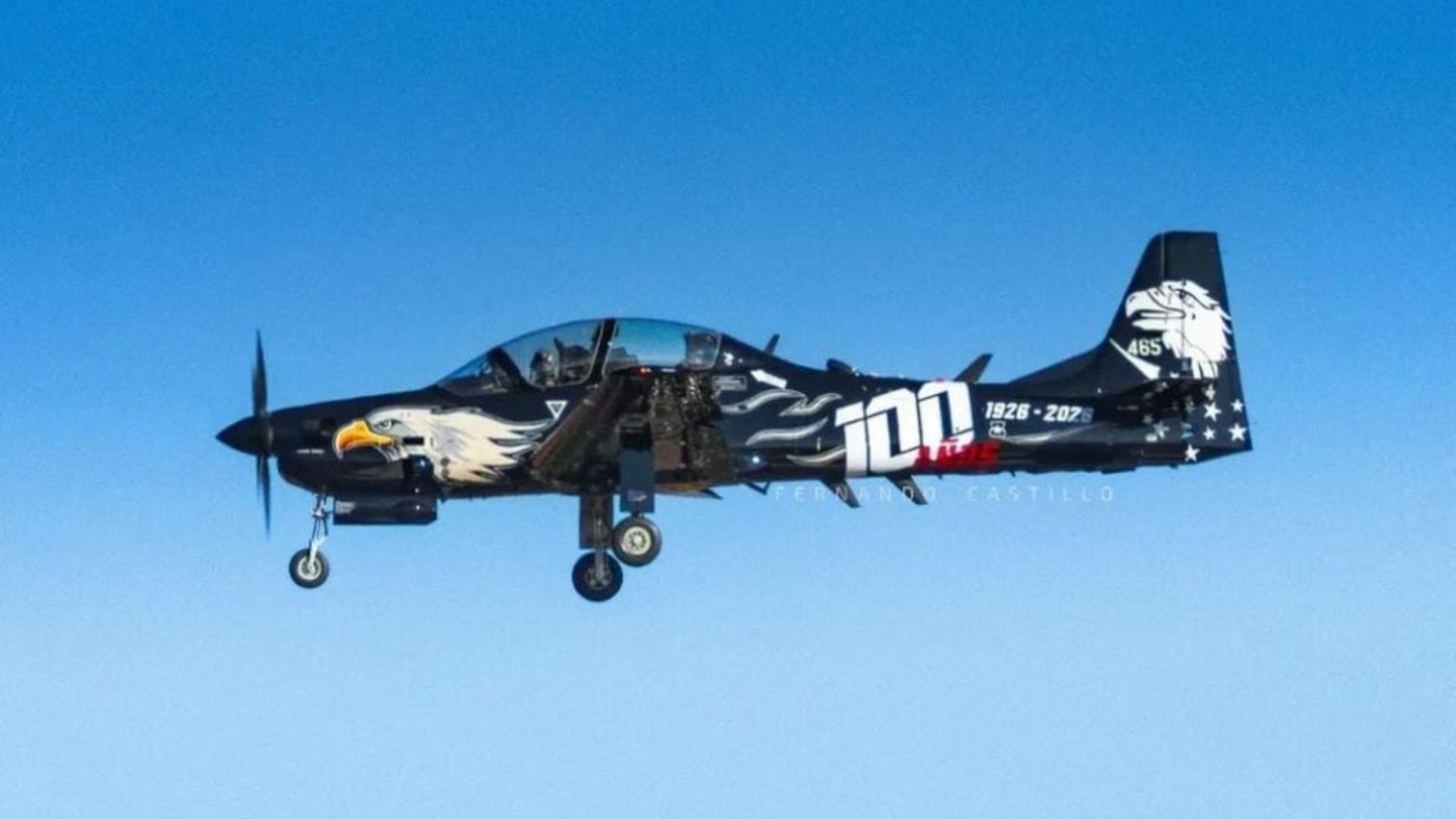
Special painting on Brazilian jet marks centenary of historical unit of Chilean aviation, highlighting military tradition, technological evolution, and the role of the Super Tucano in training combat pilots over a century of continuous operations.
The Chilean Air Force has begun displaying a special paint scheme on one of its A-29B Super Tucanos to mark the 100 years of Group of Aviation No. 1, the oldest air unit of the institution.
The aircraft with registration FACH 465 was seen on March 17 with a predominantly black fuselage, decorated with eagles — a traditional symbol of the group — and with the number 100, a direct reference to the centenary celebrated in 2026.
The tribute connects to a central date in Chilean military aviation.
-
Seen from space, a colossal ‘Y’ cuts through the largest desert in China, blending a jade-filled river, red and white mountains, and revealing the absurd scale of the transformation of the Taklamakan surrounded by a green wall with billions of trees.

-
The Pacific Ocean reveals what the cliffs of Big Sur have hidden for millennia: Pfeiffer Beach, in California, features swirling purple sand formed by garnet crystals and displays a stone arch that is illuminated by the sun in winter for just a few days each year.

-
Aursjøvegen in Norway is a 100-kilometer gravel road that crosses chasms and dark tunnels carved into the rock at an altitude of 947 meters in the fjords and is only open for four months a year.

-
With about 4,000 m², the building constructed in a traditional neighborhood in France looks like a rainbow, has a colorful facade, mixes vibrant glass, and creates one of the most unusual visuals in Bordeaux.

The Group of Aviation No. 1 originated on March 3, 1926, when it was created as Mixed Group of Aviation No. 1 by decree of the then Ministry of War.
The FACH itself would only be established in 1930, which makes the unit an entity predating the air force as it is known today.
This historical precedence is highlighted by the Chilean institution itself as it reconstructs the group’s trajectory in its centenary.
Special painting of the Super Tucano highlights historical centenary
The visual scheme applied to FACH 465 transforms the Brazilian turboprop into a commemorative piece of strong symbolic appeal.
The combination of black paint with the side eagles reinforces the historical identity of the group, while the three-digit numeral directly associates the aircraft with the centenary ceremonies held this year in Iquique, in northern Chile.

So far, the public highlight of the customization has appeared in records and specialized publications, while the FACH has focused its institutional disclosure on the official activities of the anniversary.
The unit is based at the Los Cóndores Air Base in Iquique, subordinate to the I Air Brigade.
It was there that the Group of Aviation No. 1 consolidated, over the decades, its vocation for the training and advanced instruction of crews, a role that continues to be present in recent exercises and tactical courses conducted with the A-29 Super Tucano.
Group of Aviation No. 1 and its mission in training pilots
When it emerged in 1926, the group was born with the mission to instruct and train officers destined to become combat pilots, a milestone that the FACH defines as the beginning of a structured national air doctrine.
This formative character helps explain why the unit has traversed different phases of Chilean aviation without losing relevance, even with the successive replacement of aircraft and instruction methods.
In its early years, the unit operated reconnaissance, bombing, and fighter aircraft that reflected the initial stage of military aviation in the country.
Over time, this inventory was renewed and passed through models that marked different eras, until reaching the current generation of turboprop training and light attack aircraft.
The material evolution accompanied the change of the mission itself, which ceased to be merely basic to incorporate increasingly complex tactical requirements.
This institutional transformation appears more clearly from the reactivation of the group’s tactical school in the 1980s.
According to the FACH, it was during this stage that the unit consolidated its role as a center for advanced training for combat pilots, preparing already graduated crews for the transition to more demanding missions.
The subsequent use of aircraft such as the A-36 and, later, the Super Tucano, reinforced this profile.

Fleet of A-29 Super Tucano in the Chilean Air Force
Today, the A-29Bs are at the center of the operational activity of the Group of Aviation No. 1.
The FACH has been using the model in training missions and in exercises such as Estrella Austral 2025, in which the unit’s aircraft performed tasks related to the preparation of combat crews and close air support.
The institution describes the Super Tucano as a relevant platform for both advanced instruction and more complex operational scenarios.
The Chilean fleet totals 22 A-29 Super Tucano, a number also mentioned by Embraer when announcing, in 2025, a cooperation agreement with the Chilean state-owned company ENAER.
In this announcement, the Brazilian manufacturer informed that the Chilean company would start producing components and act as a designated maintenance center for the local fleet, indicating not only the consolidation of the model in the country but also an effort to expand the industrial support of the operation.
The incorporation of these aircraft occurred in stages.
The first batch of 12 units began arriving in 2009 and was completed in 2010.
Later, the FACH received six more aircraft in 2018.
Finally, the third reinforcement of four units was delivered in 2020, bringing the total to 22 aircraft in service.
This timeline consolidated Chile as one of the most relevant South American operators of the A-29.
The choice of the Super Tucano meets a mission profile that combines lower operational costs, advanced training, and the capability for light air support operations.
In 2025, the FACH itself highlighted these characteristics by describing the A-29 as a vector suitable for close combat operations and advanced instruction.
Centenary of Group of Aviation No. 1 gains highlight in the FACH
The celebrations for the 100 years of the group were officially announced by the FACH in February 2026 and had a public program in March, with ceremonies and an air parade in Iquique.
In this context, the special paint applied to FACH 465 serves as a visual extension of the celebration and also as a way to bridge the past and present.
On one side, the unit that predates the very foundation of the Chilean air force.
On the other, the Brazilian aircraft that today represents the backbone of its tactical instruction.
More than an aesthetic resource, the customization of the Super Tucano synthesizes a well-defined institutional narrative.
The aircraft celebrates a unit created to train pilots, which has traversed a century of technological changes and remained linked to combat preparation.
By displaying the group’s eagle and the number 100 over a striking black paint scheme, the Chilean A-29 also operates as a historical symbol of a tradition that the FACH decided to take to the skies in the year of its centenary.








Seja o primeiro a reagir!