





 Portuguese
  English
  Spanish
  4 min of reading
  20 comments


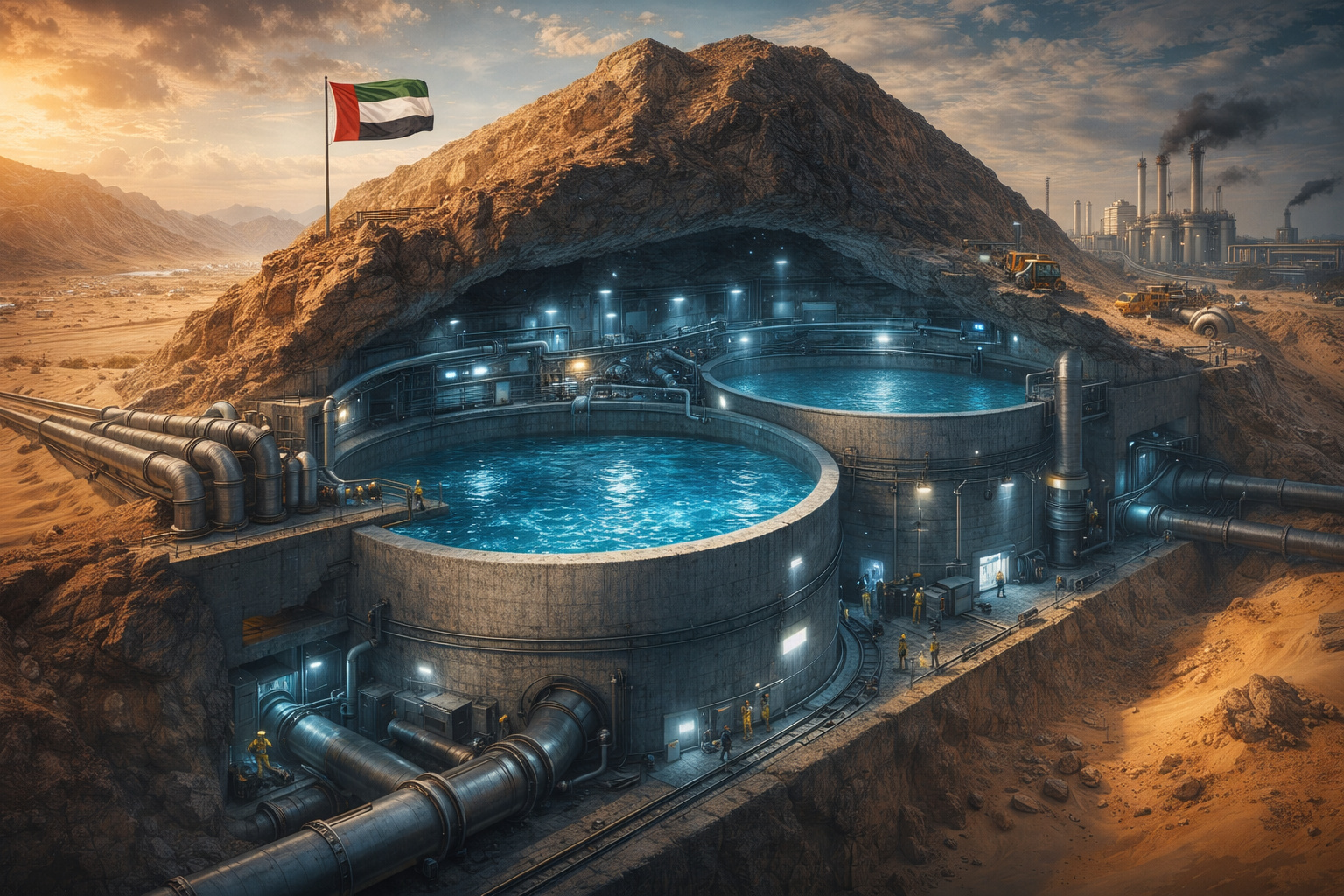


United Arab Emirates Are Exchanging Oil for Water: How Underground Reservoirs and Artificial Aquifers Have Become the New Strategic Security of the Desert
For decades, the United Arab Emirates have been known for turning rock into oil vaults. Strategic underground reserves, reinforced tunnels, and deep infrastructure have always been part of the country’s energy logic. In recent years, this same mindset has been applied to an even more critical resource for national survival: drinking water. Contrary to what many simplified narratives suggest, the UAE is not “filling natural caves with water.” What is currently underway is something more sophisticated — and proven: controlled underground storage of desalinated water in deep aquifers and excavated reservoirs, integrated into urban distribution networks.
It is national-scale water security engineering.
What Really Exists: Underground Storage and Aquifer Recharge
The country has adopted systems internationally known as Aquifer Storage and Recovery (ASR). In this model, desalinated water produced at coastal plants is intentionally injected into deep geological formations, which function as natural reservoirs sealed by impermeable rock layers.
-
New CCR concrete paving technology promises roads up to 3x more durable, less maintenance, and cost reduction in Brazil.
-
Made from recycled plastic, plastic wood is gaining space in the construction industry because it does not rot, resists moisture, and reduces maintenance costs over the years.

-
Florianópolis will receive a million-dollar BRT that will begin construction in 2026 with nearly 400 million in funding from the federal government and the Inter-American Development Bank, and the map already shows the routes for the exclusive bus corridors.

-
Without a blueprint, without an engineer, and using scrap from the dump, a father spends 15 years building an 18-room castle for his daughter, featuring tram tracks, 13 fireplaces, and over 700 m², which may now be demolished.


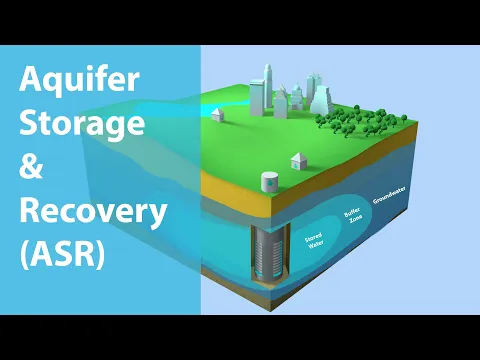

These aquifers are not underground rivers or hollow caves. They are porous structures, capable of safely storing massive volumes of water with thermal stability and complete physical protection. In times of need, water is pumped back into the urban system with controlled quality.
In addition, the UAE is also constructing excavated and lined underground reservoirs, functioning as storage tanks below the surface, directly connected to water networks.
Why the Subsoil is Essential in Desert Climates
Surface reservoirs in desert environments are highly inefficient. With temperatures often exceeding 45 °C, evaporation can eliminate significant volumes in a short time. Sandstorms, salinization, and contamination risks make artificial lakes a weak point in the infrastructure.
The subsoil simultaneously solves these problems. Water stored in aquifers or underground reservoirs maintains a stable temperature, with virtually no evaporation, protected from light, extreme heat, and climatic events. Additionally, it is shielded against sabotage, industrial accidents, and even conflict scenarios.
In practice, water is treated as a strategic asset, not merely as a public service.
Desalinated Water as a National Stock, Not Just Continuous Production
The UAE relies on desalination for over 90% of the drinking water consumed. This creates an obvious vulnerability: if coastal plants shut down — due to energy failure, cyberattack, or regional crisis — the supply collapses immediately.
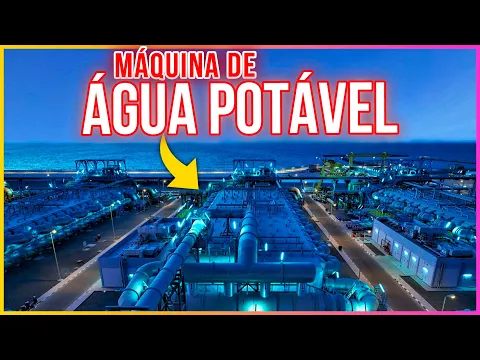
Underground storage changes this equation. Water produced outside peak consumption times is stored underground, creating strategic stocks sufficient to supply large cities for weeks. It is the same concept used in strategic oil reserves, now applied to water.
The model of “produce and consume in real-time” gives way to “produce, store, and protect.”
Real Scale: Billions of Liters Stored Beneath the Desert
Officially disclosed projects indicate individual capacities of hundreds of millions of liters per ASR system, with modular networks totaling tens of billions of liters of stored drinking water at the national level.
These systems feature continuous monitoring of quality, pressure, salinity, and geological integrity. Water does not stay “still”: there is controlled circulation, periodic testing, and safety protocols equivalent to those used in critical energy infrastructure.
It is not improvisation — it is state planning.
Water Security as National Policy
For the United Arab Emirates, water has come to be treated as a matter of sovereignty. The country has no permanent rivers, has scarce rainfall, and rapid urban growth. The only truly controllable variable is engineering.
By investing in underground storage, the country gains response time in crises, reduces immediate dependence on coastal plants, and transforms water into a strategic, protected, and predictable resource.
Few countries in the world operate water systems with this level of planning.
The Cost Is High, but the Cost of Scarcity Is Higher
Desalinating water, pumping it over long distances, and injecting it into deep aquifers requires energy, capital, and technology. The cost per cubic meter is high compared to countries with natural rivers and lakes.
Still, in the desert, not storing water costs infinitely more. For the UAE, energy — increasingly solar and nuclear — is a manageable resource. Freshwater is not.
Similar experiences are beginning to be studied by countries in the Middle East, North Africa, Australia, and arid regions of the United States. The UAE’s differentiator lies in scale, national integration, and accumulated experience in heavy underground engineering.
If before the country was the ultimate symbol of the oil era, today it is consolidating itself as an extreme laboratory of water adaptation in a hostile environment, where the subsoil replaces nonexistent rivers.
In the desert, survival doesn’t fall from the sky.
It is injected into the rock, excavated from the rock.







Y que hacen con la sal? Es una verdadera locura lo que están haciendo. Si se hipersaliniza el mar morirán los peces y la mayoría de los organismos del ecosistema marino que no están adaptados a vivir en sistemas hipersalinos. Por otra parte, una variación tan marcada en la salinidad podrá afectar las corrientes marinas con consecuencias en las condiciones climáticas. En fin, es un manotazo de ahogados que están dando justamente los países que más saquearon y contaminaron el agua del planeta.
I believe the brine reject is NOT put back in the sea but pumped into the desert making salt flats and returning the liquid ,sand filtered, to below surface or evaporated back into the earths natural water cycle. Water does not go away – what is here is always here just in various forms
It’s true that whatever we extract or produce is coversion from one form to another usable forms. But who consumes the salt( as a by product) produced in large quantity.
Considering this for developemnt/innovation/safety/ business/growth of the country, the idea is good, but from overview I see this as a slow poison to the world.
It’s also true that water is equally important as air for survival. Using the available resources in efficient way is the only solution for the survival.
Good job
Unsustainable.. better they do permaculture converting desert into lakes and streams with desalinization.
Creo que no leiste la parte de las tormentas de arena y las altas temperaturas con evaporación alarmante……