






 Portuguese


An Unusual Scene Inside a Nearly Bankrupt Chinese Factory Became a Symbol of an Industrial Shift That Decades Later Would Be Remembered in the Journey of One of the World’s Largest Appliance Manufacturers.
Today, Haier sells appliances on a global scale, brings together well-known brands across different continents, and employs around 146,000 people.
The origin of this journey, however, stems from a far less technological scene: 76 defective refrigerators lined up in front of workers and smashed with sledgehammers in a Chinese factory.
This incident occurred in 1985, shortly after Zhang Ruimin took over the Qingdao Refrigerator Factory in Qingdao, eastern China.
-
Archaeologists Unearth Rare 2,400-Year-Old Gold Coin in Ancient Greek Necropolis in Sicily: Coin Shows Hercules in Nemean Lion’s Skin, Minted in Syracuse During Carthaginian Invasion, Possibly Funding War Efforts in 5th Century BC

-
Harnessing South America’s Giant: Brazil’s Massive Concrete and Steel Undertaking on the Paraná River and the Itaipu Megaproject

-
Six Giant Modules, 12 Days of Operation, and Pieces Weighing Up to 3,320 Tons: New Terminal Takes Shape After Structures Travel Overnight for Over 800 Meters to Their Permanent Foundations
-
Andreia Tavares: From Domestic Work to Success in Goiás’ Military Police


The unit was facing debts, management issues, and struggles with product quality during a time when the Chinese industry was undergoing profound transformations.
When a consumer returned a defective refrigerator, Zhang decided to check other appliances available in the factory.
The inspection revealed dozens of units with issues.
Rather than attempting to sell the defective products at a discount or simply withdrawing them from circulation, the manager chose a demonstration that would become part of the company’s history.
The 76 refrigerators were set aside and placed in front of the employees.
Zhang handed out sledgehammers to the workers and gave the order: “Destroy them!”.
He himself participated in breaking the appliances.
More than four decades later, one of the sledgehammers associated with that episode has become a museum piece, while the small factory producing refrigerators would give rise to Haier.
Returned Refrigerator Revealed Quality Issues at the Factory
Zhang had taken over the factory’s management in 1984, when the unit was close to bankruptcy, according to historical records reproduced by Haier and the Time magazine.
In 1980s China, refrigerators were increasingly entering households, following economic changes and growing consumption.
However, producing more did not solve the problem if part of the appliances had defects.
It was in this context that the return of a single refrigerator led Zhang to examine the inventory.
The results revealed 76 units deemed below quality standards.
For the workers, those products still represented high-value equipment.
The decision to destroy them made it clear that defective appliances would not simply be sent to market.
The scene of the sledgehammer strikes ultimately served as an internal landmark for a change in how the factory approached quality.
Employees Destroyed the Refrigerators They Had Produced
The choice to put the very workers in front of the refrigerators made the episode especially notable.
According to reports later released by Haier, Zhang handed the sledgehammers to the employees involved in manufacturing the products and ordered the units to be smashed.
Plastic and metal were destroyed on the factory floor.
Zhang also picked up one of the tools and took part in the action.
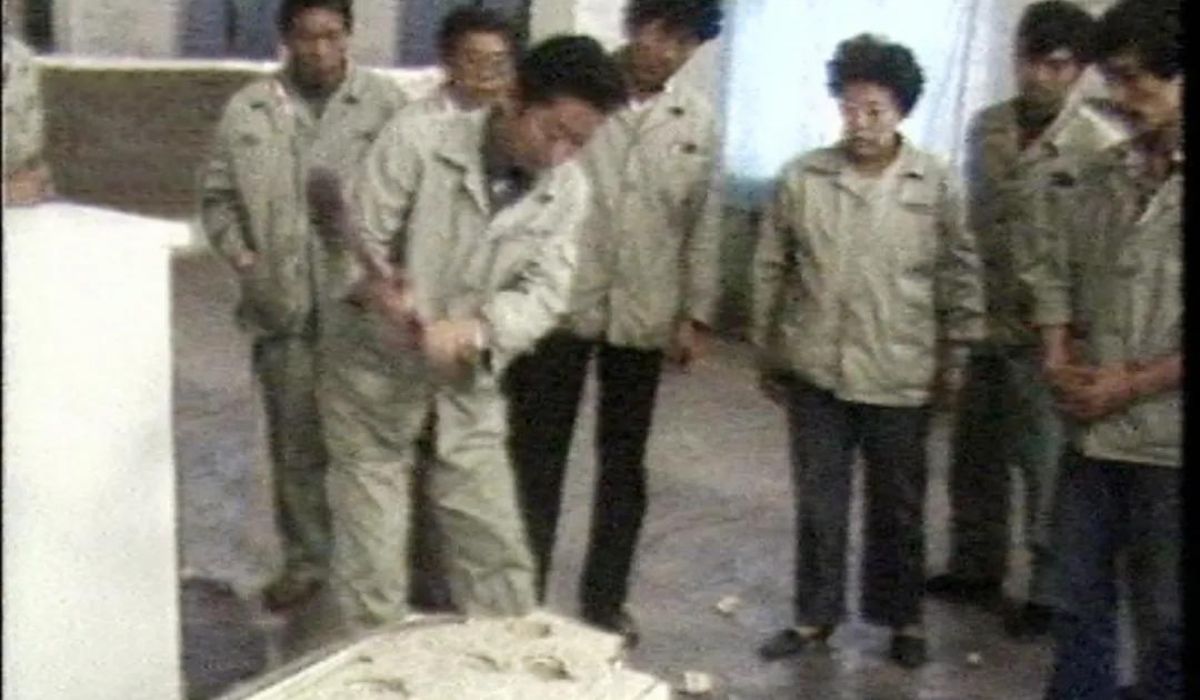
This was not an old product line being dismantled for recycling, nor a staged demonstration for publicity.
The destruction occurred because the refrigerators failed to meet the standards that the new management aimed to establish.
The image survived beyond that moment.
With the company’s subsequent growth, the 76 refrigerators became a recurring symbol in Haier’s corporate history, representing a shift in quality control.
Before Haier, there was the Qingdao Refrigerator Factory
Another detail that often gets lost in the quick retelling of this history is that the factory at that time was not the multinational known today.
Zhang managed the Qingdao Refrigerator Factory.
Over the following years, reorganizations, partnerships, rebranding, and business expansion shaped the group that would eventually adopt the name Haier.
The company also sought foreign knowledge to enhance its production.
This movement was part of a broader transformation in the Chinese economy, where local companies began to incorporate technologies, industrial methods, and business strategies from other markets.
Haier initially grew by focusing on appliances and later expanded into other categories and countries.
Thus, the former problematic factory in Qingdao did not instantly become a multinational.
Between the hammer blows of 1985 and the current global structure lie decades of industrial expansion, acquisitions, and management changes.
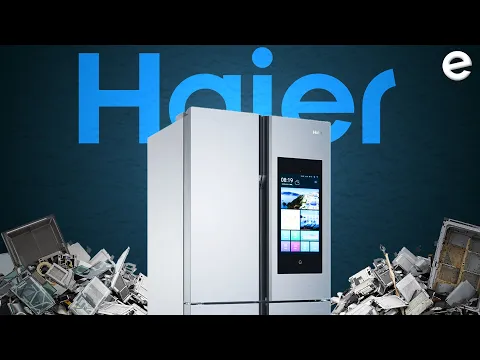

Haier transformed a local factory into a global brand network
The company’s current size helps put that 1985 scene into perspective.
In 2025, Haier Group reported global revenue of 426.8 billion yuan, approximately US$59.8 billion according to the conversion provided by the company, and reported having around 146,000 employees.
The company claims to be present in over 200 countries and regions, today encompassing brands such as Haier, Casarte, Leader, GE Appliances, Fisher & Paykel, AQUA, and Candy.
One of the most notable stages of this internationalization occurred in 2016.
In that year, Qingdao Haier completed the acquisition of GE Appliances, the home appliance business previously owned by General Electric, significantly expanding its presence in the North American market.
The global portfolio also began to incorporate companies and brands developed in other countries, allowing the group to operate under different names depending on the market.
Haier remains among the largest home appliance manufacturers
The latest update makes the comparison even more unusual.
According to Haier, based on a survey by Euromonitor International, the brand achieved in 2026 the 17th consecutive year in the top position worldwide in market share for major home appliance sales.
Haier Smart Home, the listed arm of the group associated with home appliances and residential solutions, reported revenue of 302.35 billion yuan in 2025, surpassing the 300 billion yuan mark for the first time.
The current scale is vastly different from what Zhang encountered when he arrived at the Qingdao factory.
Leadership has also changed.
Zhang Ruimin stepped down as chairman of the Haier Group in November 2021 and became the founder and honorary chairman. Zhou Yunjie took over as chairman and CEO of the group.
Modern refrigerators incorporate electronics, sensors, connectivity, and digital systems, while Haier manages dozens of industrial facilities and brands around the world.
At the beginning of this transformation, however, the message was delivered without screens, presentations, or sophisticated control systems: 76 products that were not meant for consumers were placed on the ground and destroyed in front of those who manufactured them.


