





 Portuguese
  English
  Spanish
  3 min of reading


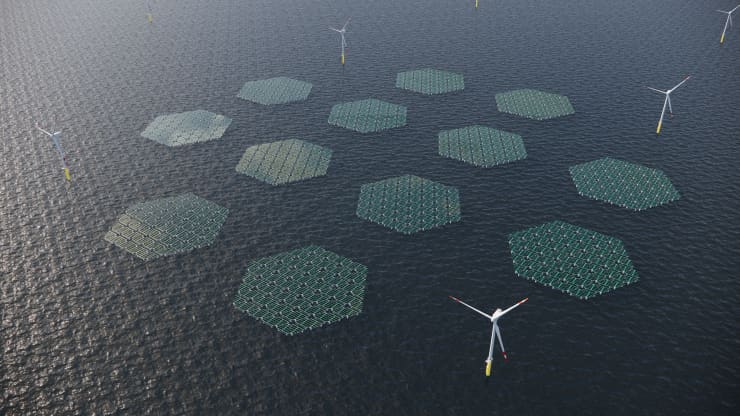
The Solar Panel Is Ultralight And Flexible, Allowing Energy Production With UV Rays Even When Exposed To Seawater And High Amounts Of Diluted Sodium.
RWE, a German company, announced that it intends to invest in the creation of flexible solar panels like a carpet to be added over seawater and produce energy from UV rays. This new technology will be added in installations in the North Sea and will be intended to increase the energy capacity of offshore companies.
The carpet/new solar panel will be durable, despite being thin and lightweight, thus able to withstand even the most intense water waves. According to the company responsible for its development, it will produce about 0.5 megawatts peak, or MWp. In a statement, RWE stated that this project will be one of the pilots of Dutch-Norwegian SolarDuck: “important firsthand experience in one of the world’s most challenging offshore environments.”
Learnings Will Enable The Sale Of This New Technology Starting In 2023
The German company stated that studies are being carried out and, according to new learnings from scientists, it is estimated that this new technology will start being traded in the market and sold to companies starting in the year 2023. Thus, it will be possible to achieve greater energy savings by operating offshore and, therefore, significantly reduce carbon dioxide emissions into the environment.
-
Historic bankruptcy of Centauro shocks the market, and the century-old company puts more than 500,000 products, machines, and complete infrastructure up for online auction.

-
Renewable energy advances over protected areas in Brazil, and a survey by the Energy Transition Observatory reveals silent impacts that challenge environmental conservation and pressure sensitive traditional territories.

-
Rio Grande do Sul accelerates energy transition: State invests in renewable technologies and consolidates decarbonization strategies and pathways to attract billions in new industrial investments.

-
With 160,000 m² of collectors, an area larger than 20 football fields, Silkeborg, in Denmark, hosts a solar thermal plant that heats 19,500 homes and could become the largest solar heating plant in the world.


Numerous technologies are being created and developed to innovate solar energy and decrease the dependence on polysilicon, a material widely used in traditional panels, which is already at one of its highest price peaks in the last eleven years due to its market shortage.
One of the developments that has drawn the most attention in 2022, in addition to this carpet-style solar panel, was an American development that could enable the creation of solar energy from seaweed that, besides everything, could capture a high amount of carbon dioxide from the environment and reduce the effects of global warming.
Solar Panel May Be Used In One Of The Largest Offshore Parks In Europe
The German company stated that the project may, if it produces the necessary energy amount as estimated, be used in one of the largest offshore parks in Europe, the Hollandse Kust West. In a statement to the press, the company said that “the integration of floating solar energy offshore in an offshore wind farm” was “a more efficient use of ocean space for energy generation.”
Currently, one of the largest solar parks in Europe is being inaugurated by EDP, which installed more than 12,000 photovoltaic panels that represent one of the continent’s largest energy reservoirs.
The project combines the solar energy grid with hydropower to increase productivity and reduce costs. In other words, there is a hybridization process in which different projects and machines are responsible for working together to produce the necessary energy. According to EDP, hybrid energy production models allow the company to achieve greater cost savings in its production in the medium and long term.
More News On Scientific Development This Week
Another news related to scientific development this week is about the announcement of North Volt, a company formed by two former Tesla executives, which reported that it is developing a study on the possibility of creating wood batteries. That is, the main raw material of the battery would be a product derived from wood that trees possess at least 20% in their composition. Read more about wood batteries here.










Seja o primeiro a reagir!