





 Portuguese
  English
  Spanish
  6 min of reading
  2 comments


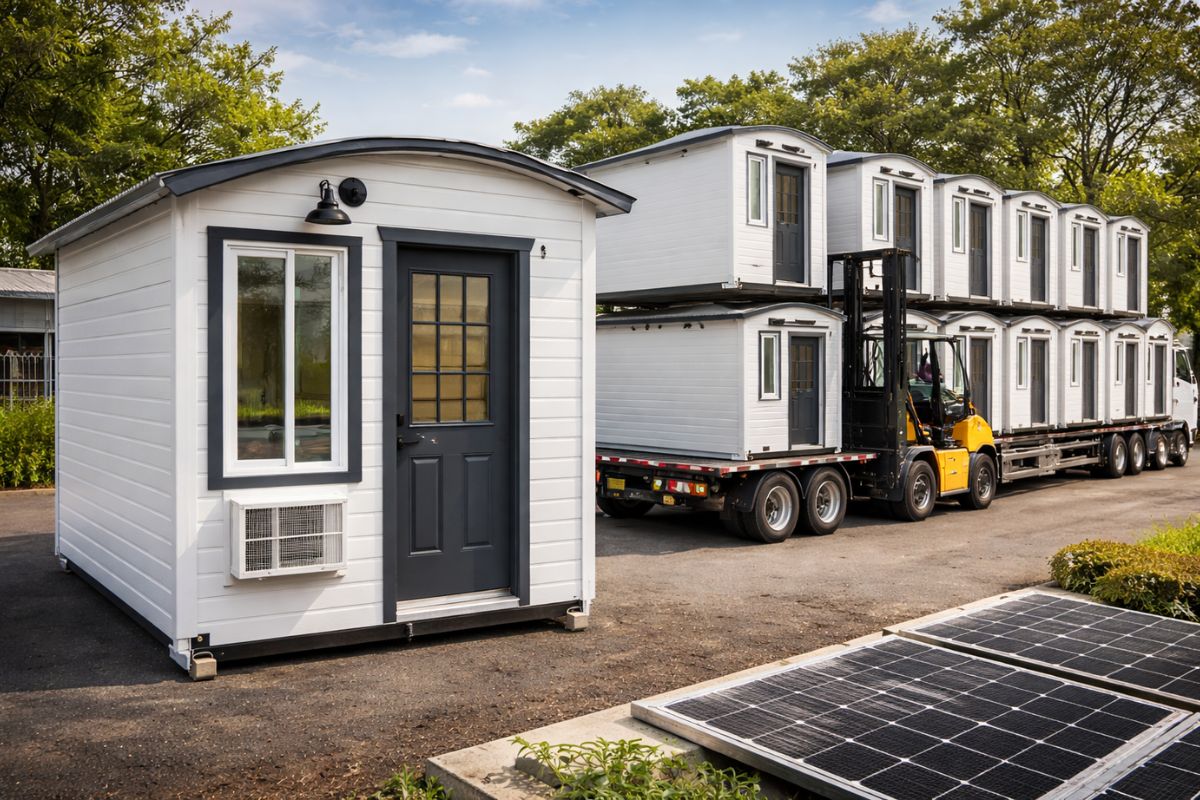


Developed by Foldum, the temporary micro-shelters combine a disassemblable structure, galvanized steel, rock wool insulation, and flat-pack shipping for accelerated deployment in emergencies, worker housing, and humanitarian aid, with on-grid or off-grid versions, climate control, accessibility, and tested resistance to extreme field conditions with optimized logistics.
The Foldum micro-shelters enter the rapid response debate with a clear proposal: to create disassemblable and ready-to-use units that can go from transport to the field with less delay, less improvisation, and more operational predictability. Instead of relying on fragile solutions or long-term construction, the company presents modules in galvanized steel designed for transitional housing, workforce, and humanitarian action.
What stands out is not just the speed. The micro-shelters attempt to bridge urgency and technical standards, incorporating climate control, keyless entry, operation connected to the grid or off the grid, accessibility, and a foldable design that, according to the company, allows transporting up to ten units per truck. The discussion, therefore, moves beyond minimum shelter and shifts to the idea of scalable deployment with some degree of comfort and permanence.
What Changes When Rapid Response Is No Longer Improvised

The logic of the micro-shelters is based on a sensitive point in any crisis or remote operation: time.
-
With 15 floors, an unusual building in Curitiba uses concrete, pilasters, and exposed roofs to create the effect of stacked houses.

-
Archaeologists opened a secret chamber that had been sealed by sand for 40,000 years inside a cave in Gibraltar and found what may be the last place where Neanderthals lived before disappearing from Europe forever.
-
The water that may have gone to the Moon with NASA during the Apollo 11 mission and been consumed by the astronauts springs in a Brazilian city at an altitude of 945 meters, famous for its thermal springs, above-average quality of life, and a natural radioactivity so unusual that it attracted Marie Curie.

-
In 200 days, a Finnish man builds with his own hands an 11-meter boat powered by solar energy with “infinite autonomy,” capable of dispensing with refueling and already used as a floating house.

When there is population displacement, the need to house teams, or a lack of local infrastructure, the delay between demand and shelter installation usually costs security, hygiene, rest, and organization.
Foldum attempts to address this with disassemblable units that arrive ready for deployment, along with installation and logistics support.
This detail matters because rapid response is not limited to providing shelter. It requires a structure that can be repeated, stacked, moved, and organized in the field with some rationale.
This is why the company positions the micro-shelters for governments, worker housing, humanitarian aid in disasters, and even education and training, in situations like transitional housing, modular classrooms, or excess demand on campuses.
Unlike solutions that only address immediate impact, the micro-shelters are presented as deployable dwellings designed to last longer.
The company insists on the idea of dignity, and this appears when it describes the shelter as a space that tries to feel more like a “home” than a provisional solution, even in scenarios of logistical pressure and operational urgency.
This ambition becomes clearer in the typologies. There is a cabin-type unit with a mini-kitchen and private bathroom, designed for long-duration missions or transition programs.
There are also sleeping units for up to eight people in bunk beds, sanitary modules with up to four cabins, each with a shower, toilet, and sink, as well as laundry units for up to six users.
It is not a single emergency piece, but a modular system for combined use.
Materials, Fire, Mold, and the Effort to Withstand Heavy Field Conditions

From a construction standpoint, the micro-shelters rely on galvanized steel and rock wool insulation.
According to Foldum, this combination resists fire up to 760°C and also inhibits microbial growth, targeting two common problems in long-term deployment environments: fire risk and deterioration caused by moisture, condensation, and continuous use.
The company also claims that the units have been tested in extreme conditions, from freezing winters to desert heat, to ensure operation year-round.
This type of assertion attempts to address a classic objection to rapid shelters: that they only serve for a short window and fail when the weather tightens.
Here, the narrative is opposite: a structure that is built for harsh field conditions without abandoning minimum comfort.
Technical specifications reinforce this image. The sidewalls are 9 feet high, the exterior uses Hardie cement board siding, the roofing includes tiles rated Class A fire resistance, and the indicated roof load is 308 PSF.
The exterior walls are constructed from 2×6, the interior from 2×3, and the electrical panel box can reach 200 amperes.
In terms of energy and thermal aspects, Foldum informs about Energy Star certification, R-38 roof insulation, R-21 wall insulation, and R-22 floor insulation, plus an Ecobee Smart thermostat and LED lighting throughout.
The set suggests an attempt to treat the shelter as habitable infrastructure, not just as a temporary protective shell.
Energy, Access, and Operation in Scenarios Where the Grid May Fail

One of the most relevant points in the design of the micro-shelters is the ability to operate both connected to the grid and off the grid. According to the company, the units are compatible with solar energy, batteries, and traditional power, which expands use in remote locations, disaster areas, temporary work fronts, and places where electrical infrastructure has not yet been restored.
This flexibility significantly alters the deployment profile.
When a module can function on-grid or off-grid, the shelter stops being entirely dependent on its surroundings.
It can enter before the rest of the infrastructure, shortening the gap between arrival, installation, and effective use. In critical scenarios, this difference can mean less time in precarious shelter and faster reorganization of space.
The presence of HVAC and keyless entry also helps to clarify who these micro-shelters are designed for.
In the case of worker housing, the company refers to remote, seasonal teams or those without access to the electrical grid. In humanitarian aid, the focus shifts to wildfires, hurricanes, and other crises that require immediate shelter.
There is also an emphasis on accessibility for people with disabilities, indicating an attempt to broaden the system’s utility for public and community operations.
In rapid response, excluding user profiles often generates bottlenecks later, and this type of adaptation seeks to prevent urgency from delivering fast structure, but incomplete.
Logistics, Flat Packaging, and the Scale That Determines If the Idea Works
If the technical discourse supports durability, logistics is what sustains scale. Foldum claims that the foldable design in flat packaging allows transporting up to ten units per truck.
This reduces shipping costs, improves space utilization, and accelerates deployment, especially when the operation needs to move many modules quickly.
This point is central because the real speed of a shelter does not depend only on assembly, but on transport to the point of use.
There is no point in having a rapid structure if it arrives slowly, occupies too much space, or requires a complex supply chain to be positioned.
The appeal of the micro-shelters lies precisely in trying to solve the whole equation: manufacturing, packing, shipping, installing, and putting into operation.
The company also speaks of community implementation, with the modules being used to form functional sets in real contexts of transitional housing and worker accommodation.
This suggests that the individual unit is just one part of the design; the other is how it fits into a larger composition with dormitories, bathrooms, laundry, and organized circulation.
In the end, the performance of the system depends on repetition. The more predictable the cycle of shipping, assembly, and operation is, the closer the micro-shelters come to the idea of replicable infrastructure.
This is where the promise goes from being “rapid shelter” to attempting to become a deployment method for governments, companies, and humanitarian actions that cannot afford to stop and rebuild from scratch every time a new demand arises.
The Foldum micro-shelters are presented as a modular response for scenarios where speed, resistance, and logistics must go hand in hand.
Galvanized steel, rock wool insulation, on-grid or off-grid operation, HVAC, keyless entry, accessibility, multiple typologies, and shipping of up to ten units per truck compose a proposal that seeks to move away from improvisation and position itself as a repeatable standard of deployment in the field.
The question that remains is not just whether the shelter arrives quickly, but what kind of life it can sustain when the urgency goes beyond the first day. If a municipality, a company, or a humanitarian operation had to choose today between tents, conventional modules, and micro-shelters, what would weigh more for you: fire and mold resistance, comfort with climate control, or the logistics of fitting ten units in a single truck?







Quanto custa uma peça destas ????
As entregas destas minis residências para o Brasil fica em torno de quanto ou uma peça e qual valor