





 English
  Francês
  Alemão
  Italiano
  Japonês
  Norueguês
  Portuguese
  Spanish
  4 min of reading


Hydrotreated Vegetable Oil (HVO) Has Been Mentioned Around the World Over the Last 12 Months, With Everyone Wanting to Know More About This New Renewable Diesel That Is Less Polluting Than Petroleum Derivatives, Capable of Reducing Carbon Emissions and Helping Companies Improve Their Environmental Impact, Without Neglecting Combustion Engines
HVO is a renewable drop in the diesel replacement fuel. that offers users a 90% reduction in greenhouse gas emissions, as well as significant air quality benefits. Its renewable status comes from the nature of its raw materials, which are typically plant-based, food, or animal waste. In addition to all these advantages, HVO reduces fine particulate matter (PM) by 33%, hydrocarbons (HC) by 30%, carbon monoxide (CO) by 24%, and nitrogen oxides (NO) by 9%. All pollutants with high levels of emissions when biodiesel is consumed.
HVO Gains Popularity and Researcher Highlights Benefits


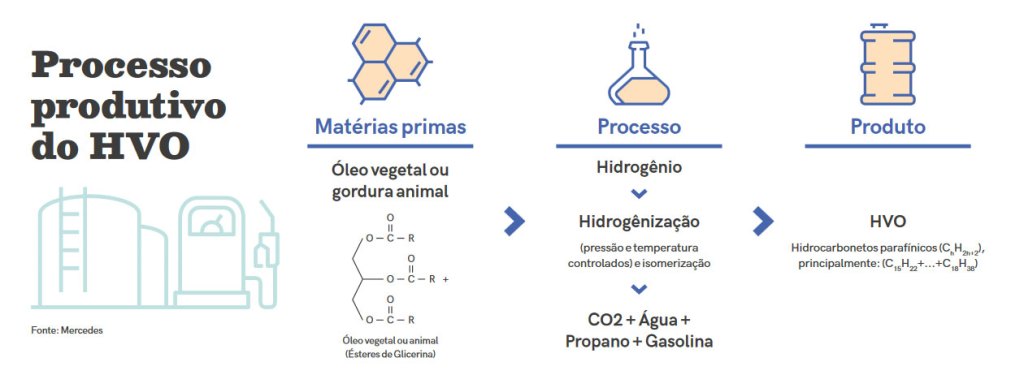
Renewable diesel (HVO) is created through a hydrogenation process, which simply means it is created using hydrogen instead of methanol as its “catalyst” and that oxygen is removed from vegetable oils in the process.
HVO is a second-generation biofuel made 100% from residual raw materials, which go through a much more complex refining process and produce a cleaner, higher-quality fuel that is fully interchangeable with diesel.
-
Brazilian giant expands borders in the Southeast: Petrobras confirms new oil discovery in ultra-deep waters in the pre-salt of the Campos Basin.

-
Alert in the global energy market: Severe tropical cyclone hits the coast and disrupts gas production at major plants in Australia, threatening global supply.

-
Engineers propose a fourth traffic light for intersections – the change promises to affect crossings, queues, and waiting times.

-
Chevrolet Suburban Z71 lands in Brazil with a V8 engine, off-road design, air suspension, seven seats, and colossal size, a rare version imported for around R$ 1.3 million with luxury and exclusivity.


It is a true immediate diesel replacement, meaning users do not need to make initial changes to infrastructure or spend significant money on retrofits to ensure compatibility.
In summary, it is a renewable fuel capable of nearly eliminating CO2 emissions when consumed, and during its lifecycle has 50% to 90% less GHG emissions compared to conventional diesel. In addition to reducing fine particulate matter (PM) by 33%, hydrocarbons (HC) by 30%, carbon monoxide (CO) by 24%, and nitrogen oxides (NO) by 9% – pollutants whose emission levels are increased when using biodiesel.
Used pure or blended with petroleum diesel in high proportions, green diesel is as efficient as fossil diesel, ideal for use in current engines without the need for adaptation. Moreover, for the production of HVO, it is possible to use the infrastructure of existing oil refineries.
HVO Is Not a New Product
Some may not have heard of HVO in recent years, but it is by no means a new product. It has been used in commercial fuels for over a decade across Europe, and in many Scandinavian countries, it is available at the pump as regular diesel for consumer use. However, in the United Kingdom, the product is finding new formulas and gaining attention, growing significantly in popularity over the last 12 months.
Companies are now realizing they need to do something different when it comes to dedicated petroleum fuels and that, although HVO is not a ‘cheap’ option compared to diesel, it is the most viable and easy-to-implement solution at the moment, potentially achieving a 90% reduction in CO2 footprint impact. Compared to other clean energy alternatives for the future, such as electricity and hydrogen, it may also be the most economical.
HVO is a fuel that, like biodiesel, can be produced from vegetable oils, such as palm, soybean, sunflower oil, tall oils (from wood scraps), waste fats (cooking oil), and animal fats. However, to specifically produce HVO, the oils must come into contact with hydrogen under high pressure, and only then is the fuel created. This process allows it to be obtained from a greater variety of raw materials that do not compete with food production.
Advantages of HVO Over Biodiesel
Here are some of the main advantages of HVO, highlighted by researcher Rogelio Sotelo-Boyás from the National Polytechnic Institute of Mexico, in relation to standard diesel used in Brazil. Check it out:
- HVO is compatible with all existing modern engines;
- Future diesel has greater flexibility in sourcing raw materials;
- Much more stability in oxidation;
- Higher cetane percentage;
- It is 90% renewable and does not pollute the environment;
- HVO does not require water in its production process;
- It does not need any type of initial treatment to be marketed;
- It performs better in colder times and in densely climatized regions;
- Its transportation does not cause any additional pollution.
As a rule, biodiesel is all fuel derived from renewable biomass, and HVO is also produced from the same raw materials. However, these products have different components because, from a chemical point of view, HVO is a mixture of hydrocarbons (made up of carbon and hydrogen), whereas biodiesel is a mixture of esters (composed of carbon, hydrogen, and oxygen).
HVO Is Being Discussed in Brazil and May Arrive Soon
The combustion engines in Brazil that meet the standards established by the Proconve 3 regulations, which run on B-10 diesel, do not require any changes to use HVO. The only necessary change would be a lubrication additive, since the renewable diesel HVO has a low lubrication content.
Brazil, however, is still starting discussions regarding the application of HVO in the country. Currently, this alternative is already available for vehicles in Europe, Asia, and North America. An industrial facility for the production of HVO is in the process of being implemented in Paraguay, which opens up a horizon for the fuel in South America.
For now, in Brazil, the fuel is produced only on a experimental basis by Petrobras, without any regulation. However, a proposal for regulation by the National Agency of Petroleum, Natural Gas and Biofuels (ANP) is already pending. Perhaps, soon, we will have this green fuel option for our vehicles.










Seja o primeiro a reagir!