





 Portuguese
  English
  Spanish
 3 min of reading


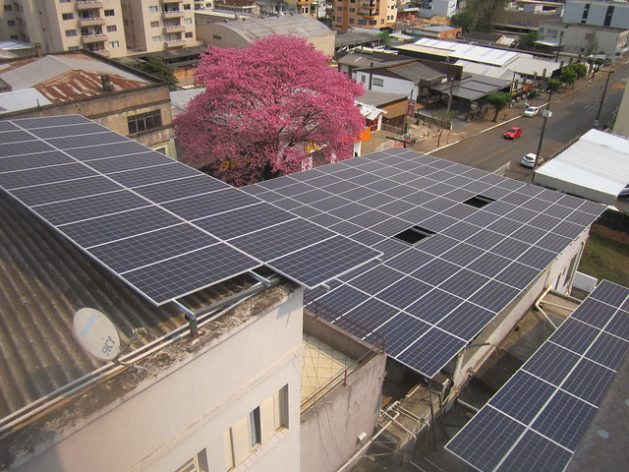
“Being Supportive Means Consuming Energy Generated in One’s Own Municipality” – This is the Motto of a Distributed Renewable Energy Generation Project in One of the Many Low-Middle-Class Neighborhoods in Brazil.
“Sertão (the word for the semi-arid hinterland of the country) with solidarity” is how the director of the Brazilian Association for Distributed Renewable Energy (ABGD) in Minas Gerais, Walter Abreu, named the renewable energy project for low-middle-class people. The entity promotes solar energy in the northern part of that state, where 1.5 million out of 2.7 million inhabitants live in poverty and half of them in extreme poverty.
Read Also
- Petrobras’ Entry into Environmental Reserve Blocked by Indigenous Groups
- Job Opportunity in the Technical Area in Macaé
- Grupo Process Provides Extensive Industrial Selection Process
The Government Should Invest More in Renewable Energy
If local governments decided to use solar panels to generate energy consumed by their offices and other facilities, it would represent significant savings in public spending and revenues comparable to a minimum wage (about 200 dollars a month) for 3,500 families, Abreu estimated in an interview with Solar TV, a channel advocating for renewable energy use.
Another estimate he provided is that increasing the proportion of renewable energy in the national power grid to five percent could lift two million people out of poverty in the semi-arid Northeast of Brazil, a region of 27 million people that experienced the worst drought from 2011 to 2018.
-
Renewable energy advances over protected areas in Brazil, and a survey by the Energy Transition Observatory reveals silent impacts that challenge environmental conservation and pressure sensitive traditional territories.

-
Rio Grande do Sul accelerates energy transition: State invests in renewable technologies and consolidates decarbonization strategies and pathways to attract billions in new industrial investments.

-
With 160,000 m² of collectors, an area larger than 20 football fields, Silkeborg, in Denmark, hosts a solar thermal plant that heats 19,500 homes and could become the largest solar heating plant in the world.

-
A study reveals the expansion of renewable energy procurement in Brazil and shows how companies are taking advantage of opportunities to reduce expenses, ensure energy efficiency, and strengthen strategic environmental commitments.


Distributed Energy Generation for Low-Middle-Class People
Distributed or decentralized generation is viewed as an important means of providing a social boost to poor or low-energy-consuming communities in different parts of this country, where 23.7 million people out of a total population of 212 million live in poverty and other low-middle-class conditions.
The expansion of decentralized generation is part of a broader transition across several sectors, such as decarbonization in response to climate change requirements, breaking monopolies, and empowering consumers to become “prosumers” – both producers and consumers of renewable energy at the same time.
Renewable Energy Generates Jobs for the Low-Middle-Class
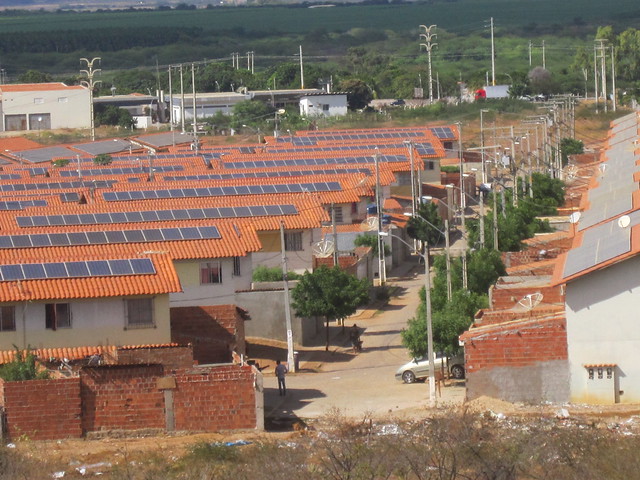
In this process, renewable energy plays a prominent role, “as the fastest-growing source that creates the most jobs,” said Carlos Evangelista, president of ABGD, over the phone from São Paulo to IPS. Additionally, 57 percent of these jobs in Brazil stem from the installation of solar energy systems, meaning they are local, not distant or foreign, unlike the manufacturing and marketing jobs of the equipment, he emphasized.
Isolated solar energy systems in many communities in the Amazon rainforest, far from the electrical grid, produce perhaps the most remarkable effects. They are used to pump water and refrigerate to preserve fish, the main source of local protein, along with other foods and exportable forest products, such as açaí, fruit from a palm tree of the same name (Euterpe oleracea).
In general, scattered villages in the jungle rely on diesel or gasoline generators, which operate only a few hours at night due to the high cost of fuel and its scarcity. Fuel takes days to be brought by riverboat.
ABGD, supported by the Charles Stewart Mott Foundation from the United States, promotes policies and projects with more than sixty municipalities in the Amazon rainforest in northern Brazil, aiming to “mobilize resources for an economy transitioning from fossil fuels to renewables and solar energy is one of the solutions,” Evangelista stated.










Seja o primeiro a reagir!