





 English
  Francês
  Alemão
  Italiano
  Japonês
  Norueguês
  Portuguese
  Spanish
 3 min of reading


Mato Grosso Capital, Cuiabá Maintains Its Position as the Main Source of Distributed Solar Energy Generation in Brazil, According to Research from a Specialized Institute
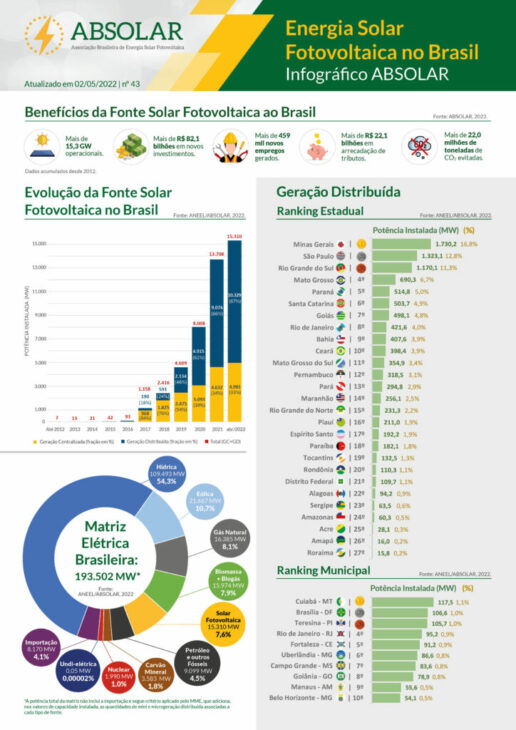
Cuiabá (MT) has been leading the ranking of Distributed Solar Energy Generation for a year, according to information released this month by ABSOLAR (Brazilian Association of Photovoltaic Solar Energy).
The research revealed that the municipality has 117.5 megawatts (MW) of power distributed across small plots, closed areas, and rooftops, accounting for 1.1% of all Distributed Solar Energy Generation power spread across Brazil.
According to data from April, Brasília, in the Federal District, occupies the second position, with 106.6 MW (1% of the total). In third place is Teresina, in Piauí, which has 105.7 MW (also 1% of the national total).
-
Renewable energy advances over protected areas in Brazil, and a survey by the Energy Transition Observatory reveals silent impacts that challenge environmental conservation and pressure sensitive traditional territories.

-
Rio Grande do Sul accelerates energy transition: State invests in renewable technologies and consolidates decarbonization strategies and pathways to attract billions in new industrial investments.

-
With 160,000 m² of collectors, an area larger than 20 football fields, Silkeborg, in Denmark, hosts a solar thermal plant that heats 19,500 homes and could become the largest solar heating plant in the world.

-
A study reveals the expansion of renewable energy procurement in Brazil and shows how companies are taking advantage of opportunities to reduce expenses, ensure energy efficiency, and strengthen strategic environmental commitments.


Learn How Solar Energy Works:
According to data from April, Brasília, in the Federal District, occupies the second position, with 106.6 MW (1% of the total). In third place is Teresina, in Piauí, which has 105.7 MW (also 1% of the national total).
In December of last year, Cuiabá took the lead in the municipal solar energy ranking for the first time. At that time, the capital had 51.6 MW of operated power. In January of this year, the number increased to 53.0 MW, then rose to 58.8 MW in February. After that, from March to April, Cuiabá dropped to second place (with 61.5 MW and 65.3 MW). During that time, Brasília (64.8 MW and 66.0 MW) held the first position. Cuiabá regained the top spot in May, consolidating itself for eleven months as the best capital in this regard.
Check the Statistics:
- 2021
- May: 76.9 (1.4% of the total in Brazil)
- June: 81.8 (1.4%)
- July: 76.1 (1.3%)
- August: 79.9 (1.3%)
- September: 86.0 (1.3%)
- October: 89.1 (1.3%)
- November: 91.9 (1.3%)
- December: 95.9 (1.3%).
- 2022
- January: 99.7 (1.2%)
- February: 104.3 (1.2%)
- March: 114.1 (1.1%).
According to Sindenergia, the union of Construction, Generation, Transmission, and Distribution of Electric Energy and Gas in Mato Grosso, the solar source of large plants raised over R$ 21.7 billion for Brazilian public coffers in solar energy investments. The total capital exceeds R$ 78 billion, generating over 450,000 jobs since 2012. This also helped avoid the emission of 20 tons of carbon dioxide. At its peak, Brazil once reached a 118% increase in solar energy. The data is from ABSOLAR.
According to Tiago Vianna, the regional director of ABSOLAR and president of Sindenergia, the current context is the result of the continuous rise in electricity tariffs in recent months: “Solar energy is a reality, an option for the average citizen to manage their expenses. They have legal security on their side,” he said.
See Indices and Benefits of Solar Energy in Cuiabá and Brazil
Vianna also comments that, starting in January of this year, solar energy production in residences is supported by law, the Legal Framework for Distributed Generation: “This greatly helps in reducing the electricity bill, especially for those who use the system.”
As the ABSOLAR study shows, the sector expects significant development in 2022 in national solar energy systems and Distributed Generation, among other reasons due to the enactment of Law No. 14.300/2022, enacted by President Jair Bolsonaro in January. The law creates the legal framework for autonomous energy generation. “Therefore, this is the best time to invest in solar energy, due to this transition expected in the law, ensuring that current regulations remain in place for those who consume and install solar operations on rooftops until the year 2045,” explains Ronaldo Koloszuk, Chairman of the Board of Directors of ABSOLAR, which created 150,000 jobs in two years in Brazil.









Seja o primeiro a reagir!