





 English
  Francês
  Alemão
  Italiano
  Japonês
  Norueguês
  Portuguese
  Spanish
  3 min of reading


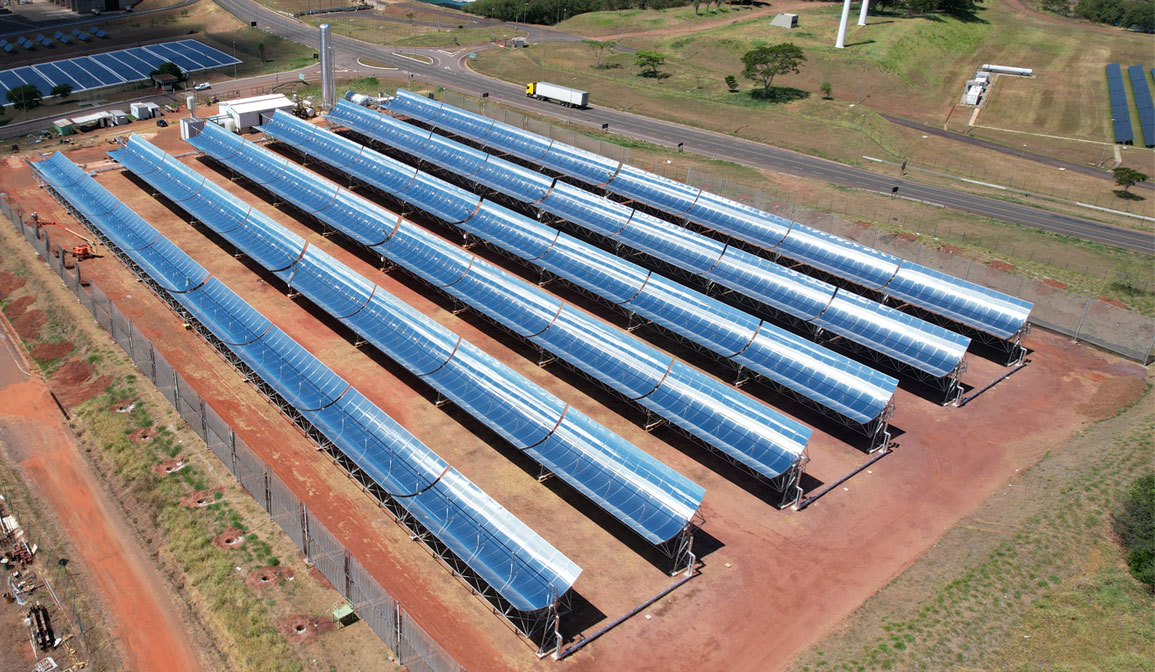
The New Concentrated Solar Power Plant Guarantees Advantages Such As Heat Storage for Use After Sunset
The São Paulo Energy Company (CESP) inaugurated Brazil’s first concentrated solar power plant during the week of March 20, located in the municipality of Rosana, São Paulo. In development for approximately 5 years, since 2017, the country now receives a new milestone for energy generation with the start of operations. In partnership with Lactec, Eudora Energia, MRTS Consultoria, and MFAP Consultoria, the plant’s project was created as part of the Research and Development Program for the Electric Energy Sector, regulated by the National Electric Energy Agency (Aneel).
The pioneering plant received an investment of 57 million reais, aiming to demonstrate that the new technology, known as heliothermal, is also present in national soil. According to CESP, the heliothermal source is characterized by its ability to produce adjustable energy and is less vulnerable to the impacts of sunlight. The most notable advantage of this technology compared to other intermittent renewable sources is the capacity to store heat for use in situations that benefit the electrical system. Thus, the heated fluid can continue to generate thermal energy to the turbines even in the absence of sunlight.
More Details on the Concentrated Solar Power Plant
According to the website PetroNotícias, the initial concentrated solar power plant was integrated into the Porto Primavera Hydroelectric Power Plant’s Renewable Alternative Energy Complex. The system features experimental structures for photovoltaic solar sources and energy storage devices. The project has a capacity of 0.5 MW, enough to supply 360 households with an average monthly consumption of around 180 kWh. The technology model used in CESP’s newest plant, also known as CSP (concentrating solar power), follows a similar processing method to thermoelectric plants but uses solar heat as an energy source instead of fossil fuels.
-
While Russia dominates the global wheat market, Brazil emerges as an unexpected competitor in the Cerrado, offering grain available in July and August when stocks in the Northern Hemisphere are at their lowest point of the year.

-
China returned almost 20 Brazilian ships with soybeans, but now everything could change: the country that buys 80% of the grain is considering relaxing regulations after impurities held up shipments of thousands of tons and caused million-dollar losses.

-
Chinese giant worth nearly R$ 4 billion that manufactures cables for electric cars, solar energy, and robotics wants to open a factory in SC.

-
Many employers do not know, but the law guarantees domestic workers a 25% increase in salary during trips, 50% for overtime, 20% for night shifts, and 17 additional benefits that can lead to labor lawsuits if not paid.


The concentrated solar power plant from CESP was built with parabolic troughs, consisting of panels made of concave mirrors that track the sun’s position. The stored heat warms a transfer fluid that passes through pipes located in the focal region of these troughs, thus generating steam that drives the turbines to produce electricity.
Luis Paschoalotto, CESP’s Operations and Maintenance Engineering Manager, says: “In large-scale units, this generation can last up to 18 hours, allowing the plant to generate energy even without the presence of the source and providing greater control over the processes.” Another feature of the technology chosen by CESP is that the panels are made of aluminum mirrors with a reflective film, a more durable component than glass, which is more common in commercial photovoltaic structures.
“The concentrated solar power source has significant potential for electricity generation in Brazil, as it adds renewable aspects to important attributes for managing the National Interconnected System, such as production control capacity and the inertia associated with rotating machines. The heat produced can also be utilized in other industrial processes, such as cogeneration, and electricity generation can also be combined with production from another type of source in a hybrid model,” says Paschoalotto. According to him, for concentrated solar power to gain prominence and competitiveness in Brazil’s energy scenario, substantial incentives are needed, considering that the investment demand for implementation, operation, and maintenance is much higher than that for other energy sources, such as wind and photovoltaic solar.
Additionally, at the Renewable Alternative Energy Complex of the Porto Primavera Hydroelectric Power Plant, there is also a research and development project by Aneel that studied energy storage through green hydrogen, which is gaining traction in Brazil. The production of the fuel occurs through water electrolysis, meaning that a water molecule (H2O) is separated into hydrogen and oxygen when passed through an electric current, consuming electrical energy and generating hydrogen, which is stored without producing polluting waste.





Seja o primeiro a reagir!