





 Portuguese
  English
  Spanish
  2 min of reading
  0 comments


Brazilian Leads Group At NASA Controlling Communication With Space Robots
A Brazilian is in charge of one of the most important groups at NASA, ensuring that our space robots continue to explore the universe. Luciano Camilo Alexandre, at 39, fulfilled the dream of many engineers by leading the robotic telecommunications group at the Jet Propulsion Laboratory (JPL) of NASA.
Graduated in Santa Rita do Sapucaí, Minas Gerais, with a PhD in telecommunications engineering from Inatel, Luciano nearly gave up his profession in 2019. “In 2019, I even thought about quitting engineering”, he confessed. But life took a turn when he saw a job opening at NASA advertised online. Today, he describes his job as “a dream come true”.
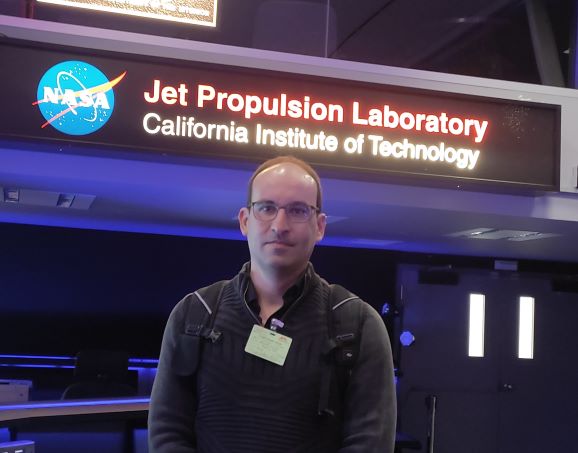
“We have the communication planning for each spacecraft, for each mission in space. For each mission, I have what is like a highway lane, where I will transmit and receive data. And I have to ensure that no mission will interfere with another.”
-
The coldest seawater ever recorded in Earth’s history was hidden under extreme ice 717 million years ago and reached an impressive -15°C.

-
China has launched the world’s first floating artificial island, a scientific structure designed to face open seas, test equipment weighing hundreds of tons, and reach depths of 10,000 meters.

-
China accelerates global science and may surpass the United States in 2 years with increased public investment, continuous growth, and direct impact on the global technological competition.

-
Scientific studies indicate that drought may be strengthening a much greater silent threat: more resistant superbugs.


Luciano is involved in two of the current 40 missions of NASA: the Europa Clipper, which will visit Jupiter’s moon Europa, and the Artemis mission, which marks humanity’s return to the Moon. “We are developing some experiments in the telecommunications area to simulate a possible environment similar to what we could see on Europa”, he explained about the Europa Clipper.
Regarding Artemis, he emphasized: “Enabling new types of services, such as cellular, Wi-Fi, Bluetooth, using the same technologies we have on Earth, adapted to the lunar environment.”
Luciano’s journey is inspiring, showing that, even in the face of challenges, it is possible to achieve prominent positions in institutions like NASA. His story was featured on Globo Repórter, where he shared more details about his journey.
And you, do you believe that more Brazilians can follow Luciano’s footsteps and gain places at NASA and other space agencies? Leave your opinion in the comments!







Seja o primeiro a reagir!