





 Portuguese
  English
  Spanish
  3 min of reading
  0 comments


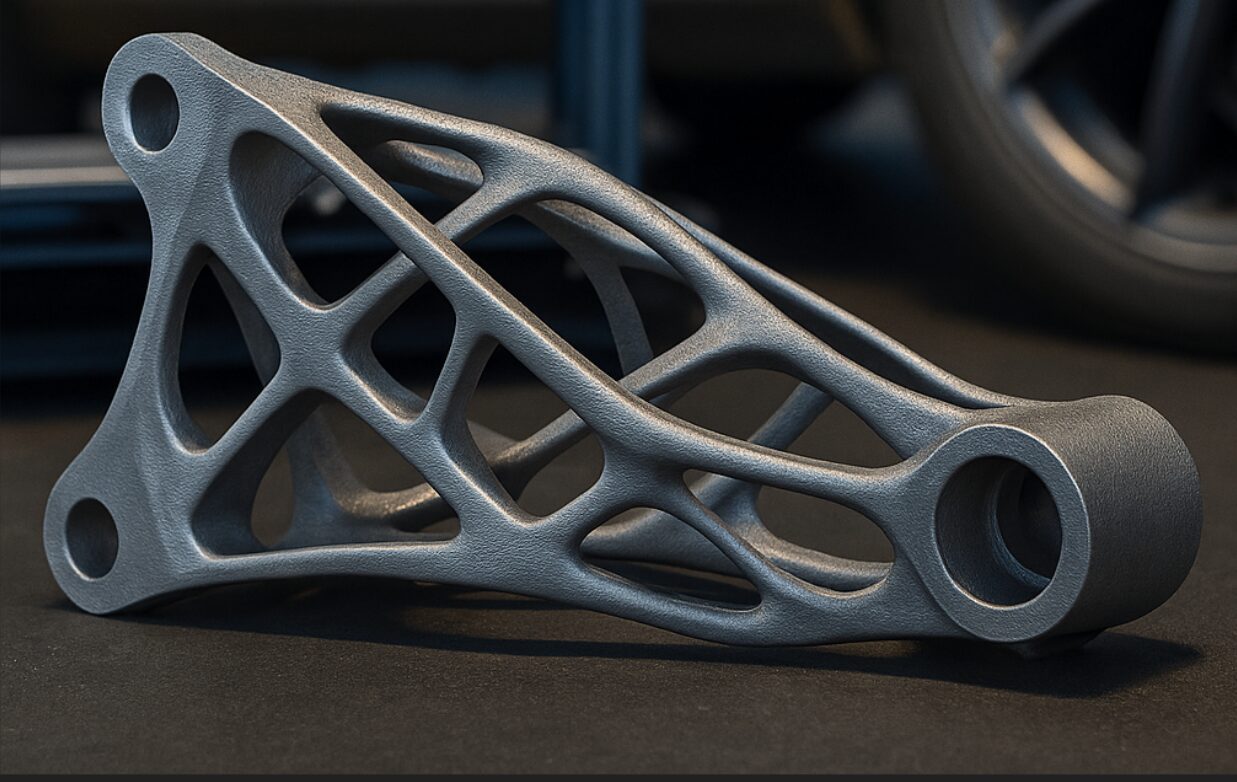
Engineers Developed an Innovative 3D Printing Process Capable of Drastically Reducing the Weight of Parts Used in Vehicles — in Some Cases, by Up to 80%
Engineers from the University of Nottingham created a new way to produce automotive parts that could change the industry. Using 3D printing, they managed to reduce the weight of parts by up to 80%, which has direct impacts on vehicle efficiency and pollutant emissions.
The technique used in the project is called Selective Laser Melting, known as SLM. It allows parts to be manufactured in layers, using 3D models made by computer. This enables the creation of complex structures with aluminum powder, forming strong yet much lighter parts.
Since the process is done layer by layer, only the necessary material is used. There is no waste. And what is left over can be reused.
-
China has launched the world’s first floating artificial island, a scientific structure designed to face open seas, test equipment weighing hundreds of tons, and reach depths of 10,000 meters.

-
China accelerates global science and may surpass the United States in 2 years with increased public investment, continuous growth, and direct impact on the global technological competition.

-
Scientific studies indicate that drought may be strengthening a much greater silent threat: more resistant superbugs.

-
Man builds functional 5-meter submarine in his garage using gas cylinders, PVC pipes, and a refrigerator motor, and navigates with the vessel on a lake in Colombia.
Thus, there is less waste and more resource savings. Additionally, no toxic fluids are used, which improves safety for the environment and workers.
Project FLAC: Less Weight of Parts, More Efficiency
The initiative is part of the FLAC project, an acronym for “Functional Structures for Automotive Components”. The goal is to reduce the weight of parts by up to 80%. As a result, cars use less fuel and emit less carbon dioxide (CO₂).
The reduction in the number of parts also helps. With fewer components, the assembly process is simpler and faster. This can reduce costs for factories and speed up production. Another advantage is the possibility of creating parts with much more efficient shapes that would be difficult or impossible to manufacture using traditional methods.
First Tests in Luxury and Racing Cars
The initial application will be in high-performance vehicles. This includes luxury and racing cars, where every gram counts and innovation is welcome. The tested parts include brake calipers, cooling systems for LED headlights, and components of the powertrain.
These parts are already being evaluated, and the results indicate real performance gains. Over time, the expectation is that the technology will reach regular cars.
Technology That Could Change the Automotive Sector
The proposal goes beyond just producing better parts. The idea is to demonstrate that the technology can be used on a large scale. To that end, the project also studies how to adapt the current production chain to include this form of manufacturing.
The University of Nottingham received over £368,000 for its part in the research. This amount is part of a larger investment of £1.7 million made by the British agency Innovate UK.
Less CO₂ and Greener Production
The environmental impact is one of the project’s strong points. With lighter cars, CO₂ emissions decrease. The estimate is up to 16.97 grams less per kilometer driven, per vehicle. On a large scale, this could represent a significant change.
Another positive factor is the use of recyclable aluminum. The savings in material and the absence of dangerous chemicals help make the process more sustainable from start to finish.
For a Future with Less Impact and More Innovation
If the technology is adopted on a large scale, it could contribute to the global reduction of emissions in the transport sector. It could also stimulate a model of circular economy, where materials are reused instead of discarded.
Local manufacturing, with 3D printers, could also reduce the need for transportation of parts. This decreases the environmental impact of logistical chains and promotes more independence in production.
Selective Laser Melting emerges as a promising tool. It combines innovation, resource savings, and environmental responsibility in a single process. A combination that can elevate the automotive industry to a new level of efficiency and sustainability.








Seja o primeiro a reagir!