





 Portuguese
  English
  Spanish
  4 min of reading
  0 comments


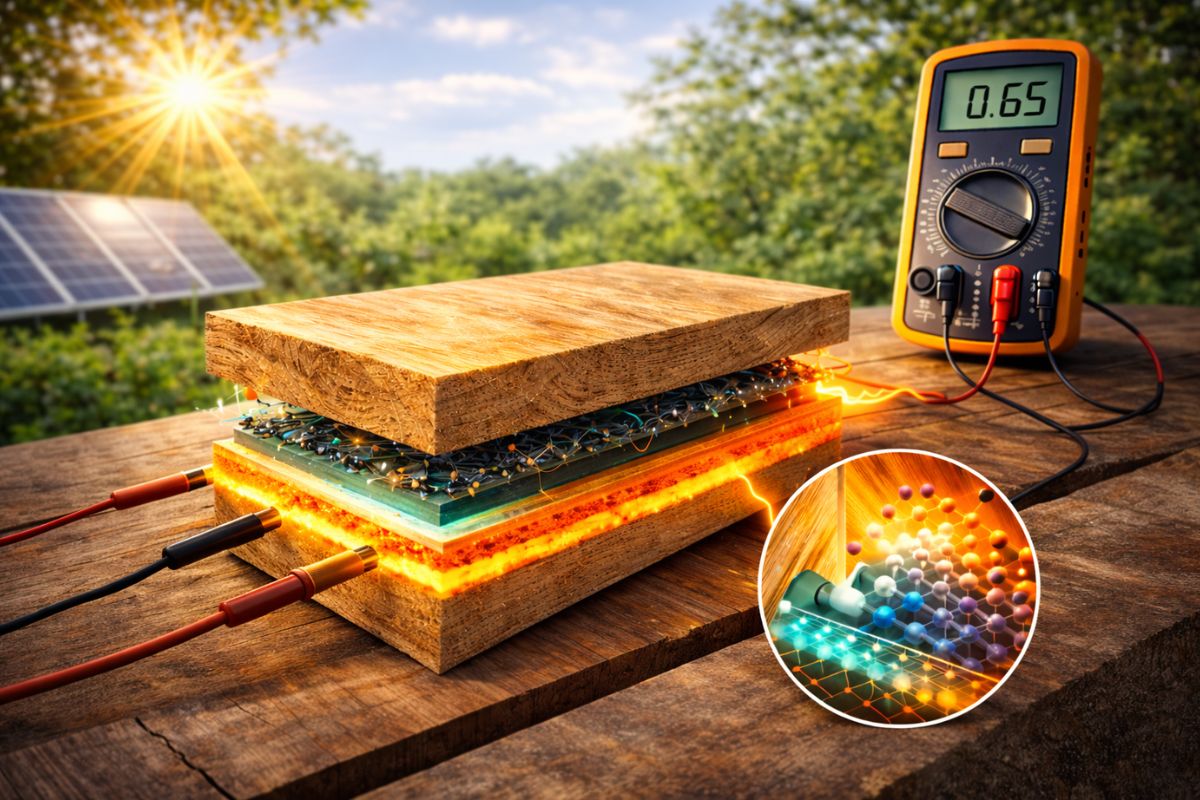
Engineered wood redesigns the balsa from the inside, stores heat in stearic acid with 175 kJ/kg, achieves 91% solar conversion, and delivers up to 0.65 V even after the light disappears
Engineered wood can tackle a classic weakness of solar energy: when the Sun disappears, generation drops too. By redesigning the internal structure of the balsa on a microscopic and nanometric scale, researchers created a material that absorbs light, stores energy as heat, and continues generating electricity even after dark.
The advancement lies in transforming the engineered wood itself into an “all-in-one” system, without stacking different layers that often waste energy at the boundaries between materials. The wood ceases to be just a support and becomes an active part of the conversion, storage, and protection of the system.
Why solar energy “dies” at night and what engineered wood changes
Solar systems can be very efficient at capturing light, but they remain bound to a basic limit: without radiation, there is no immediate power. One solution is to store energy as heat, but this often requires several layers, each with a function, which generates losses.
-
Europe teams up with China on the SMILE mission to study Earth’s “shield” against the Sun and predict solar storms, while NASA gives little attention to the European contribution that helped take the Artemis II crew towards the Moon.

-
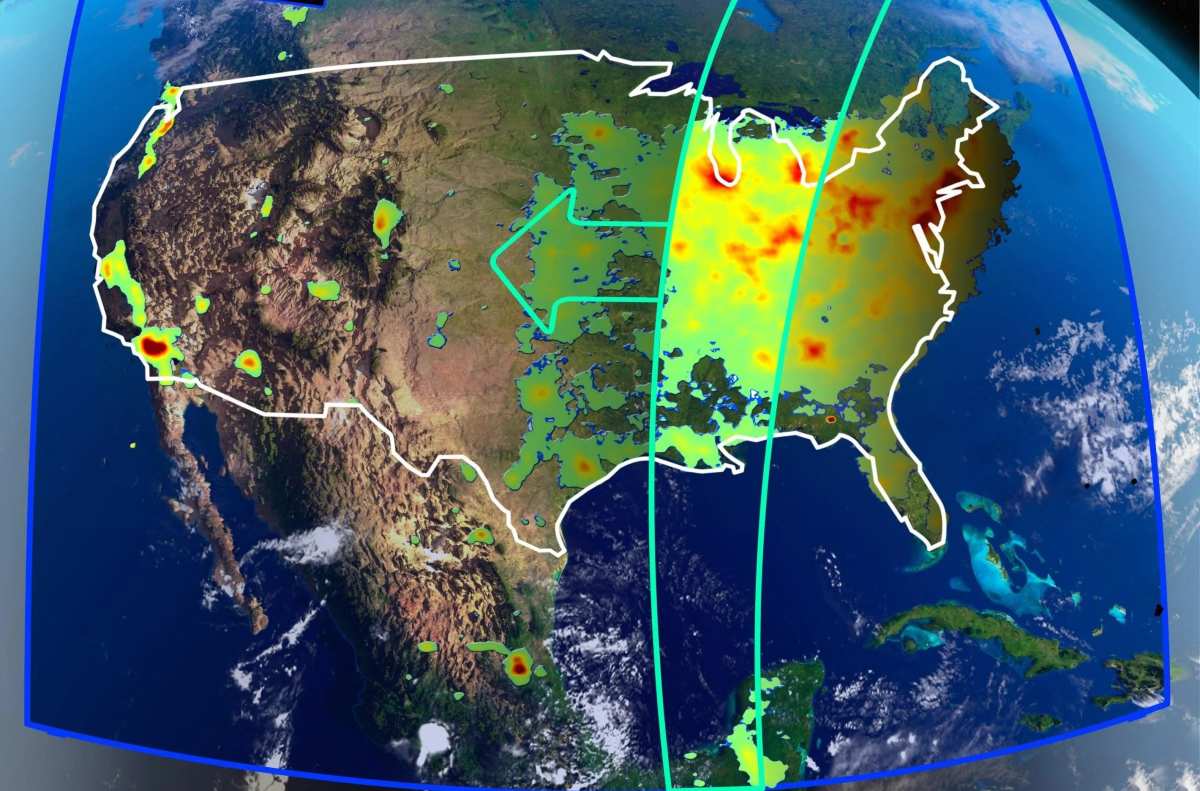
NASA’s satellite now shows where air pollution truly begins, locating roads, factories, and ports in almost real-time, and also adjusts NO₂ measurements with a margin of error between 10% and 20%.
-
Explorers found a colossal underwater mountain hidden in the Pacific, taller than Mount Olympus and nearly four times the Burj Khalifa, and what emerged around it seemed straight out of science fiction, with rare squids, ghost octopuses, and the so-called “flying spaghetti monsters.”

-
The total solar eclipse in August 2026 will transform the day into “night” for 1 to 2 minutes in the path of totality, when the Moon completely covers the Sun and the perfect alignment creates a rare and highly anticipated spectacle for observers around the world.

The proposal of engineered wood is different: to integrate light absorption, thermal storage, and electrical generation into a single structure, using the natural architecture of wood as a “scaffold” for advanced materials.
Balsa from the inside: microtubes that became a natural “scaffold”
The choice of balsa was not for its strength, but for its internal geometry. Under a microscope, it looks like a bundle of aligned microtubes, with channels about 20 to 50 micrometers wide. These channels help guide heat and accommodate other materials.
The problem is that raw wood reflects light and absorbs water. To solve this, the team removed lignin, raising porosity to over 93% and exposing an internal network with many reactive surfaces. The wood becomes a “porous sponge” inside, but maintains direction and structure.
Protected black phosphor: absorbs from UV to infrared and turns into heat
Instead of carbonizing the wood, the engineering was chemical on the walls of the channels. They were coated with ultrathin sheets of black phosphor, capable of absorbing light in ultraviolet, visible, and infrared and converting it into heat.
As phosphor degrades in air, each sheet was protected by a layer made of tannic acid and iron ions, creating a network that acts as a shield against oxidation and also enhances absorption through charge transfer effects. Even after 150 days of solar exposure, the coated material remained stable.
Silver and superhydrophobicity: more light capture and less water
The material received silver nanoparticles to enhance light absorption through plasmonic effects. Then, the surface was modified with long chains of hydrocarbons, making it extremely water-repellent.
The result was a superhydrophobic structure with a contact angle of 153°, meaning water simply rolls off, which helps in outdoor use.
Stearic acid stores heat and sustains generation after the light disappears
With the “scaffold” ready, the channels were filled with stearic acid, a phase change material. When heated, it melts and stores energy; when cooled, it solidifies and releases that heat.
The performance numbers summarize the leap of engineered wood:
- Thermal storage of about 175 kJ/kg
- Solar conversion to heat of 91.27%
- Heat conduction nearly 3.9 times greater along the natural grain of the wood
- Together with a thermoelectric generator, output voltage of up to 0.65 V under standard “one Sun” illumination
In practice, light heats the structure and melts the stearic acid. When the light disappears, the heat is released gradually, maintaining a temperature difference in the thermoelectric generator. This is what allows continued electricity production even in the dark.
Durability and safety: thermal cycles, flame, and microorganisms
Engineered wood was tested in 100 cycles of heating and cooling and maintained performance almost unchanged. It also showed relevant safety behavior: withstood burning and self-extinguished in up to two minutes.
Another point is the antimicrobial surface, designed to reduce the colonization of microorganisms that could degrade performance in outdoor environments. This helps maintain photothermal performance for longer.
What still needs to be done before it becomes a product
Even with the results, the work is still a proof of concept. The next step is to show that engineered wood can operate on a larger scale with adequate energy output for real applications, maintaining stability, viable cost, and repeatable manufacturing.
If this path works, the concept could pave the way for simpler solar storage solutions, as well as uses such as thermal management in electronics, more efficient building materials, and off-grid systems where reliability matters more than peak power.
Do you think engineered wood has more future in off-grid energy and emergencies, or in building materials to reduce climate control costs?
With information from Interesting Engineering









Seja o primeiro a reagir!