





 Portuguese
  English
  Spanish
  4 min of reading
  0 comments


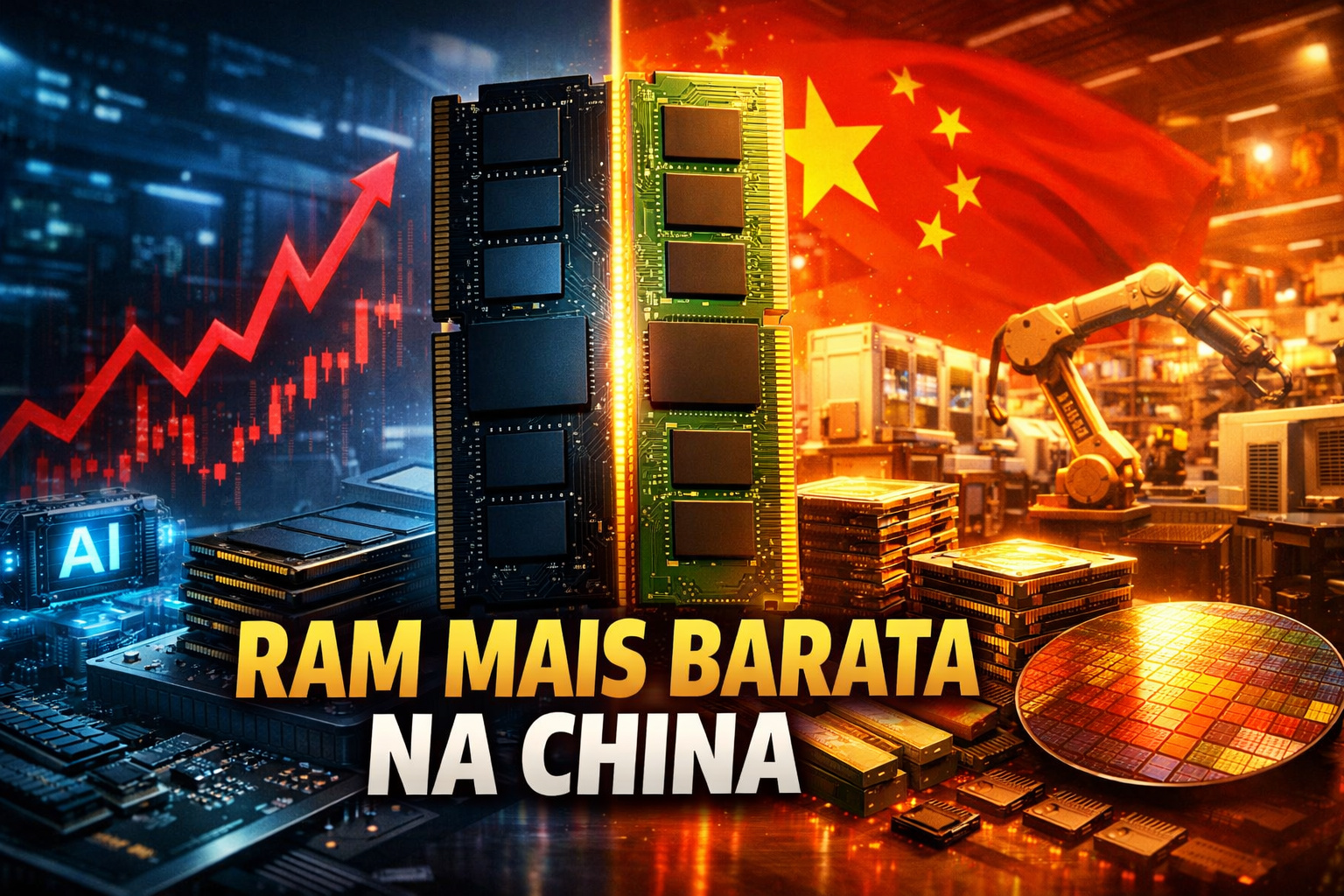
Demand For AI Pressures RAM Prices Worldwide, But In China Chips Are Getting Cheaper And Local Manufacturers Are Accelerating Expansion.
In Beijing, Shanghai, and Hefei (China), throughout 2024 and early 2025, Chinese semiconductor manufacturers began selling RAM and NAND at significantly lower prices than those practiced in the international market. This shift occurs in parallel to a global price increase, driven by the explosion in demand for artificial intelligence.
The information comes from reports published by Reuters, Financial Times and the portal Terra, based on market data and statements from executives and analysts in the semiconductor industry. Among the companies directly involved are ChangXin Memory Technologies (CXMT), the leading Chinese DRAM manufacturer, and Yangtze Memory Technologies (YMTC), focused on NAND memory.
The Explosion of AI and the Global Shock in RAM
Since 2023, the popularization of generative AI models, high-performance data centers, and massive training of neural networks has drastically increased memory consumption. AI-focused servers use much larger volumes of DRAM and HBM (High Bandwidth Memory) than conventional computers.
-
Motorola launched the Signature with a gold seal from DxOMark, tying with the iPhone 17 Pro in camera performance, Snapdragon 8 Gen 5 that surpassed 3 million in benchmarks, and a zoom that impresses even at night.

-
Satellites reveal beneath the Sahara a giant river buried for thousands of kilometers: study shows that the largest hot desert on the planet was once traversed by a river system comparable to the largest on Earth.

-
Scientists have captured something never seen in space: newly born stars are creating gigantic rings of light a thousand times larger than the distance between the Earth and the Sun, and this changes everything we knew about stellar birth.

-
Geologists find traces of a continent that disappeared 155 million years ago after separating from Australia and reveal that it did not sink, but broke into fragments scattered across Southeast Asia.

Global giants such as Samsung Electronics, SK Hynix and Micron Technology have shifted to prioritize production lines aimed at advanced memories for AI, reducing the supply of traditional modules used in PCs, laptops, and standard servers.
The result was direct:
– international RAM prices rising between 20% and 40% in 2024,
– corporate contracts adjusted,
– and bottlenecks for electronics manufacturers in various countries.
Why Prices Fell in China
In China, the scenario is structurally different. The technological sanctions imposed by the United States have limited Chinese companies’ access to advanced chips, state-of-the-art lithography machines, and the high-value external market.
As a consequence, local manufacturers have begun to strongly focus on the domestic market, producing large volumes of conventional DRAM DDR4, LPDDR, and NAND, exactly the types of memory that have become scarcer outside of China.
With abundant supply and controlled domestic demand, local prices fell between 30% and 40%, according to data compiled by analysts cited by Reuters. In some industrial contracts, Chinese modules have cost less than half the equivalent international price.
CXMT and YMTC Operate at the Limit to Fill the Space Left by the West
CXMT, based in Hefei, has accelerated investments in DRAM lines and has begun supplying memory to Chinese manufacturers of PCs, smartphones, servers, and industrial equipment. Although it is still a technological generation behind global leaders, its products perfectly meet applications unrelated to cutting-edge AI.
Meanwhile, YMTC, specializing in NAND flash, has aggressively expanded SSD and storage chip production. The company has managed to maintain competitiveness even after restrictions imposed by the U.S., adjusting processes and focusing on efficiency of scale.
Industry executives claim that the excess of domestic production has become a strategic advantage, allowing low prices, long-term contracts, and greater predictability for Chinese hardware companies.
The Domino Effect in the Chinese Electronics Industry
With cheaper memory, Chinese manufacturers of computers, servers, routers, industrial equipment, and consumer electronics have gained a margin that does not exist outside the country. This has allowed for:
– reduction in production costs,
– maintenance of competitive final prices,
– and expansion of exports to emerging markets.
While Western companies deal with rising component costs, Chinese companies can assemble products with more stable cost structures, even in a globally inflationary semiconductor environment.
A Temporary Advantage or Structural Change?
Analysts diverge on the duration of this phenomenon. Some point out that as global demand for AI stabilizes, international manufacturers may return to balancing the production of conventional memories, reducing the price difference.
Others, however, see the movement as a lasting side effect of global technological fragmentation. With supply chains becoming increasingly regionalized, China is likely to maintain its own semiconductor ecosystem, with prices, priorities, and strategies different from the West.
In this scenario, cheap memory ceases to be just a market anomaly and becomes a tool of industrial and geopolitical competitiveness.
The Silent Paradox of the Global Chip Market
While artificial intelligence pressures prices, concentrates production, and creates shortages across much of the planet, China experiences a rare paradox: abundance amid crisis. What began as a response to sanctions and technological isolation has created a strategic window that local companies are quickly exploiting.
The global memory market, traditionally cyclical, is now entering a more complex phase, marked not only by supply and demand, but by industrial policy, technology, geopolitics, and AI. And, in this game, China has found a gap where few imagined it existed.








-

-

7 pessoas reagiram a isso.