





 Portuguese
  English
  Spanish
  6 min of reading
  0 comments


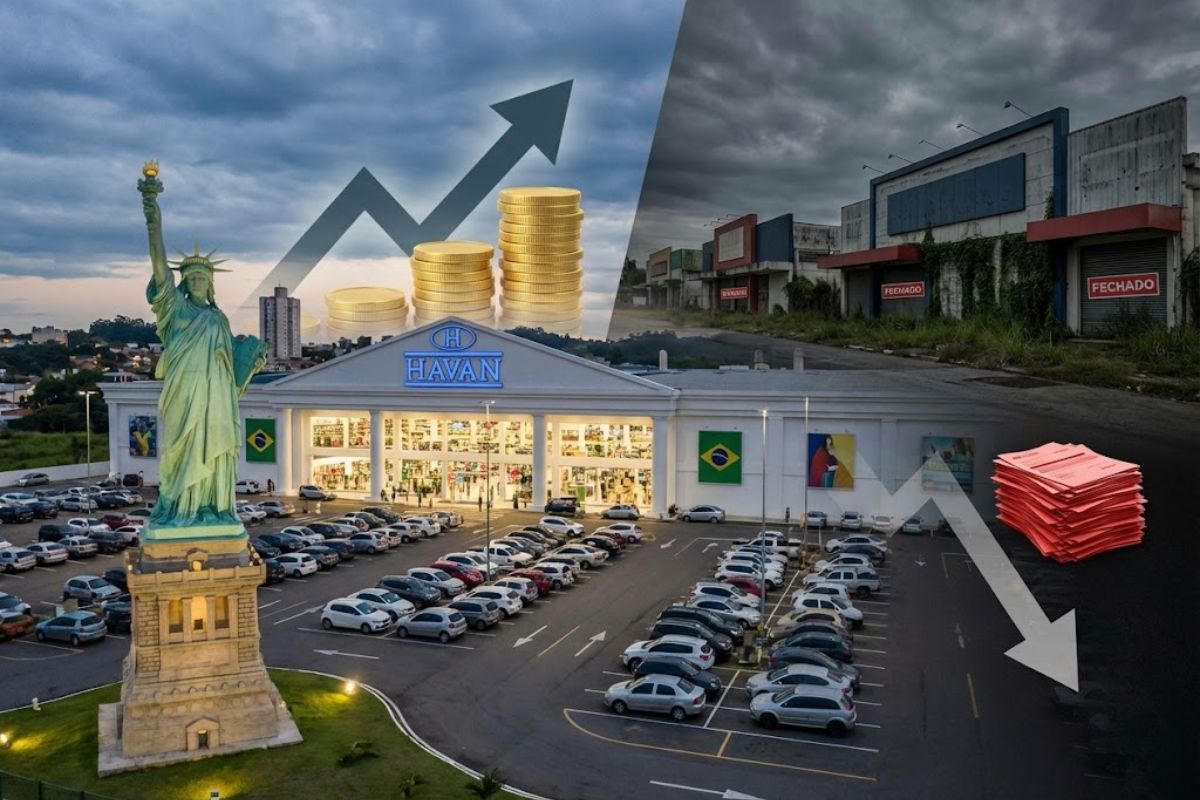
Havan Achieves Record Profit of R$ 3.45 Billion While Brazilian Traditional Retail Networks Face Debts and Bankruptcy Recovery, and the Company’s Performance Raises an Inevitable Question: What Strategy Allows the Company to Grow with Physical Stores in an Increasingly Pressured Market
Havan appears today as an unusual case within Brazilian retail. While large chains face high debts, compressed margins, and bankruptcy recovery processes, the company from Santa Catarina recorded a record profit of approximately R$ 3.45 billion, opening an inevitable debate about the real workings of its business model.
The performance draws attention because it occurs precisely at a time of strong financial pressure in the sector. Havan grows in an environment where many retailers are struggling just to maintain operations, prompting economists and business people to examine more closely the pillars that support this performance.
Financial Structure of Havan Creates a Rare Shield in Retail

One of the first factors that explain Havan’s performance lies in the financial structure of the company.
-
Brazilian city bets on the business environment to generate jobs and attract investments in the energy sector — secretary reveals strategy at Macaé Energy 2026.

-
50 viaducts, 4 tunnels, 28 bridges, and 40 kilometers of bike paths: BR-262 in Espírito Santo will receive 8.6 billion reais for the largest engineering project in the state’s history, inspired by the Immigrant Highway in São Paulo.

-
Brazil produces too much clean energy and doesn’t know what to do with it: over 20% of solar and wind capacity was wasted in 2025 while investors flee and 509 renewable generation projects were abandoned in the last year.

-
Piauí will produce a new fuel that replaces diesel without needing to change anything in the truck’s engine and reduces pollutant gas emissions by half: truck drivers from all over the Northeast are already celebrating the news that will arrive later this decade.


While many retailers rely heavily on bank credit to finance operations and expansion, the company ended the year with approximately R$ 4.9 billion in cash and a gross debt close to R$ 78 million, resulting in a negative net debt.
This situation creates an unusual effect in the market. Instead of paying high interest, Havan ends up generating financial income, which totaled approximately R$ 800 million in 2025.
In a country where interest rates often pressure indebted companies, the logic is inverted: the company transforms the macroeconomic scenario into a profit ally.
Another decisive element is the corporate structure. Havan maintains closed capital, which means it doesn’t have to respond to quarterly pressures from stock market investors for accelerated growth.
This freedom allows for decisions focused on long-term profitability, without the need for aggressive promotions just to inflate momentary revenues.
Real Estate Strategy Reduces One of the Biggest Costs in Retail
Another important pillar of Havan’s model lies in how the company utilizes its properties. Unlike many chains that operate within shopping centers and pay high rents, about 76% of Havan’s stores operate in owned properties.
This strategy completely changes the cost structure. What for most retailers is a permanent expense transforms into assets on the company’s balance sheet, eliminating costs associated with rent, condominium fees, and shopping center fees that often erode margins.
Additionally, the units are often located in large street stores, frequently situated in medium-sized towns in the interior. This positioning reduces operational costs and creates a kind of regional monopoly, attracting consumers from various nearby cities.
The choice of the interior also allows for spacious stores, free parking, and leisure facilities, transforming the visit into an extended consumption experience. In 2025, the company recorded approximately 190 million customers, with a growth of about 7%.
Centralized Logistics Sustains the Expansion of Physical Stores


While part of Brazilian retail concentrated investments in rapid deliveries and complex urban logistics, Havan adopted a different model. The company structured a large distribution center in Barra Velha, Santa Catarina, covering about 200,000 square meters.
In this complex, approximately R$ 100 million was invested in automation, including robots capable of sorting up to 3,000 boxes per hour. This system allows for rapid and predictable replenishment of stores.
The logistics logic is also different from the race for the so-called “last mile.” Havan prioritizes long-distance road transport between the distribution center and its megastores, avoiding the high costs of fragmented urban deliveries.
This strategy reduces logistics expenses and ensures that stores maintain regular stock. Fewer stockouts mean more sales and higher consumer satisfaction, creating an operational cycle that favors repeat purchases.
Product Mix Protects Margins and Maintains High Profitability
Another central element in Havan’s structure is the product mix. While part of the retail sector relies heavily on the sale of appliances, whose net margin typically ranges between 1% and 2%, the company concentrates a large portion of its revenue in categories with higher profitability.
About 60% of sales come from fashion and textiles, categories that can exceed 50% gross margin. Household goods and utility products also present margins close to 42%.
Appliances remain in the portfolio, but they serve a different strategic role. They function as attraction products, capable of generating customer traffic and increasing the average ticket within the store.
This balance allows the company to maintain a consolidated net margin close to 25.1%, something uncommon in Brazilian mass retail.
In-House Credit Becomes a Profit Engine
Another point that differentiates Havan is the use of in-house credit. Instead of relying solely on banks or finance companies, the company maintains an internal financing system for customers.
In 2025, approximately 40% of Havan’s sales were made through the store’s own card. This creates two sources of revenue: the sale of the product and the financing of the purchase.
After the pandemic, the company made an important adjustment to this system. About 2 million high-risk customers had their credit cut, drastically reducing delinquencies.
The result was significant. The delinquency rate fell from around 10% to approximately 2.5%, while the financial income generated by in-house credit reached R$ 800 million.
Additionally, the no-annual-fee card encourages repeat purchases, strengthening the relationship between consumer and store.
The Debate About International Competition and Market Rules
Havan has also actively participated in regulatory discussions related to international trade. One of the most sensitive topics involves the influx of low-value imported products through foreign platforms.
According to the company’s view, the difference in taxation between national and imported products creates competitive distortions. The company argues that Brazilian retailers pay high volumes of taxes, while some foreign products enter the country with a lower tax burden.
As a large portion of Havan’s revenue comes from fashion and textiles, categories directly affected by cheap imports, the topic has become significantly relevant in the company’s institutional strategy.
Why Havan Grows While Others Face Crisis
By observing all these elements together, a clearer picture emerges. Havan does not operate merely as a traditional chain of stores, but as an integrated structure that combines efficient logistics, in-house credit, real estate control, and strong capital management.
While part of Brazilian retail bet on accelerated growth based on indebtedness and costly digital expansion, the company chose a different path. The priority was to maintain high cash levels, reduce structural costs, and protect margins.
This model explains why the company is able to grow even in an adverse economic scenario. The combination of low indebtedness, centralized logistics, and high-margin product mix creates a structure that is more resilient to market fluctuations.
The very presence of Luciano Hang has also become a marketing tool. The constant exposure of the entrepreneur’s figure keeps the brand in evidence, reducing the need for massive investments in traditional advertising.
The case of Havan raises an important discussion about the future of Brazilian retail. In a sector pressured by high interest rates, digital competition, and ever-decreasing margins, the company has built a model that combines financial prudence and operational strategy.
While many competitors sought to grow rapidly, Havan focused on cost control, efficient logistics, and gradual expansion. The result was a profit of R$ 3.45 billion in a period when several chains struggle to survive.
And you, looking at this scenario, do you believe that Havan found a formula that other companies can replicate, or is this result dependent on unique factors of the company’s model?









Seja o primeiro a reagir!