





 Portuguese
  English
  Spanish
  6 min of reading
  7 comments


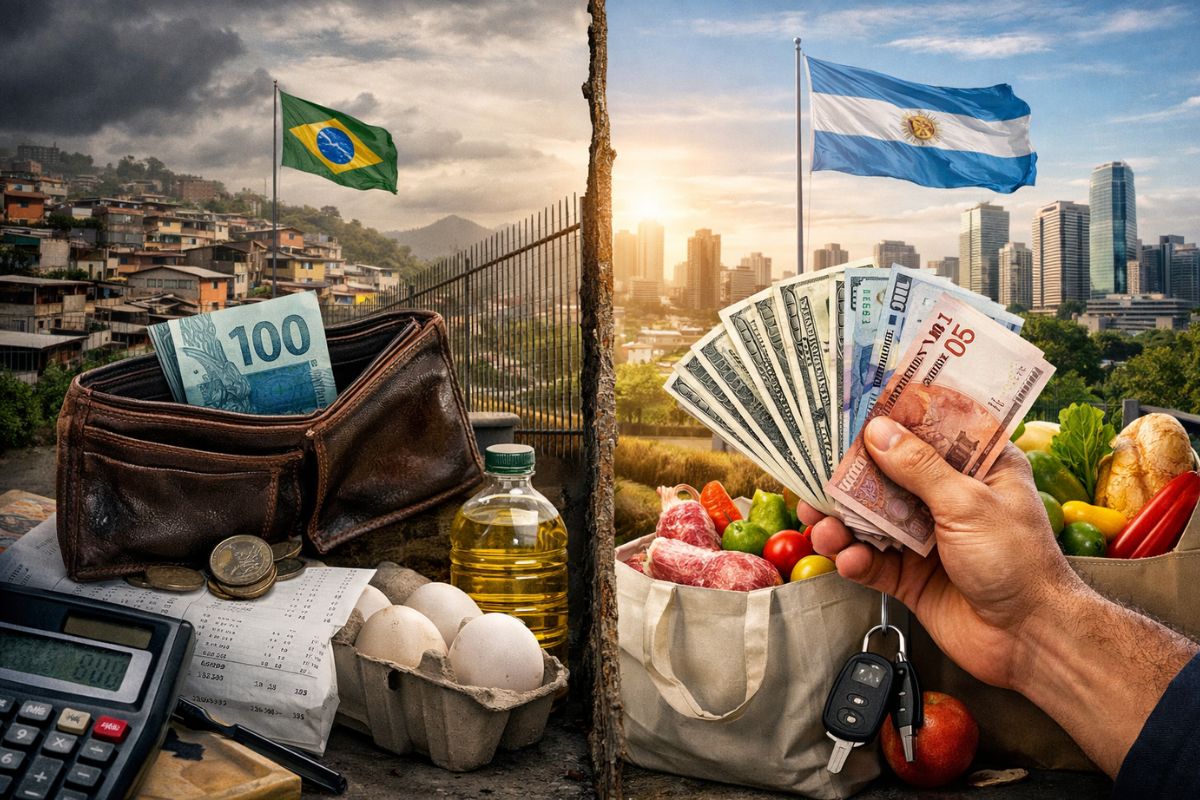


Neighboring Country South of Brazil, Uruguay Sets Minimum Wage at 25,383 Pesos in July 2026, About 620 Dollars and R$ 3,339.75, After Annual Adjustment of 7.54% Split Between January and July in a Scenario of Inflation Close to 4%, Prioritizing Low Income and Projecting Gains for Workers.
In the neighboring country, the announcement of the new minimum wage for 2026 placed concrete numbers on the worker’s table and reignited immediate comparisons with Brazil. Uruguay set the minimum wage to reach 25,383 pesos in July, estimated at around 620 dollars and equivalent to R$ 3,339.75 at the current exchange rate, a value marked as the highest in South America.
The change in the neighboring country does not happen all at once. The adjustment will be 7.54% over 2026, divided into two moments, and was presented as a policy aimed at protecting the lower income brackets, in a scenario described with inflation around 4%, a factor that broadens the discussion on real gains and purchasing power in Uruguay and Brazil.
Calendar of the Neighboring Country and the Values Set for 2026
The schedule released for the neighboring country details two stages.
-
The largest food company on the planet, JBS, has just opened a 4,000 square meter laboratory in Florianópolis to develop customized proteins that modulate muscle mass gain, immune response, and metabolic performance.

-
After nearly 30 bids and competition among industry giants, a Spanish company purchases one of the largest airports in Brazil for almost R$ 3 billion and takes over the management of Galeão in a concession that will last until 2039.

-
The Federal Revenue Service now automatically cross-references everything you declare with data from banks, credit cards, brokerage firms, and insurance companies, and any discrepancy between your income and your expenses triggers an alert in seconds.

-
Amid global tensions, Brazil blocks the United States’ proposal at the WTO and paves the way for a trade crisis and possible retaliations.

The first takes effect from January 1, 2026, when the minimum wage rises by 4.1% to 24,572 pesos, a value estimated at around 606 dollars.
The second stage occurs in July, with a new adjustment of 3.3%, raising the floor to 25,383 pesos, estimated at about 620 dollars.
This design in two steps is the center of comparison because it transforms the minimum wage into a reference that changes within the same year.
In the neighboring country, those who earn the minimum see the value increase at the beginning of 2026 and again in the middle of the year, which affects wage negotiations, household planning, and the very reading of real gains.
By bringing the value in pesos, dollars, and reais, the neighboring country also pushes the conversation toward international conversion.
The floor of 25,383 pesos was presented as equivalent to R$ 3,339.75 at the current exchange rate, a number that becomes a shortcut for direct comparison in Brazil, although the conversion depends on the moment and the currency used as reference.
Adjustment of 7.54% and the Reading of Real Gain with Inflation Close to 4%
The repeated institutional justification for the neighboring country is that the adjustment of 7.54% annually, on two occasions, occurs with controlled inflation, cited as around 4%.
In this logic, the minimum wage not only follows prices but advances above them, generating real gains for those at the lower end of income.
The president of the National Directorate of Labor of Uruguay, Marcela Barrios, associated the design of the adjustment with the commitment to prioritize the lower brackets.
In practice, the signal is that the minimum wage of the neighboring country is treated as a public policy tool, with a direct impact on the finances of workers who depend on the floor to balance their accounts.
The two-stage format also creates two dates for public collection.
In January, the value of 24,572 pesos becomes the new floor. In July, the number changes again, reaching 25,383 pesos.
For the worker, this means two objective milestones throughout 2026. For comparison with Brazil, it means two windows in which the minimum wage of the neighboring country returns to the center of the debate.
What the Neighboring Country Seeks to Protect by Prioritizing Lower Income Brackets
When the neighboring country declares that the adjustment follows the commitment to prioritize lower incomes, the message is that the discussion is not restricted to indexes.
The minimum wage appears as a protection mechanism for those with less margin to absorb price increases and changes in the cost of living, as the floor functions as a direct reference for remuneration at the base of the market.
This point matters because, in political terms, the neighboring country transforms the decision into a message.
By stating that inflation is around 4% and projecting a adjustment of 7.54% for the whole year, the intended reading is that there is real gain.
At the forefront, the consequence is simple: the worker tends to measure how much the floor covers essential expenses, and the comparison with Brazil arises almost automatically.
Why the Minimum Wage of the Neighboring Country Becomes a Regional Reference in 2026
The neighboring country begins to be described as a regional reference when the minimum wage is converted into dollars, consolidating the highest floor in South America in 2026.
This highlight carries symbolic and political weight, as it transforms an administrative number into an argument about the salary valuation model, with an immediate impact on the perception of purchasing power.
In addition to serving as a base for formal workers, the minimum wage influences collective negotiations in different sectors of the Uruguayan economy.
This expands the reach of the adjustment, as the floor ceases to be just an entry value and starts to function as a reference in conversations between employers and employees throughout the neighboring country.
When the debate talks about reference, the focus is not just on the final figure.
It’s the path: a adjustment in January, another in July, in a scenario of inflation described as controlled.
This sequence is what sustains the argument of real gain and reinforces why Uruguay stands out in the comparison with Brazil.
Brazil Sets Minimum Wage at R$ 1,621 and Maintains Gradual Valuation Policy
In Brazil, the national minimum wage for 2026 has been set at R$ 1,621.
The increase was R$ 103 compared to the previous value and follows the valuation policy that combines inflation measured by the INPC with the growth of the Gross Domestic Product from two years prior, as described in the announcement.
The formalization of the value in Brazil was attributed to Decree No. 12,797/2025, reinforcing the legal path used to define the floor.
In comparison with the neighboring country, this normative reference helps explain why the Brazilian adjustment is usually presented as predictable and staggered, linked to indexes and past economic performance.
The minimum wage in Brazil also plays an expanded role as it serves as a reference for pensions, benefits, and social assistance, such as the Continuous Cash Benefit.
This characteristic gives the Brazilian minimum a effect that goes beyond the formal labor market, reaching the base of the social protection system, something that weighs in the discussion about public accounts and purchasing power.
Direct Comparison Between Neighboring Country and Brazil and the Limits of the Converted Number
The difference between the neighboring country and Brazil becomes a headline when the value is translated into reais.
Uruguay appears with R$ 3,339.75 and Brazil with R$ 1,621, two figures that seem to speak without intermediaries.
However, the comparison depends on conversions, the timing of the exchange rate, and the very way each country structures prices and costs.
Still, the social impact of the number is immediate. For workers in Brazil, looking at the minimum wage of the neighboring country in reais creates a sense of distance between wallets.
For workers in the neighboring country, the minimum wage in dollars reinforces the idea of regional leadership in 2026, especially when the adjustment is described as exceeding inflation.
At the center of the debate, the adjustment ceases to be just a percentage and becomes a practical question. What changes in the life of those who receive the floor?
How significant is it to have two update milestones in the year? How does the neighboring country sustain the narrative of real gain with inflation around 4%?
And how does Brazil balance gradual valuation with the role of the minimum wage as a reference for benefits?
In 2026, the neighboring country Uruguay sets the minimum wage at 25,383 pesos in July, with an annual adjustment of 7.54% split between January and July, and with the narrative of inflation close to 4% to support real gain.
In Brazil, the minimum wage of R$ 1,621 reinforces the gradual policy and maintains the floor as a base for benefits and formal links.
In your view, when comparing the neighboring country and Brazil, does it make more sense to look only at the minimum wage converted into reais or also observe the adjustment calendar and the inflation mentioned in each country?









Agora me diz! Como as empresas brasileiras estão a se mudar pra país vizinho, se eles não querem pagar o salário mínimo brasileiro e irão pagar o mínimo do Uruguai?
Tamanho do Uruguai? Menor do que o Ceará! População:menor que Porto Alegre. Não tem como comPARAR COM o Brasil, que é um continente!
Vamos comparar com a espanha, frança e Portugal então. Ou na América do Sul o Chile todos tem salários mínimos muito superiores que o Brasil.
O visto de vida do Uruguai NÃO É MAIOR QUE O DOBRO do Brasil !!!!!A vida é bem melhor no Uruguai ….