





 Portuguese
  English
  Spanish
  7 min of reading
  0 comments


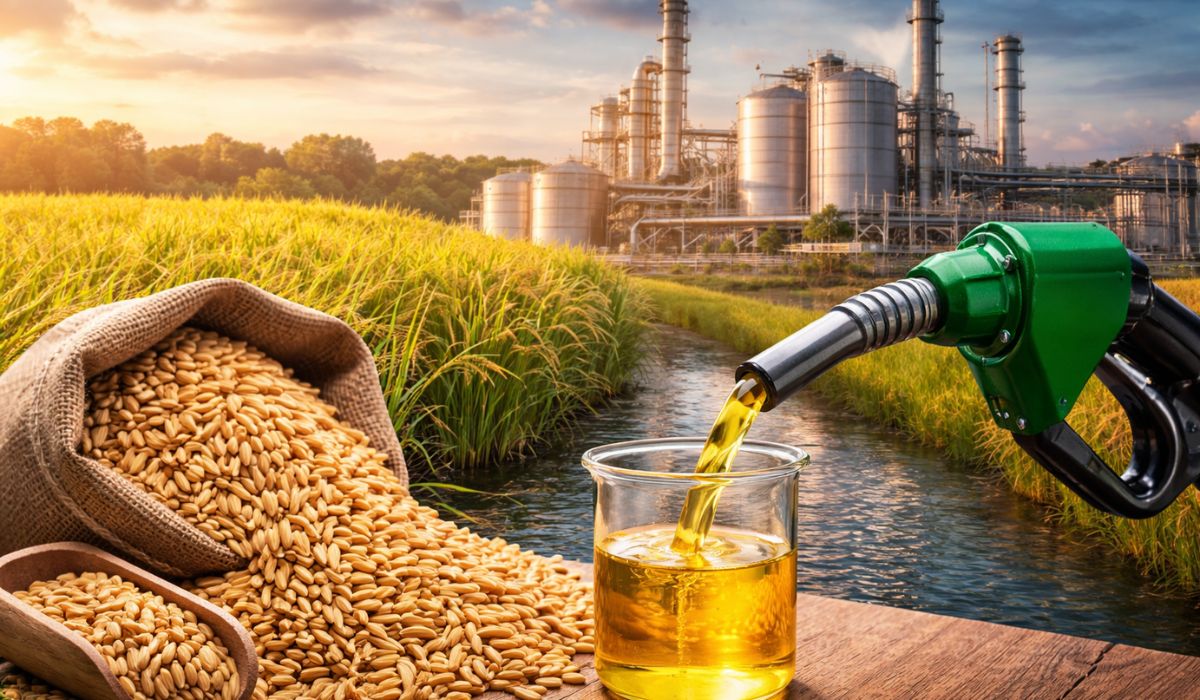
A Variety Of Rice Outside The Standard Table Variety Reappears In The Sector Debate In The South Of The Country, Associated With Ethanol And Feed, While Entities And Public Research Discuss New Destinations For Production Amid Pressured Margins.
A variety of rice developed to become fuel and also serve as an alternative for animal feed has returned to the debate in the rice sector of Rio Grande do Sul.
The BRS AG, developed by Embrapa specifically for ethanol production, is among the highlights announced for the 36th Official Rice Harvest Opening, in Capão do Leão, scheduled to take place from February 24 to 26.
According to Embrapa, it is possible to obtain 430 liters of ethanol from one ton of BRS AG grains.
-
The sugar-energy sector advances with agricultural technology, but agricultural productivity still raises concerns.

-
The eggshell that almost everyone throws away is made up of about 95% calcium carbonate and can help enrich the soil when crushed, slowly releasing nutrients and being reused in home gardens and vegetable patches.

-
This farm in the United States does not use sunlight, does not use soil, and produces 500 times more food per square meter than traditional agriculture: the secret lies in 42,000 LEDs, hydroponics, and a system that recycles even the heat from the lamps.

-
The water that almost everyone throws away after cooking potatoes carries nutrients released during the preparation and can be reused to help in the development of plants when used correctly at the base of gardens and pots, at no additional cost and without changing the routine.


The institution compares this yield to other raw materials used in biofuels: corn, with an average potential of 360 liters per ton, and sugarcane, with about 70 liters per ton.
The BRS AG has larger grains than those of long-grain rice, the predominant standard in the fields of Rio Grande do Sul and on supermarket shelves.
Additionally, it has a high starch content and a high carbohydrate level, a combination that, according to Embrapa, favors fermentation and transformation into ethanol.
At the same time, the cultivar does not meet the quality standards required for human consumption.
It is classified as DCH (Not Classified For Human Consumption), which directs its use for industrial purposes and feed, without competing with rice intended for the plate.
According to the assessment presented by Embrapa, this characteristic reduces the risk of questioning the use of a traditional food as raw material for fuel.
Rice is a central item in the Brazilian diet and tends to be more affordable than other food components, which makes the topic sensitive during times of price and supply fluctuations.
Even with a different purpose, BRS AG can be cultivated within the system already used in rice farming in Rio Grande do Sul, according to the institution.
The material is also presented as capable of yielding 10,000 kilos of grain per hectare, according to information released by Embrapa in the context of the event.
BRS AG: Rice For Ethanol And Feed In Rio Grande Do Sul
The development of BRS AG took place at Embrapa Temperate Climate, in Pelotas, and was completed in 2014, according to the researcher and breeder responsible for its registration and protection, Ariano Martins de Magalhães Júnior.
“BRS AG was the first cultivar launched in the world for this purpose,” he stated.
In the description made by the researcher, the differences go beyond industrial destination.
“It has some characteristics different from long-grain rice in terms of yield, production, hydrolysis, and grain size.

It is more floury, and the grain size is larger,” he said.
The industrial focus is precisely linked to this set of attributes, according to Embrapa.
The presence of more starch and the profile of the grain favor the conversion of the cereal into ethanol, a process that depends on transformation and fermentation stages.
Why BRS AG Did Not Become A Market When It Was Launched
Despite being registered for more than a decade, BRS AG has not established itself as a commercial option, according to Magalhães Júnior.
He attributes the outcome to a lack of industrial demand at the time of the launch and the context of the rice market during that period.
“At the time, there was no interest from the processing industries since the rice market was booming,” he reported.
“The biorefineries did not establish themselves.
Rice reacted positively in terms of price, and producers continued to grow long-grain rice,” he stated.
The researcher also mentioned that there was seed production, but the chain did not progress to commercial planting at scale due to a lack of industrial buyers.
“We produced seeds for it, but when it was time for producers to plant it as a commercial cultivar, there was no demand,” he shared.
Subsequently, he emphasized that the main obstacle was the absence of biorefineries to absorb the raw material.
“An offer was made, but there was no demand because there were no biorefineries installed to use this rice as raw material.
Today, commercially, there is nothing,” he said.
Crisis In Rice Farming And Alternatives For Income In The Field
Now, according to the researcher, the scenario has changed because the rice chain is facing a moment of pressure on margins and prices.
The described context includes stagnant consumption and prices below production costs, leading producers and entities to discuss alternatives to diversify income.
Within this logic, BRS AG is once again pointed out as a possibility for not requiring, according to Magalhães Júnior, additional investment in the already existing production structure in properties that cultivate irrigated rice.


Another reason cited for the resumption of the topic is the movement of investments in the State towards biofuel industries focused on other raw materials, such as corn ethanol and biodiesel produced from soy and canola.
In this environment, the discussion about the use of rice as an industrial input gains space, according to sector reports.
“It is a perspective that is latent.
We have it ready, developed.
Now we would just have to do a new production (of seeds) to offer to producers to use as raw material.
And enough volume according to the demand of the biorefineries,” stated Magalhães Júnior.
He also mentioned a seed multiplication horizon to make scale feasible.
“In two or three harvests, we would have enough volume to supply the biorefineries,” he said, while discussing the formation of a volume compatible with industrial demand.
Rice Seeds And Production To Supply Biorefineries
For the researcher, the first step would be to start obtaining the necessary seeds to meet the demand, in a timeline he associates with the 2026/2027 harvest.
The argument presented is that Rio Grande do Sul has the aptitude for irrigated rice, which could make the culture suitable to supply industrial units if there is organized purchasing.
“Here in Rio Grande do Sul, it would be a very interesting energy matrix, because we have excellent aptitude for irrigated rice cultivation,” he said.
He added that, in his assessment, corn and sugarcane do not adapt the same way to floodplain areas, while rice is already traditional in this environment.
Magalhães Júnior also described a scenario where the producer would keep long-grain rice as a base but would set aside part of the area for BRS AG, directed towards the industry.
“The producer who cultivates long-grain rice could set aside part of his area for the production of the giant rice, BRS AG, to supply raw material,” he said.
In the researcher’s assessment, this strategy could reduce the supply of long-grain rice in the market, which, according to him, would tend to influence the commercialization of the product.
“We would have a little less production of long-grain rice, which would value its commercialization.
This is the reasoning,” he stated.
The Use Of Rice For Ethanol Enters The Agenda Of Federarroz And Embrapa
In addition to the debate about BRS AG, the researcher highlighted that conventional rice can also be transformed into ethanol, depending on the conditions and industrial viability.
This topic, according to him, has been discussed in sector articulation spaces.
Federarroz recently reported that it sent a request, through the Sectoral Chamber of the Rice Productive Chain, for Embrapa to deepen studies on the use of rice for ethanol.
“Through the Sectoral Chamber (of the Rice Productive Chain), we sent a request to the Strategic Affairs Advisory of Embrapa’s Presidency so that, via Embrapa Agroenergy, we can deepen studies on the use of rice for ethanol,” stated the president of the entity, Denis Nunes.
In the same statement, Nunes said that the advisory is also evaluating other destinations and purposes for the cereal.
“In addition, this same advisory is evaluating other destinations and purposes for rice,” he declared.
He added that there are negotiations with plants that are being established in the State for other raw materials, looking to test the use of rice.
“We are in negotiations with the plants that are being established in Rio Grande do Sul for other grains to test the use of rice,” he said.









-

Uma pessoa reagiu a isso.